







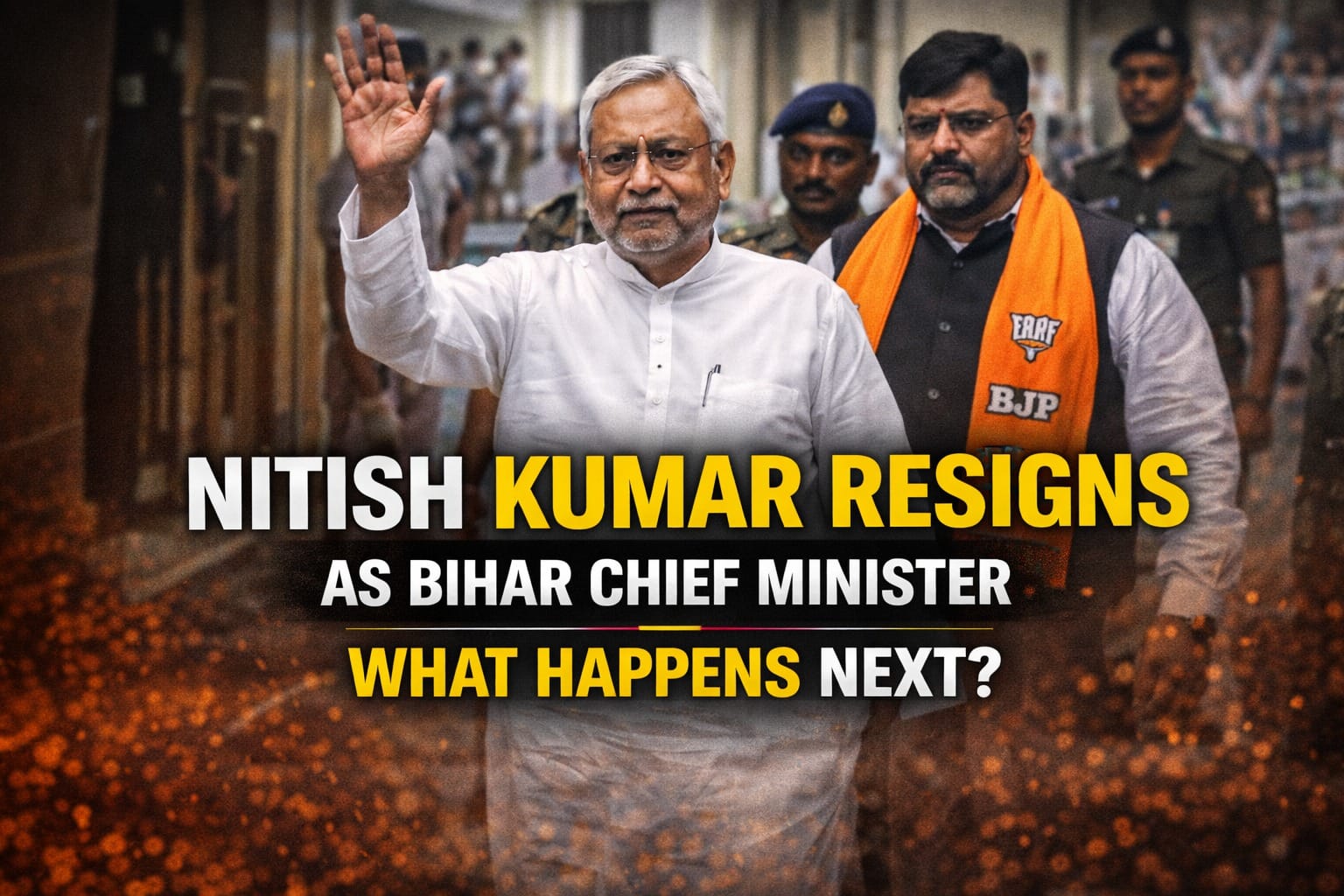
Nitish Kumar Resigns as Bihar Chief Minister
Introduction: A Major Political Shift in Bihar
In a dramatic political development on April 14, 2026, Nitish Kumar officially resigned as the Chief Minister of Bihar, marking the end of one of the longest and most influential political tenures in the state’s history.
The resignation has triggered:
- A major leadership transition
- The possibility of a BJP-led government for the first time in Bihar
- A new political phase after nearly two decades of Nitish Kumar’s dominance
But why did Nitish Kumar resign? What led to this sudden decision? And what happens next?
Let’s break down everything you need to know.
Breaking News: What Happened on April 14, 2026
‘Bihar will keep moving forward’: Nitish Kumar resigns as Bihar chief minister
Bihar’s longest-serving CM Nitish Kumar chairs last cabinet meet, recommends dissolution
End of Nitish Raj, for now: Bihar’s longest-serving Chief Minister resign
Nitish Kumar begins shifting from official residence; NDA likely to pick new Bihar CM by April 14
On April 14, 2026, Nitish Kumar:
- Chaired his final cabinet meeting
- Recommended dissolution of the cabinet
- Met Bihar Governor Syed Ata Hasnain
- Officially submitted his resignation
This sequence of events marked the formal end of his tenure as Chief Minister.
According to reports:
- He reached Lok Bhavan in Patna around 3 PM to resign
- The move followed his recent election to the Rajya Sabha
This resignation is not just a routine political step—it signals a complete shift in Bihar’s power structure.
Why Did Nitish Kumar Resign? Key Reasons Explained
1. Transition to National Politics
One of the biggest reasons:
- Nitish Kumar was recently elected as a Rajya Sabha MP
This indicates a clear shift:
From state leadership → to a national political role
2. Strategic Political Realignment
Nitish Kumar’s political journey has always been dynamic.
Over the years, he:
- Switched alliances between BJP and opposition blocs
- Balanced regional and national interests
This resignation could be seen as:
- A planned exit strategy
- A move to allow new leadership under NDA
3. End of a Political Era (“Nitish Raj”)
Nitish Kumar served as Bihar CM for:
- Nearly 20 years (since 2005)
His tenure saw:
- Infrastructure development
- Law and order improvements
- Social welfare schemes
But his resignation marks:
The symbolic end of the “Nitish Raj” era
4. Internal Political Dynamics
Reports suggest:
- BJP had already begun preparations for a leadership change
- Observers like Shivraj Singh Chouhan were sent to Bihar
This indicates:
- A pre-planned transition within the NDA alliance
What Happened in the Final Cabinet Meeting
Before resigning, Nitish Kumar:
- Addressed ministers in his last cabinet meeting
- Spoke about his work since 2005
- Announced his decision to step down
He stated:
The new government will have his “guidance” going forward
The cabinet also:
- Passed a resolution thanking his leadership
- Approved dissolution of the council of ministers
Who Will Be the Next Bihar Chief Minister?
This is now the biggest question.
Top Contender:
- Samrat Choudhary
Reports indicate:
- He is emerging as the strongest candidate for CM
Other names being discussed:
- Nityanand Rai
- Senior BJP leadership figures
Big Shift: BJP-Led Government Likely
For the first time:
Bihar may see a BJP-led Chief Minister
This marks a significant change because:
- Nitish Kumar (JD(U)) was the face of governance for years
- BJP will now likely take direct control
Also read – The New Running Sensation Gout Gout Who Broke Usain Bolts Record
Political Reactions and Statements
After resigning, Nitish Kumar said:
- He had decided to step down after the cabinet meeting
- The new government will take forward development work
- Bihar will continue to “advance”
Meanwhile:
- Leaders like Chirag Paswan called it a “new beginning” for Bihar
Impact of Nitish Kumar’s Resignation
1. End of Stability Era
Nitish Kumar was seen as:
- A stabilizing figure in Bihar politics
His exit may lead to:
- Political reshuffling
- New governance style
2. Rise of BJP in Bihar
This transition could:
- Strengthen BJP’s position in eastern India
- Change electoral dynamics for 2029
3. Shift in National Politics
With Nitish Kumar moving to Rajya Sabha:
- His role in national politics may increase
- He could influence coalition strategies
4. Administrative Continuity vs Change
While:
- Policies may continue
But:
- Leadership style and priorities may shift
Timeline of Key Events
- April 10, 2026: Nitish Kumar becomes Rajya Sabha MP
- April 14 (Morning): Final cabinet meeting held
- April 14 (Afternoon): Cabinet dissolved
- April 14 (~3 PM): Resignation submitted to Governor
- April 15 (Expected): New CM to take oath
What Happens Next in Bihar Politics?
Immediate Steps:
- NDA legislative meeting
- Selection of new leader
- Swearing-in of new CM
Long-Term Questions:
- Will BJP maintain stability without Nitish?
- How will JD(U) position itself?
- Will Nitish Kumar return to active politics later?
Is This the End of Nitish Kumar’s Political Career?
Not necessarily.
While he has stepped down as CM:
- He is now active in Rajya Sabha
- Could play a key national role
This may not be an exit—but a transition.
Conclusion: A Turning Point for Bihar
Nitish Kumar’s resignation is more than just a political update.
It marks:
- The end of a 20-year leadership era
- The beginning of a new power structure
- A critical moment in Bihar’s political evolution
Final Insight
Bihar is not just changing leaders.
It is entering a completely new political chapter.
Subscribe to our YouTube Channel The Logic Stick for more video insights