







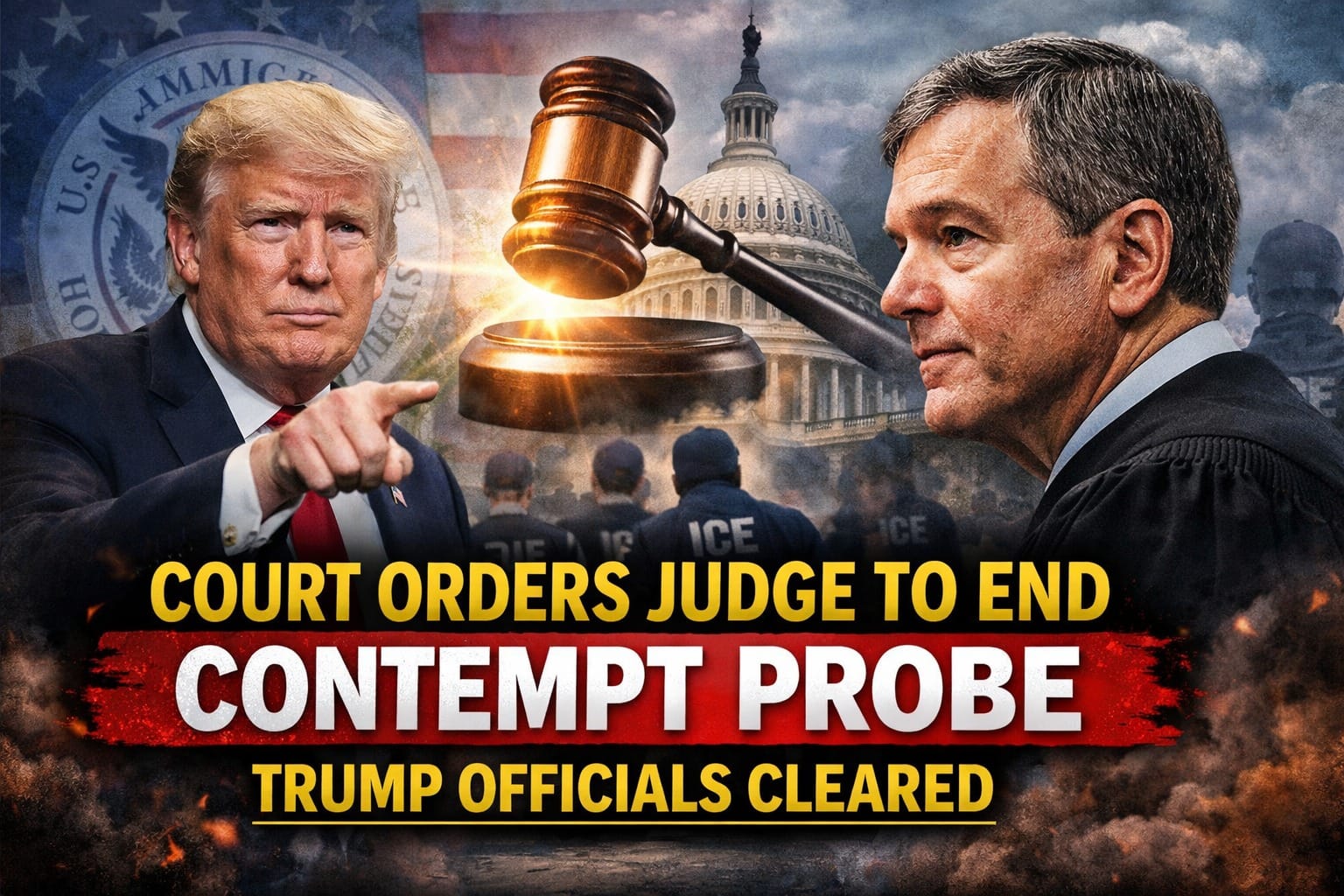
Introduction: A Landmark Legal Twist in Trump’s Immigration Battle
In a significant legal development in April 2026, a U.S. appeals court has ordered a Washington, D.C. judge to end a high-profile contempt investigation into officials from Donald Trump’s administration.
The case, which revolves around deportation flights of Venezuelan migrants, has now become a flashpoint in the ongoing power struggle between the judiciary and the executive branch in the United States.
But what exactly happened? Why was the investigation stopped? And what does this mean for U.S. law and immigration policy?
Let’s break it down.
Breaking News: What the Court Ruled
According to reports, a 2-1 decision by the U.S. Court of Appeals for the D.C. Circuit ordered Chief Judge James Boasberg to halt his contempt probe.
- The court ruled that the judge “abused his discretion” in pursuing criminal contempt proceedings
- The investigation was linked to deportation flights carried out in 2025
- The majority opinion argued that the judge’s original order was not clear enough to justify criminal charges
This effectively brings an end—at least for now—to a year-long legal battle.
What Was the Case About? (Deportation Flights Controversy)
The controversy dates back to March 2025, when the Trump administration:
- Deported hundreds of Venezuelan migrants
- Sent them to El Salvador
- Used the rarely invoked Alien Enemies Act of 1798
At the time:
- Judge Boasberg issued an order to halt deportation flights
- However, flights continued despite the order
This triggered allegations that:
The Trump administration may have violated a federal court order
Also read – PM Modi’s 6 Promises to West Bengal
Why the Contempt Investigation Was Launched
Judge Boasberg initiated a criminal contempt probe to determine:
- Whether officials deliberately ignored the court’s order
- Whether there was “bad faith” in executing deportations
He even considered:
- Calling witnesses
- Investigating top officials
- Referring the case for prosecution
This raised serious constitutional questions:
Can the executive branch ignore judicial authority?
Why the Appeals Court Stopped the Investigation
The appeals court gave several key reasons:
1. Lack of Clarity in the Original Order
The court said the judge’s directive:
- Did not clearly prohibit transfer of custody of migrants
Without clarity:
- Criminal contempt becomes legally weak
2. Judicial Overreach Concerns
The ruling stated that:
- The probe intruded into executive decision-making
- Especially in areas like national security and immigration policy
3. “Legal Dead End” Argument
Judges in the majority concluded:
- Even if pursued, the case would not lead to prosecution
The Dissent: Why Some Judges Disagreed
The decision was not unanimous.
Judge J. Michelle Childs strongly opposed the ruling, arguing:
- Ending the probe weakens judicial authority
- Courts must have the power to investigate possible violations
- Without enforcement, the rule of law is at risk
This highlights a deeper issue:
A divided judiciary on how far courts can go in checking executive power
Trump Administration’s Response
The ruling is being seen as a major win for Donald Trump.
- Officials argued the probe was politically motivated
- The administration maintained that its actions were within legal authority
Supporters say:
- The ruling protects executive power
Critics argue:
- It allows potential accountability gaps
Impact on U.S. Immigration Policy
This case is deeply connected to Trump’s broader immigration strategy, which includes:
- Aggressive deportation policies
- Expanded executive powers
- Use of historic laws like the Alien Enemies Act
The ruling could:
1. Strengthen Executive Authority
- Gives more room for policy decisions without judicial interference
2. Limit Court Enforcement Power
- Makes it harder to pursue contempt cases
3. Influence Future Deportation Policies
- Sets a precedent for handling similar disputes
Legal & Political Implications
This case is bigger than deportations.
It reflects a fundamental question in democracy:
Who Has the Final Authority?
- The courts (judiciary)
- Or the government in power (executive)
Key Takeaways
- Appeals court blocks contempt investigation
- Judge accused of overstepping authority
- Case linked to Venezuelan migrant deportations
- Strong disagreement within judiciary
- Major implications for U.S. constitutional balance
What Happens Next?
The story is not over.
- Civil rights groups like the ACLU may appeal further
- The case could go to a full bench review
- Or even reach the U.S. Supreme Court
Conclusion: A Defining Moment in U.S. Law
The decision to halt the contempt probe is not just a legal ruling—it is a moment that could shape:
- Judicial authority
- Executive power
- Immigration policy
Final Insight
This case is no longer just about deportation flights.
It is about how power is balanced in a democracy.
Subscribe to our YouTube Channel The Logic Stick for more video insights