





Introduction: Why Everyone Is Talking About the SIR Row in India
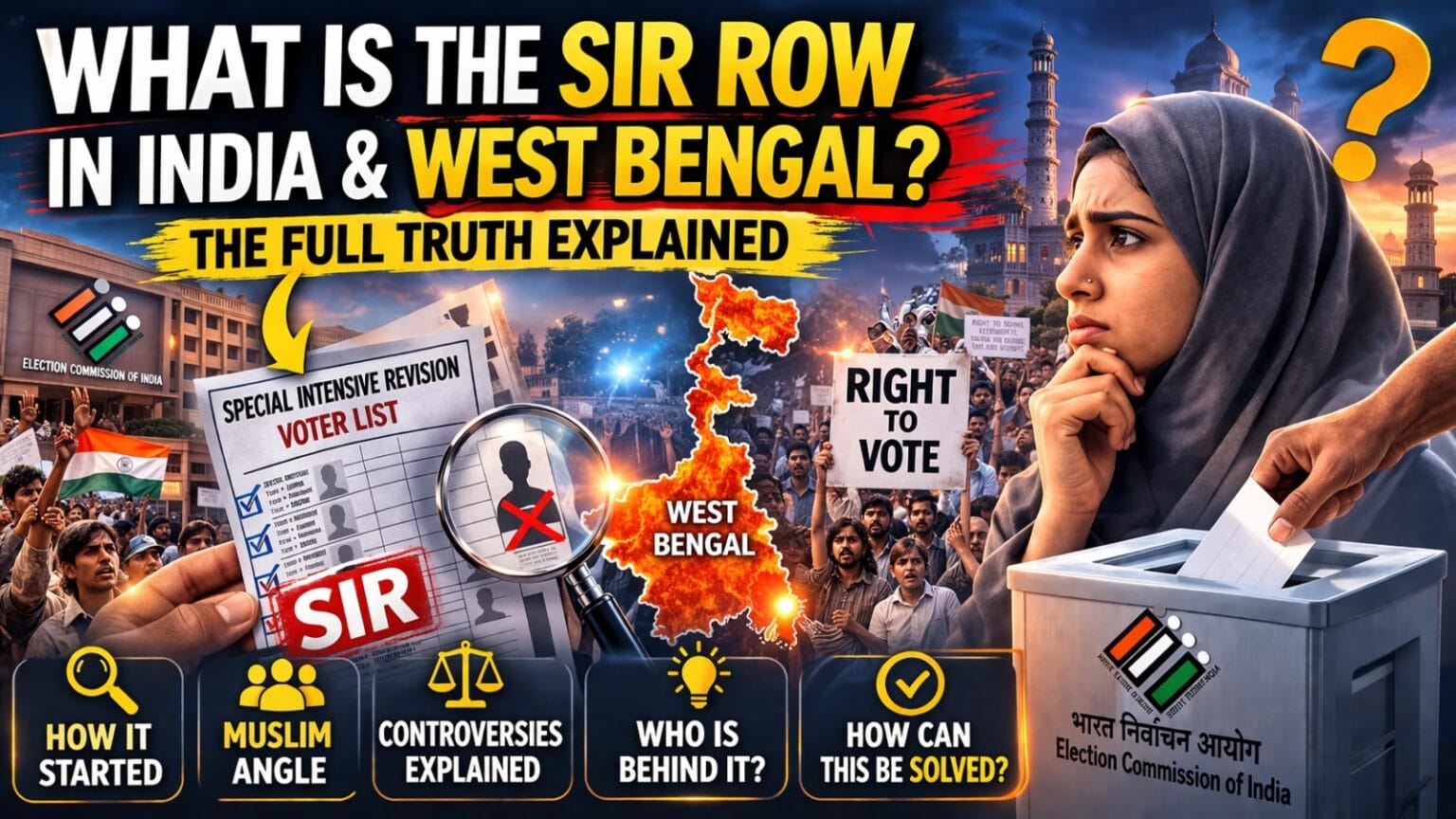
The SIR row in India, especially in West Bengal, has quickly become one of the most heated political and social controversies of 2026. What began as a routine administrative exercise by the Election Commission has now turned into a nationwide debate touching on democracy, identity, religion, and political power.
At the center of this issue is something very fundamental—the right to vote. When millions of names reportedly disappear from voter lists, it is no longer just a bureaucratic update. It becomes a question of who gets to participate in democracy and who does not.
But what exactly is the SIR process? Why is it controversial? And why has it taken a strong religious and political turn, particularly involving the Muslim community?
Let’s break it down in simple, clear language.
What is SIR (Special Intensive Revision) and Why Was It Introduced?
The Special Intensive Revision (SIR) is an exercise conducted by the Election Commission of India to update voter lists across the country. Its purpose is straightforward:
- Remove duplicate voters
- Delete names of deceased individuals
- Add new eligible voters
- Identify ineligible or illegal entries
This process is not new. It has existed in different forms since the early years of Indian democracy.
However, what makes the current SIR different is its scale and intensity. Starting in late 2025, the Election Commission launched a large-scale revision across multiple states, including politically sensitive regions like West Bengal.
In theory, this is meant to clean the electoral system. But in practice, it has triggered widespread fear and controversy.
What Happened in West Bengal? Why Did the SIR Row Explode?
West Bengal became the epicenter of the SIR controversy due to the sheer scale of voter deletions and the timing—right before elections.
Reports suggest that tens of lakhs of voters were removed from electoral rolls, with estimates going as high as 80–90 lakh in some phases.
This triggered immediate backlash because:
- Many people claimed they were wrongfully removed
- Even candidates discovered their names missing
- Appeals were filed, but many were not resolved before elections
The Supreme Court itself acknowledged the seriousness of the issue, noting that over 34 lakh people were excluded and could not vote while their appeals were pending.
This is where the controversy moved from administrative to political and emotional.
The Core Issue: Right to Vote vs System Accuracy
At the heart of the SIR row is a fundamental conflict:
- The Election Commission says:
“We are ensuring only genuine voters remain.” - Critics say:
“You are removing genuine voters in the process.”
The Supreme Court clarified an important legal position—
the right to vote is not a fundamental right, but a statutory one.
But for citizens, this distinction doesn’t matter.
For them, losing the right to vote feels like losing their voice.
Political War: BJP vs TMC Narrative
The SIR controversy has turned into a full-blown political war in West Bengal.
- The ruling Trinamool Congress (TMC) has accused the process of being manipulated to benefit the BJP
- The BJP has dismissed these claims as baseless and politically motivated
Mamata Banerjee even called the process a “scam to bring BJP to power”
On the other hand, BJP leaders argue that the exercise is necessary to remove illegal voters and infiltrators.
This political clash has made the SIR not just a technical process—but a battle for control over the electorate.
The Muslim Angle: Why This Became a Religious Debate
One of the most sensitive aspects of the SIR row is the “Muslim angle”, which has intensified the controversy.
Why are Muslims at the center of the debate?
Critics, activists, and opposition leaders have raised concerns that:
- The process disproportionately affects Muslim voters
- It resembles the controversial NRC (National Register of Citizens) exercise
- It could lead to targeted disenfranchisement
Some reports suggest that communities fear being labeled as “infiltrators”, especially in border states like West Bengal.
This has created anxiety among:
- Muslim communities
- Migrant populations
- Border residents
At the same time, the government and supporters argue that:
- The process is religion-neutral
- It targets illegal entries, not specific communities
Also read – Nitish Kumar Resigns as Chief Minister of Bihar: Samrat Chaudhary Takes Over
The Bangladesh Factor: Migration and Identity Politics
West Bengal’s geography plays a huge role in this controversy.
Being a border state with Bangladesh, it has a long history of:
- Migration (both legal and illegal)
- Refugee settlements
- Identity-based politics
The SIR process requires document verification and legacy linkage, meaning people must prove their connection to older voter records.
This creates problems for:
- Migrants
- Refugees
- Economically weaker groups
Many people fear that they might be:
- Declared ineligible
- Removed from voter lists
- Or even flagged in future citizenship processes
Fear, Panic, and Real-Life Impact
The SIR row is not just political—it has real human consequences.
There have been reports of:
- People discovering their names missing unexpectedly
- Families struggling to prove identity
- Migrants fearing deportation
In some areas, fear was so intense that people reportedly left their homes or avoided verification processes.
The controversy has created an environment of:
- Anxiety
- Confusion
- Distrust in institutions
Legal Complications: Why People Could Not Get Immediate Relief
Many affected individuals approached the courts.
But the Supreme Court took a cautious stance:
- It acknowledged possible errors in the process
- But refused to allow voting until appeals were resolved
The reasoning was simple:
If some excluded voters are allowed to vote,
then others might demand the same—creating chaos.
This decision, however, left millions in a difficult position:
- Legally excluded
- Politically voiceless
Is This “Vote Chori”? The Bigger Allegation
The SIR row is also being linked to a broader controversy known as “Vote Chori” (vote theft).
Opposition parties allege that:
- Genuine voters are being removed
- Electoral rolls are being manipulated
- The system is being used for political advantage
These allegations are still debated and not proven conclusively, but they have gained traction in public discourse.
Is There Really a Conspiracy? Or Just a Broken System?
This is the most important question.
There are two possible explanations:
1. System Failure
- Errors in verification
- Poor data handling
- Ground-level mistakes
2. Political Manipulation (Alleged)
- Selective deletions
- Targeting specific voter groups
- Strategic electoral influence
The truth may lie somewhere in between.
Large-scale processes like SIR often involve both inefficiencies and political narratives.
Why This Issue Matters Beyond Politics
The SIR row is not just about elections—it is about:
- Trust in democracy
- Institutional credibility
- Citizen identity
When people start questioning whether they will be allowed to vote,
it shakes the very foundation of a democratic system.
How Can This Be Solved?
Resolving the SIR controversy requires multiple steps:
1. Transparent Verification
Clear guidelines on why names are deleted
2. Strong Appeal Mechanism
Fast and accessible systems to restore names
3. Independent Audits
Third-party verification of voter roll changes
4. Political Accountability
Ensuring no misuse of administrative processes
5. Public Awareness
Helping citizens understand and verify their voter status
What Happens Next? The Future of the SIR Row
The SIR controversy is far from over.
With elections approaching, this issue will likely:
- Influence voter sentiment
- Shape political campaigns
- Trigger further legal battles
The outcome of this debate could set a precedent for:
- Future elections
- Citizenship-related policies
- Electoral reforms in India
Conclusion: A Democracy at a Crossroads
The SIR row in India, especially in West Bengal, is a complex issue with no simple answers.
On paper, it is a technical exercise.
In reality, it has become a symbol of trust vs suspicion.
For some, it is about cleaning the system.
For others, it is about being excluded from it.
And somewhere in between lies the real challenge:
How do you ensure accuracy without losing inclusivity?
Because in a democracy, the biggest risk is not just wrong votes—
it is missing voices.
Subscribe to our YouTube Channel The Logic Stick for more video insights