






Introduction
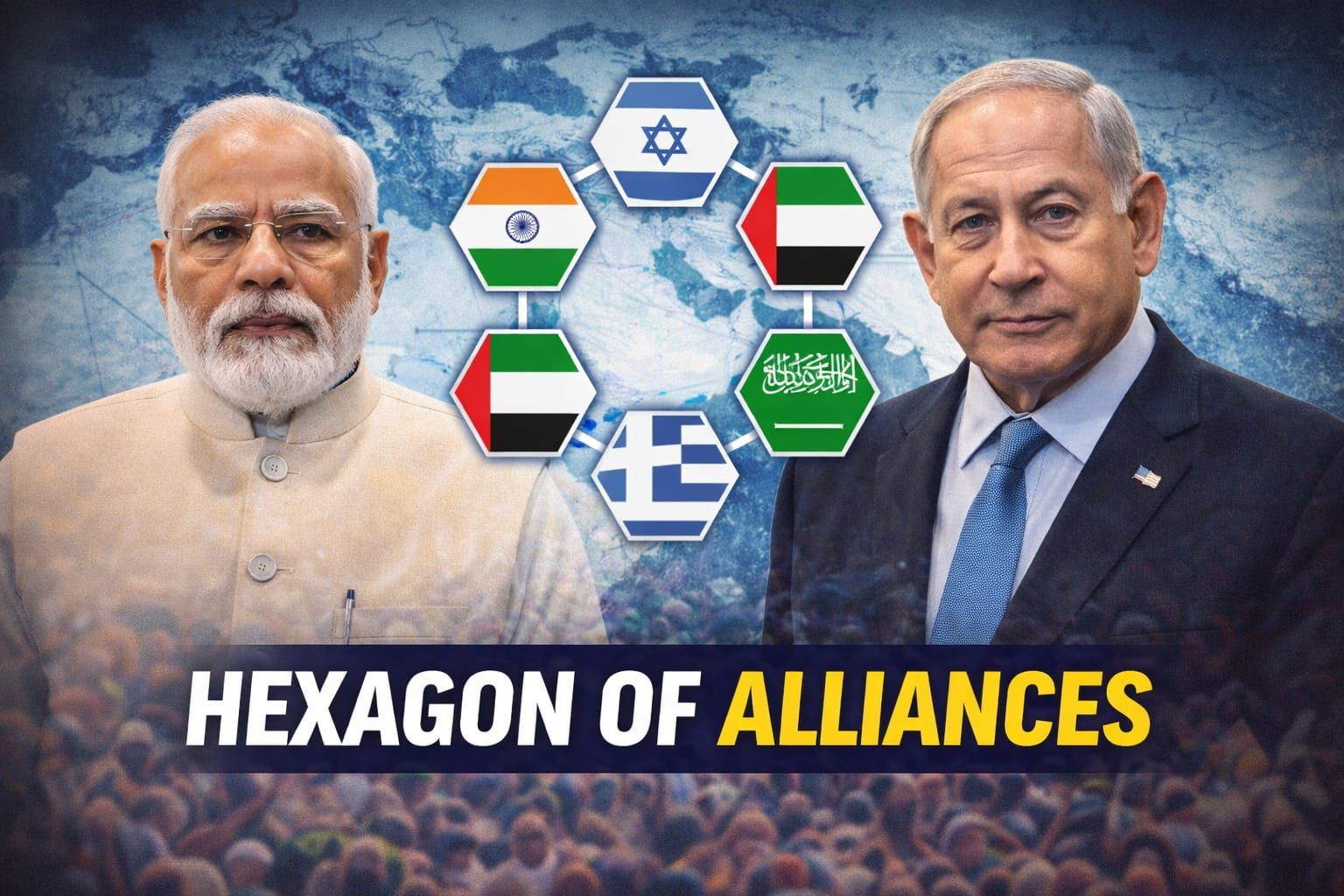
The emerging concept of the “Hexagon of Alliances” has become one of the most discussed geopolitical ideas in 2026 following Israeli Prime Minister Benjamin Netanyahu’s remarks ahead of Indian Prime Minister Narendra Modi’s visit to Israel. The proposal outlines a six-nation strategic framework aimed at reshaping regional security, diplomacy, and economic cooperation across West Asia, the Mediterranean, and parts of Asia and Africa.
Netanyahu’s proposal is not merely a diplomatic idea but reflects a broader strategic effort to counter rival geopolitical blocs, strengthen partnerships among like-minded nations, and build a collaborative security architecture around the Middle East.
This article provides a complete SEO-centric deep dive into:
- What the Hexagon of Alliances is
- Details shared by Netanyahu during Modi meeting
- Countries involved and strategic objectives
- India’s role in the alliance
- Military, economic, and diplomatic implications
- Pakistan’s reaction and concerns
- Regional and global geopolitical consequences
What Is Netanyahu’s Hexagon of Alliances?
The Hexagon of Alliances is a proposed six-nation strategic framework envisioned by Netanyahu to enhance cooperation in security, technology, economics, and diplomacy across key regions surrounding the Middle East.
Netanyahu described the initiative as the creation of “an entire system… a hexagon of alliances around or within the Middle East.”
The alliance aims to:
- Counter regional threats and extremist networks
- Reduce influence of rival geopolitical axes
- Enhance economic and technological collaboration
- Strengthen military and intelligence coordination
- Promote stability and connectivity across regions
Countries Involved in the Hexagon Alliance
While the alliance remains conceptual, Netanyahu has named several key partners.
Core countries mentioned
- Israel
- India
- Greece
- Cyprus
Additional potential partners
- Arab nations
- African nations
- Asian countries (unnamed publicly)
This mix reflects a multi-regional alliance combining Mediterranean, Middle Eastern, Asian, and African strategic interests.
Strategic Purpose of the Alliance
Countering rival geopolitical axes
Netanyahu framed the alliance as a counterweight to what he described as:
- Radical Shia axis led by Iran
- Emerging radical Sunni networks
The alliance therefore carries strong security and ideological dimensions.
Also read – El Mencho Death & the Chaos in Mexico: Everything you need to know
Building a regional security architecture
The hexagon is envisioned as a framework that integrates:
- Intelligence sharing
- Counter-terrorism operations
- Defense technology cooperation
- Maritime security collaboration
Economic and technology integration
Beyond security, the alliance seeks to expand:
- Trade corridors
- Innovation partnerships
- AI and cybersecurity cooperation
- Energy and infrastructure development
Netanyahu’s Statements During Modi Meeting
During discussions around Modi’s 2026 visit, Netanyahu emphasized India’s importance in the alliance.
He described India as a “global power” and highlighted its strategic value in building a multi-regional system of alliances.
Netanyahu also outlined the broader vision:
- Creation of a system of alliances around the Middle East
- Inclusion of Mediterranean and Asian powers
- Integration of Arab and African partners
- Long-term strategic coordination against shared threats
Why Netanyahu Wants India in the Hexagon
1. India’s global strategic weight
India’s growing economic and military power makes it a critical partner.
2. Strong India–Israel ties
The two countries share deep cooperation in:
- Defense technology
- Intelligence sharing
- Counter-terrorism
- Agriculture and innovation
India is Israel’s largest defense export client, reflecting strong strategic trust.
3. Indo-Mediterranean connectivity
India’s inclusion links:
- Indo-Pacific region
- Mediterranean corridor
- Middle Eastern security framework
4. Technology and innovation collaboration
India’s tech ecosystem complements Israel’s innovation strengths, making joint partnerships strategically valuable.
Key Discussion Areas in Modi–Netanyahu Talks
During Modi’s visit, discussions focused on multiple strategic themes.
Defense cooperation
Talks reportedly included:
- Advanced defense systems integration
- Missile defense technology collaboration
- Intelligence sharing
- Counter-terror operations
Economic partnerships
Negotiations addressed:
- Free Trade Agreement prospects
- Mobility agreements for workers
- Investment and innovation collaboration
Strategic alignment
The hexagon alliance itself formed a central geopolitical discussion topic.
India’s Position on the Hexagon Alliance
India’s stance remains cautious.
Analysts believe India is interested in strategic cooperation but unlikely to join formal military blocs due to its historical non-aligned foreign policy approach.
India’s strategy may involve:
- Issue-based cooperation
- Strategic autonomy preservation
- Multi-alignment rather than alliance politics
Pakistan’s Reaction to the Hexagon Alliance
Pakistan has expressed strong concern regarding the proposed alliance.
Senate condemnation
Pakistan’s Senate unanimously passed a resolution condemning the alliance, calling it an attempt to create an “anti-Muslim Ummah bloc.”
The resolution criticized:
- Potential division within Muslim nations
- Impact on Palestinian issues
- Perceived ideological and political implications
Security concerns
Pakistan fears the alliance may:
- Strengthen India–Israel military cooperation
- Shift regional power balance
- Intensify diplomatic isolation
- Impact South Asian security dynamics
Analysts also warn that closer India–Israel ties could challenge Pakistan’s diplomatic and security calculus.
Broader Geopolitical Implications
1. Middle East realignment
The hexagon reflects emerging regional partnerships beyond traditional alliances.
2. Shift toward multi-regional blocs
The alliance connects Mediterranean, Middle Eastern, and Indo-Pacific interests.
3. Iran containment strategy
The framework aligns with broader efforts to counter Iranian influence.
4. NATO-style regional cooperation possibility
Some analysts view the hexagon as a flexible security arrangement rather than a formal military alliance.
Challenges Facing the Hexagon Alliance
Lack of clarity on members
The alliance remains conceptual with unnamed participants.
Diverging foreign policies
Member nations may have conflicting strategic priorities.
Arab world sensitivities
Alliance with Israel remains controversial in some regions.
India’s strategic autonomy
India may resist formal bloc alignment.
Risk of geopolitical polarization
The alliance could deepen regional rivalries.
Expert Analysis
Experts interpret the hexagon alliance as:
- A diplomatic signaling strategy
- A geopolitical balancing initiative
- A framework for economic connectivity
- A counter-axis coalition
Some analysts also question feasibility, calling it ambitious given complex regional dynamics.
Future Scenarios
Scenario 1: Informal strategic network
Cooperation without formal treaty framework.
Scenario 2: Security-focused alliance
Counter-terror and defense coordination intensifies.
Scenario 3: Economic corridor model
Alliance evolves into trade and innovation platform.
Scenario 4: Limited impact
Political constraints limit implementation.
Conclusion
Netanyahu’s Hexagon of Alliances represents a bold attempt to reshape regional geopolitics through a multi-regional framework linking Israel, India, Mediterranean states, and potential Arab and African partners. The proposal highlights the growing importance of India in Middle Eastern strategic calculations while reflecting Israel’s efforts to counter rival geopolitical axes.
However, the alliance remains in conceptual stages and faces significant challenges including geopolitical sensitivities, differing foreign policy priorities, and India’s commitment to strategic autonomy.
Pakistan’s strong reaction underscores the alliance’s potential to influence regional security dynamics and diplomatic alignments.
Whether the Hexagon becomes a transformative geopolitical bloc or remains a strategic concept will depend on diplomatic negotiations, regional stability, and member nations’ willingness to institutionalize cooperation.
Subscribe to our YouTube Channel The Logic Stick for more video insights and stories