







Updated 28 September 2026. This is a developing story; the account below reflects reporting available at the time of writing.
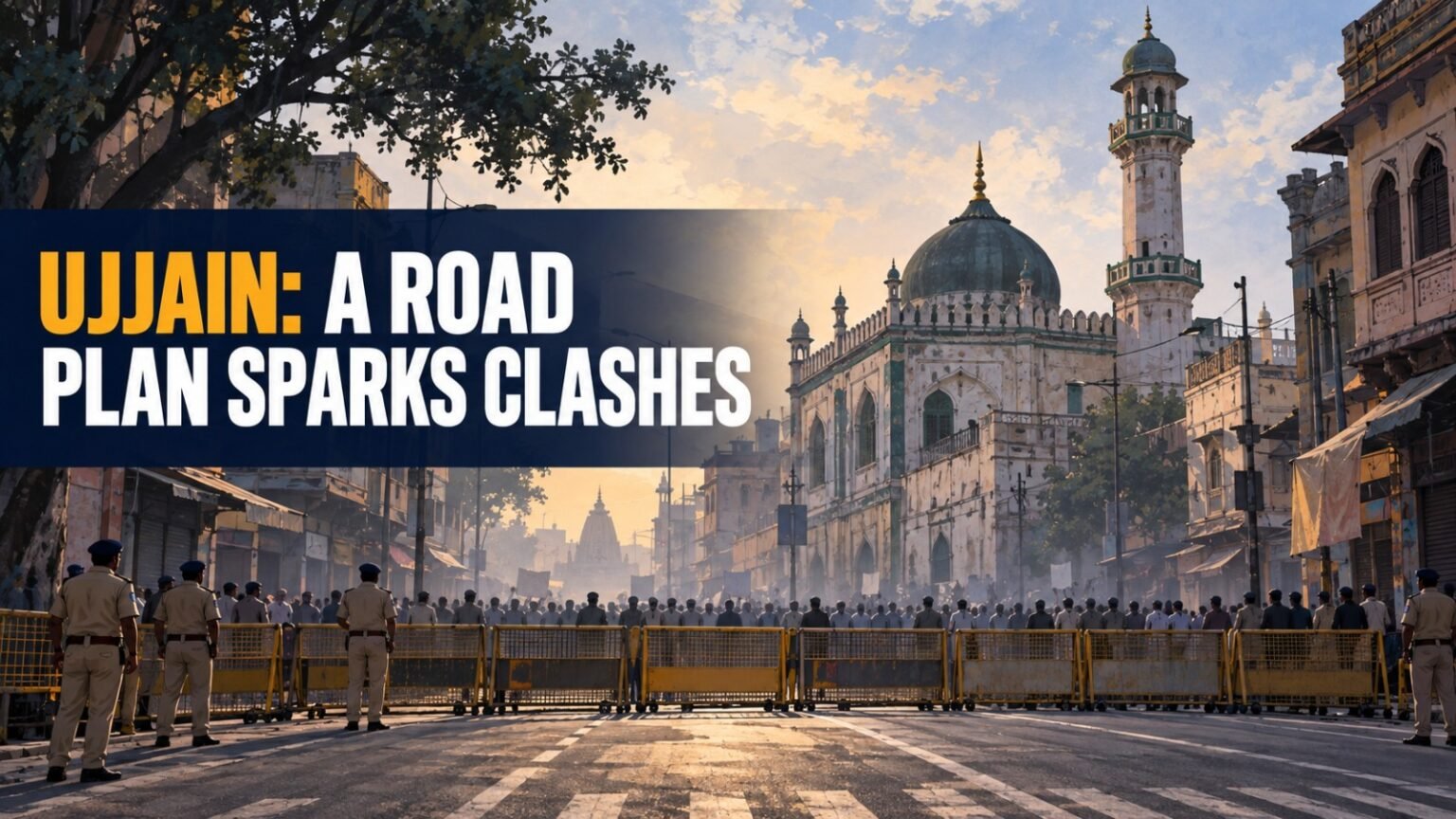
Tension rose in Ujjain, Madhya Pradesh, on Monday, 28 September, when people protesting the proposed removal of part of the Shahi Masjid clashed with police. Stones were thrown during the confrontation, police used tear gas, and Rapid Action Force personnel were deployed near the mosque. The immediate dispute concerns a road-widening project linked to preparations for the Simhastha Mela in 2028.
Videos and reports of the confrontation have prompted descriptions of a “riot-like situation”. The verified accounts available so far describe clashes around the Shahi Masjid site. They do not establish that riots spread across Ujjain. That distinction matters as the situation and the court proceedings continue to develop.
What happened in Ujjain today?
A crowd gathered near the Shahi Masjid as authorities prepared to remove a portion of the structure that falls within a proposed road alignment. Protesters opposed the move and attempted to advance through nearby lanes. During the confrontation, stones were thrown towards police personnel. Police fired tear gas shells to disperse the crowd, while a large security presence remained in the area.
The protest did not begin without warning. Residents and members of the mosque community had gathered at the site on Sunday, 27 September, ahead of the proposed action and a court hearing scheduled for Monday. Some planned to remain inside the premises overnight. Ujjain Superintendent of Police Pradeep Sharma told The Indian Express before Monday’s clashes that officials were speaking with mosque committee members and were, at that point, holding back from demolition while seeking a resolution through dialogue.
Monday morning’s confrontation showed how far the dispute had moved beyond a question of road design. For the administration, the project forms part of preparations to handle future crowds. For those opposing the proposed removal, it concerns a functioning religious site and a structure they consider historically important.
Also read- Why are stock markets falling?
Why does the road-widening project affect Shahi Masjid?
Ujjain Municipal Corporation plans to widen the road at this location to 15 metres. Part of the Shahi Masjid falls within the proposed alignment. The larger exercise is connected to infrastructure preparations for Simhastha 2028, when Ujjain expects a major influx of pilgrims and increased pressure on its streets and public facilities. Reports say 272 structures have been marked for removal as part of the road-widening work.
Municipal chairperson Kalawati Yadav has described road widening as necessary to manage the expected crowds. The administration has also pointed to wider work associated with the event, including ghats and other infrastructure. In the court proceedings, the corporation linked the road project to the Ujjain Development Plan, 2035, as well as traffic needs during religious processions and Simhastha.
Opponents question whether this particular alignment is necessary. Community members have asked why the road cannot instead be widened on the opposite side, or why the mosque cannot be excluded from the exercise. Imam Mohammad Ibrahim has argued that religious places should be spared. He has also said the mosque dates to 1390; that age is his claim, rather than a historical conclusion independently established by the reporting cited here.
These competing positions explain the cause of the protest more precisely than a simple claim that people are “against development”. The dispute is over which structures must be removed, whether another alignment is possible, and how the project should account for a place of worship.
What has the Madhya Pradesh High Court said?
The legal history is essential to understanding why tensions intensified this week. On 9 September 2026, a single judge of the Madhya Pradesh High Court dismissed petitions challenging municipal notices for the proposed removal of part of the mosque. The Shahi Masjid is registered as a Waqf property. The petitioners argued that the proposed action would affect the prayer hall, a minaret and the Mazhar Chowk Shahi, and raised constitutional and property-rights objections.
In its order, the court found that the municipal corporation had followed the required procedure and given the affected parties an opportunity to object. It accepted the public-interest case for widening the road and did not find that the mosque had been singled out for discriminatory treatment. The court noted action affecting other religious structures along the road and elsewhere in Ujjain. It declined to interfere with the municipal decision in those petitions.
That ruling did not end the disagreement. Mosque authorities pursued a further challenge, with another hearing expected on Monday, 28 September. Early reports said that hearing was still pending. Its outcome should not be presumed from the earlier judgment, and the earlier judgment should not be described as a ruling on every subsequent legal step.
This timing helps explain the heightened emotions at the site. Protesters were facing the prospect of physical action affecting the mosque while also awaiting another hearing. Police and municipal authorities, meanwhile, were dealing with a project for which earlier challenges had already been dismissed.
Why has the issue become so sensitive?
There are three overlapping causes behind the Ujjain situation.
First is the physical impact on the mosque. Petitioners told the court that the proposed removal could affect areas used for prayer and other prominent parts of the complex. For worshippers, that makes this a question about their place of worship, not simply the loss of a roadside strip. The municipality and the court have treated the affected portion within the context of a wider public road project.
Second is the choice of road alignment. Residents who oppose the plan say alternatives should be considered, including widening on the other side. The High Court’s September order found no basis to stop the action on the arguments then presented, but disagreement about the practical and cultural cost of the alignment remains at the centre of the public protest.
Third is the proximity of enforcement and a fresh hearing. A large gathering formed before Monday’s proceedings, and police were already deployed near the complex. Once people attempted to move towards the site and stone-pelting began, the dispute became an immediate public-order matter. That sequence explains the escalation; it does not establish who threw each stone or justify assigning responsibility to an entire community.
The issue has also drawn political comment. Congress MP Imran Pratapgarhi criticised the proposed removal and called for the administration to consider public sentiment and another alignment. His characterisation of the project represents his position. The municipality’s stated position is that widening is needed for traffic and crowd management.
What is confirmed, and what remains unclear?
The central facts reported by multiple outlets are that protesters and police clashed near the Shahi Masjid on Monday; stones were thrown; police used tear gas; and security forces, including the RAF, were deployed. The dispute concerns the proposed removal of part of the mosque for a Simhastha-linked road-widening project.
At the time of writing, the sources reviewed do not provide a reliable final account of injuries, arrests, the full extent of any removal carried out on Monday, or the result of the scheduled further hearing. Those details require an updated police statement, court order or on-the-ground report. Claims about them should not be presented as settled facts.
The next developments to watch are the court’s directions, the administration’s decision on the proposed work, and whether talks with mosque representatives resume. Ujjain’s immediate challenge is to keep people safe while the legal and planning questions are addressed. The road project and the objections to its alignment have been documented; Monday’s violence makes a clear, timely account of the next official steps all the more necessary.