







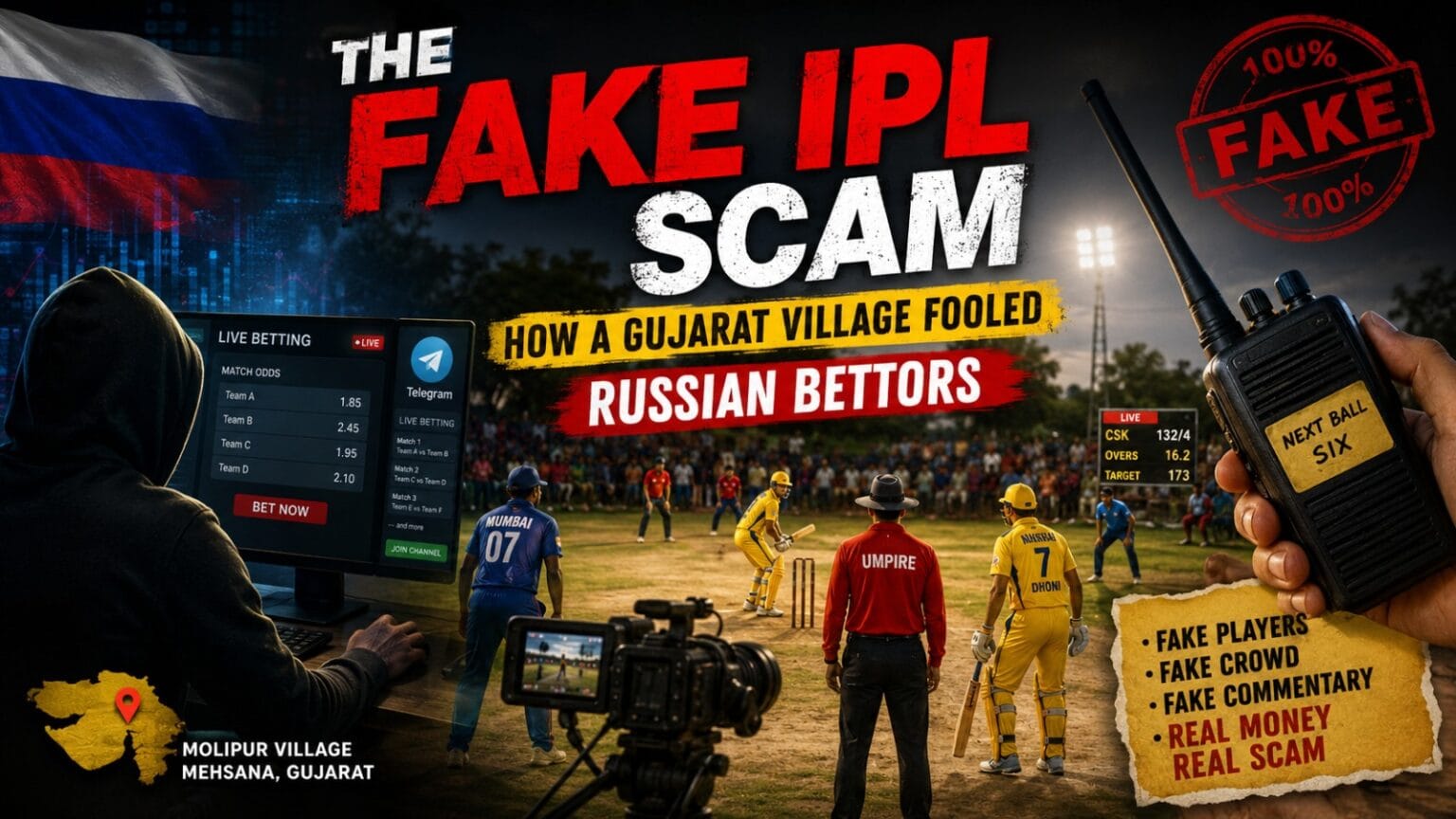
The Fake IPL Scam: How a Gujarat Village Fooled Russian Bettors
In a country where cricket is not just a sport but an emotion, the Indian Premier League has become one of the biggest entertainment properties in the world. Every season, millions of fans follow their favourite teams, watch every boundary, track every wicket and celebrate every last-over finish. But in 2022, one of the strangest cricket scams in India came to light — a fake IPL-style tournament allegedly staged in a small village in Gujarat to fool Russian bettors.
This was not a fake website. It was not just a fake scorecard. It was not a simple betting app fraud.
It was a complete cricket performance.
A cricket ground was created on a farm. Local workers were dressed in team-coloured jerseys. Cameras were installed. Crowd noise was added. Commentary was arranged. A YouTube livestream was created. Telegram channels were used for betting. And thousands of kilometres away, Russian bettors reportedly believed they were watching a real cricket tournament.
The story of the Fake IPL Scam from Molipur village in Mehsana, Gujarat is one of the most bizarre examples of sports fraud, digital deception and cricket betting manipulation India has ever seen.
What Was the Fake IPL Scam?
The Fake IPL Scam was an alleged betting fraud in which a group of men in Gujarat staged cricket matches on a farm and broadcast them online to convince Russian bettors that they were watching an IPL-style cricket tournament.
The matches were reportedly streamed on YouTube and betting activity was managed through Telegram channels. The organisers used local farm labourers and unemployed youth as players. They wore jerseys resembling the colours of popular IPL teams such as Chennai Super Kings, Mumbai Indians and Gujarat Titans.
From a distance, on a mobile screen, the setup looked convincing enough.
There were players, umpires, cameras, score graphics, crowd sound effects and commentary. But the entire tournament was fake. The players were not professional cricketers. The venue was not an official stadium. The league had no connection with the real Indian Premier League.
The aim was simple: make the match look real enough so that foreign bettors would place money on it.
WATCH
Where Did the Fake IPL Take Place?
The scam was reportedly staged in Molipur village in Mehsana district of Gujarat.
Molipur is not a place most cricket fans would associate with international-level cricket. It is a small rural village surrounded by farmland. That is what makes this story so unbelievable.
Instead of using a real stadium, the organisers allegedly turned a remote farm into a makeshift cricket ground. They marked boundaries, arranged a pitch, used floodlights and set up cameras to create the illusion of a professional T20 match.
For a person watching from the ground, the setup might have looked amateur. But for someone watching on a small phone screen from Russia, the illusion was apparently strong enough.
This is the central lesson of the Fake IPL Scam: digital fraud does not need to be perfect. It only needs to be believable from the victim’s point of view.
Also read – PoK Protests Explained
How Did the Fake IPL Scam Work?
The scam worked by combining three things: cricket, live streaming and online betting.
First, the organisers created a fake cricket match environment. Local workers were hired as players and reportedly paid around ₹400 per match. They were given jerseys in the colours of famous IPL teams. The matches were played on a makeshift ground in Gujarat.
Second, the matches were livestreamed online. Cameras captured the action in a way that made the ground look more official than it actually was. Crowd noise downloaded from the internet was added to make the match feel alive. Commentary was also arranged, reportedly with a mimic imitating the style of well-known cricket commentator Harsha Bhogle.
Third, Russian bettors were invited to place bets through Telegram channels. They reportedly bet on ball-by-ball events such as fours, sixes, wickets and match outcomes.
This is where the scam became more complex.
The match itself was allegedly controlled through instructions. The organiser would monitor the bets coming in and then pass instructions through walkie-talkie. The umpire would signal the bowler and batsman. If the next ball needed to be a boundary, the bowler and batsman could act accordingly.
So the viewers thought they were betting on unpredictable cricket.
In reality, the outcome was allegedly being directed.
The Role of Telegram in the Fake IPL Scam
Telegram played an important role in the Fake IPL betting operation.
Telegram channels and groups are often used for fast communication, anonymous coordination and betting-related activity. In this case, the Russian bettors were reportedly connected through Telegram, where they placed bets on the fake cricket matches.
This made the scam easier to run because Telegram allowed instant updates, quick communication and a closed environment for bettors. The organisers could monitor betting patterns and manipulate the match action accordingly.
This is why the Fake IPL Scam was not just a cricket scam. It was also a digital betting scam.
It showed how online platforms, livestreams and messaging apps can be used together to create believable fraud systems.
Why Russian Bettors Were Targeted
One of the most interesting parts of the Fake IPL Scam is that the victims were reportedly Russian bettors.
According to reports, bets came from Russian cities including Tver, Voronezh and Moscow. The reason this worked may have been simple: the bettors were interested in cricket betting but were not familiar enough with the real Indian cricket environment to detect the fraud.
An Indian cricket fan might quickly notice something wrong — the wrong stadium, wrong player names, poor-quality jerseys, unusual camera angles or an unofficial broadcast.
But for someone thousands of kilometres away, watching on a small mobile screen, those details may not be obvious.
The distance made the illusion stronger.
The scam depended on the fact that the audience did not have enough cultural or cricketing context to verify what they were watching.
The Harsha Bhogle Mimic and Fake Commentary
One of the most talked-about details of the Fake IPL Scam was the use of a commentator who reportedly mimicked Harsha Bhogle.
Harsha Bhogle is one of India’s most recognisable cricket commentators. His voice and style are strongly associated with Indian cricket broadcasts. By using a mimic, the organisers allegedly tried to add credibility to the fake match.
Again, the mimic did not have to be perfect. It only had to sound familiar enough to a foreign betting audience.
The scam also used fake crowd noise to make the match feel authentic. Crowd reaction is a powerful part of sports broadcasting. A boundary feels bigger when the crowd erupts. A wicket feels more dramatic when there is a loud reaction. By adding downloaded crowd sounds, the organisers gave the fake match a more professional broadcast feel.
This was production design used for fraud.
The Walkie-Talkie System: How the Match Was Controlled
The most cinematic detail of the scam was the use of walkie-talkies.
According to reports, the organisers used walkie-talkies to coordinate what would happen in the match. The person monitoring bets would communicate with the umpire. The umpire would then signal players on the field.
This meant that the match could be manipulated ball by ball.
If bettors were placing money on a six, the organiser could allegedly instruct the players to produce that result. If a wicket was needed, the players could stage one. The entire match became less like sport and more like theatre.
The players were not playing to win.
They were performing outcomes.
That is what makes the Fake IPL Scam so fascinating. It was not just a fake tournament. It was a live scripted event designed to manipulate betting behaviour in real time.
How the Fake IPL Was Busted
The fake tournament reportedly reached the quarter-final stage before police busted the racket.
Mehsana police received information and investigated the operation. When they reached the location, they found a setup that reportedly included cameras, lights, jerseys, walkie-talkies and other equipment used to run the fake cricket matches.
Several people were arrested in connection with the scam. Reports named Shoeb Davda as one of the key organisers. Other accused were also identified in media reports.
The police were also reportedly investigating the money trail and possible hawala channels connected to the betting operation.
By the time the scam was exposed, it had already become one of the most unbelievable cricket fraud stories in India.
Why the Fake IPL Scam Went Viral
The Fake IPL Scam went viral because it sounded almost fictional.
A fake cricket league running from a Gujarat farm.
Local labourers pretending to be IPL players.
Russian bettors placing money on Telegram.
A Harsha Bhogle mimic doing commentary.
Crowd noise downloaded from the internet.
Walkie-talkies controlling the next ball.
Every detail made the story more unbelievable.
But beyond the humour, the story also exposed a serious problem: the growth of online betting fraud and the ease with which digital reality can be manufactured.
Today, people trust what they see on screens. If something is live, has graphics, has commentary and looks professionally packaged, viewers often assume it is real.
The Fake IPL Scam broke that assumption.
It proved that a basic setup, if framed correctly, can fool people who are far away and emotionally invested in the outcome.
What the Fake IPL Scam Teaches Us About Digital Trust
The biggest lesson from the Fake IPL Scam is that digital trust is fragile.
In the past, fraud often required forged documents, fake offices or physical impersonation. Today, a livestream can create authority. A scoreboard can create legitimacy. A voiceover can create credibility. A Telegram channel can create urgency. A mobile screen can hide imperfections.
This scam worked because the victims were not standing on the ground. They were watching from far away. The phone screen controlled what they saw. The camera decided what was real.
That is why the Fake IPL story is not only about cricket betting. It is about the modern digital world.
We live in an age where reality can be staged, packaged and streamed. The more people trust screens, the more scammers can exploit that trust.
The Dark Comedy of the Fake IPL Scam
There is no denying that the story has a strange comic quality.
The idea of a fake IPL being played in a village field is absurd. The use of local workers as cricketers sounds like a scene from a dark comedy. The Harsha Bhogle mimic adds another layer of disbelief.
But behind the absurdity was a real fraud.
Money was involved. People were deceived. Betting systems were manipulated. Digital platforms were misused. And a rural field became the centre of an international betting scam.
That contradiction is what makes the story unforgettable.
It is funny because it is absurd.
It is serious because it actually happened.
Conclusion: The Fake IPL Scam Was More Than a Cricket Fraud
The Fake IPL Scam of Gujarat remains one of the most unusual cricket scams ever reported in India. It combined rural improvisation, digital deception, online betting, fake broadcasting and real-time manipulation into one bizarre operation.
A small farm in Molipur became a fake cricket venue. Local workers became pretend cricketers. A mimic became a commentator. A Telegram channel became a betting hub. And Russian bettors believed they were watching a real match.
The scam showed how easily perception can be controlled when people see the world through screens.
In the end, the Fake IPL Scam was not just about fake cricket.
It was about fake reality.
And in today’s digital world, that is the part that should worry us the most.
Subscribe to our YouTube Channel The Logic Stick for more video insights