







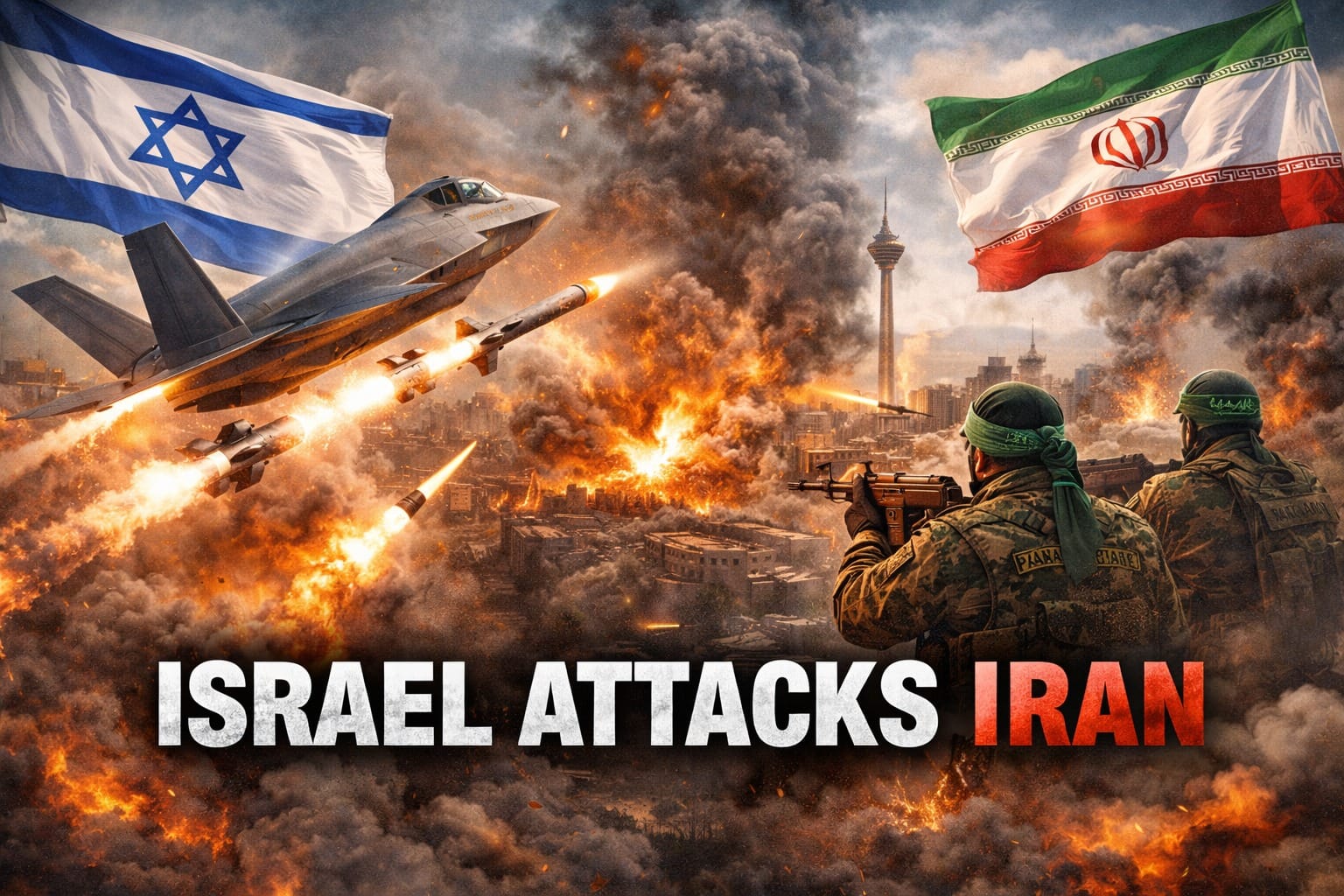
Israel Attacks Iran 2026: Full Breakdown
In a dramatic and dangerous turn of events on 28 February 2026, Israel launched a pre-emptive military attack against Iran, including strikes on Tehran and other strategic sites, marking a major escalation in long-standing tensions between the two countries. The operation, Israel says, was coordinated with the United States as part of a broader effort to counter Iran’s nuclear and missile programs and prevent future threats to Israel and regional stability.
This article unpacks:
- What happened in the attacks and how they unfolded
- The historical and strategic causes of the confrontation
- The role of the United States and Western powers
- Diplomatic and regional implications
- Possible future trajectories and global concerns
ALSO READ
What Happened: The Israel-Iran Attack Explained
On 28 February 2026, the Israeli government announced it had launched what it termed a “pre-emptive attack” against Iran. According to Israeli Defence Minister Israel Katz, the strike was aimed at removing imminent threats to the State of Israel and was planned well in advance, in coordination with the United States.
Explosions in Tehran
Reports from Iranian state media and independent sources confirm that explosions were heard in Tehran, particularly near government and security infrastructure. Sirens were also activated across Israel, signaling heightened readiness for further conflict.
In response, Iran shut down its airspace and reportedly placed Supreme Leader Ayatollah Ali Khamenei in a secure location, highlighting the seriousness of the attack.
Was the U.S. Involved?
Multiple credible reports, including those citing U.S. officials, state that the United States was involved in the military operation, though Washington has been cautious about publicly detailing the extent. U.S. forces were already reported to be striking Iranian targets alongside Israeli units, indicating joint operational activity.
On 28th February Trump accepted that it was a joint operation with Israel.
Also read
Why It Happened: The Causes Behind the Attack
The Israeli attack did not occur in a vacuum. It is rooted in years of mounting tensions, rivalries, and mistrust — most notably over Iran’s nuclear ambitions and ballistic missile capabilities.
Iran’s Nuclear Program
For decades, Iran’s nuclear enrichment activities have been a central source of concern for both Israel and the United States. Western powers have accused Tehran of pursuing a program that could lead to nuclear weapons capability, a charge Iran consistently denies.
In June 2025, Israel and the U.S. earlier bombed Iranian nuclear sites during a 12-day conflict, severely damaging key facilities. Iran subsequently withdrew cooperation from International Atomic Energy Agency (IAEA) inspections and refused to disclose its remaining enriched uranium stockpile.
The latest attack appears aimed at further degrading Iran’s ability to develop nuclear and missile capabilities that could threaten Israel and alter the regional balance of power.
Ballistic Missiles and Regional Threat Perceptions
Iran’s ballistic missile arsenal — estimated to include over 1,500 missiles — presents a strategic concern for both Israel and the U.S. military presence in the Middle East. These missiles have ranges capable of hitting major Israeli population centers and U.S. bases in the region.
This perceived threat, combined with Iran’s expansion of proxy influence through groups like Hezbollah and militias in Iraq and Yemen, has contributed to Israeli and American urgency to constrain Tehran’s capabilities.
Historical Context: A Long-Running Conflict Escalates Again
The 2026 attack comes against the backdrop of an evolving Iran-Israel war that has spanned years and erupted at various points, including a significant conflict in June 2025.
During that earlier conflict:
- Israel launched major strikes on Iranian nuclear and military sites.
- Iran responded with ballistic missiles and drones targeting Israel.
- Hundreds were killed, and thousands were wounded on both sides.
These previous engagements set the stage for continued volatility, with both nations viewing the other as an existential threat.
Also read – Netanyahu’s Hexagon of Alliances Explained
The U.S. Role: Why America Is Involved
The United States has played a central — and controversial — role in this conflict. Washington’s involvement stems from several interlinked strategic objectives:
1. Shared Security Interests with Israel
The U.S. considers Israel a key strategic ally in the Middle East and has repeatedly emphasized Iran’s nuclear program and missile arsenal as threats not only to Israel but to regional stability and U.S. forces abroad.
2. Diplomatic Efforts and Nuclear Negotiations
Earlier in February 2026, the U.S. and Iran had resumed nuclear negotiations, aiming to find a diplomatic resolution to Tehran’s nuclear ambitions. However, Israel publicly opposed any deal that did not include dismantling Iran’s nuclear infrastructure and curbing its ballistic missile program, complicating diplomatic efforts.
3. Military Preparations and Western Presence
The U.S. has significantly increased its military footprint in the region due to rising tensions. Both the United States and the United Kingdom have pulled diplomats and family members out of the Middle East, and Western countries have issued advisories urging citizens to evacuate areas near the conflict zone.
Regional and Global Repercussions
The sudden escalation has ripple effects that extend far beyond Tehran and Jerusalem:
Oil Markets and Economic Risks
With Iran controlling access to the Strait of Hormuz, through which a substantial portion of the world’s oil passes, even limited conflict risks major disruptions in global energy supplies.
Proxy Fronts and Militias
Iran’s influence over proxy groups, including Hezbollah in Lebanon and various Iraqi militias, means that conflict could spread across multiple fronts, drawing in other regional actors.
Great Power Dynamics
Countries like Russia and China have shown increased cooperation with Iran in recent years, complicating U.S. efforts to isolate Tehran and raising the stakes of global geopolitics beyond the Middle East alone.
Where Things Could Go Next
1. Full-Scale Regional War
If Iran retaliates proportionally or escalates across multiple borders, the conflict could expand into a broader regional war involving multiple states and proxies.
2. NATO-Style Coalition or Containment
The U.S. and Western allies might deepen military cooperation to contain Iran’s capabilities, potentially involving bases in Europe, the Gulf, and the Indian Ocean.
3. Renewed Diplomacy
Global and regional powers could restart high-stakes negotiations involving nuclear limits, ballistic missile restrictions, and regional security guarantees — but trust deficits make this challenging.
4. Proxy Intensification
Hostilities could continue at the level of proxy warfare, with increased actions by Hezbollah, Houthi forces, or Iraq-based militias backed by Tehran.
Conclusion: A Pivotal Moment for Middle East Security
The Israel attack on Iran in February 2026 represents one of the most serious escalations in Middle East geopolitics in decades. Coordinated military operations involving Israel and the United States underscore how deeply intertwined security concerns, diplomatic failures, nuclear anxieties, and strategic miscalculations have become.
With the Iran nuclear issue unresolved and ballistic missile threats persisting, the region stands at a dangerous inflection point — where missteps could spiral into full-blown war with global repercussions.
As of now, diplomatic efforts continue in some forums, but the path to peace remains fraught, requiring not only negotiation but significant concessions, confidence-building, and international mediation to prevent a regional conflagration.
SUBSCRIBE TO OUR YOUTUBE CHANNEL THE LOGIC STICK FOR MORE VIDEO CONTENT