







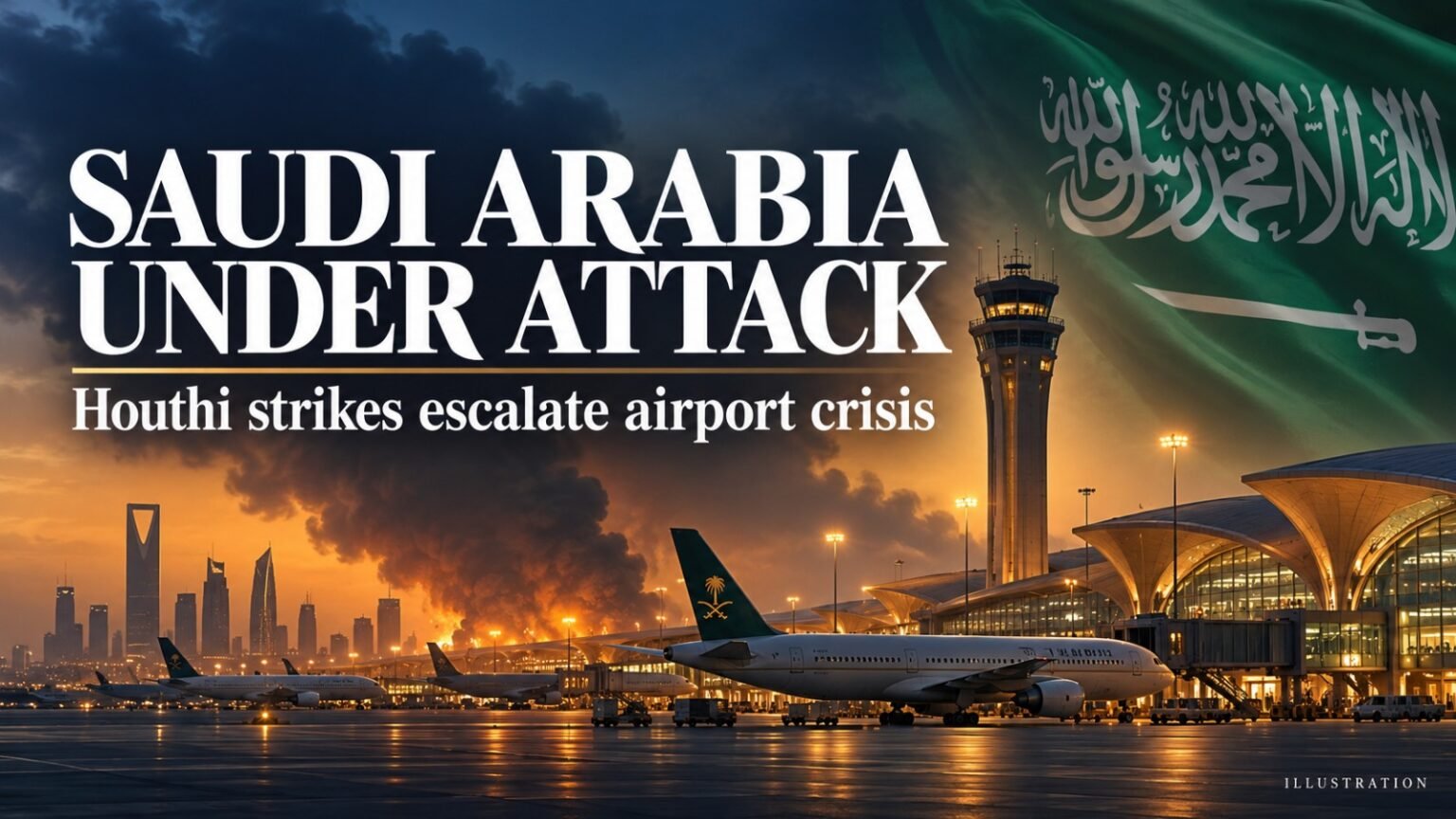
Saudi Arabia Houthi attacks
Saudi Arabia is facing a serious escalation in cross-border attacks after deadly strikes on Riyadh’s King Khalid International Airport and a reported attack at Dammam’s King Fahd International Airport. The incidents have intensified concerns over civilian safety, disrupted aviation and prompted regional governments to express support for the kingdom.
The latest Reuters reporting puts the death toll from the October 10 Riyadh airport attack at 13, with more than 300 injured. A separate attack on October 11 killed one person and injured 11, according to Saudi authorities. Yemen’s Houthis claimed responsibility for Saturday’s strike. These are separate incidents, and their casualty figures should not be confused. Reuters
Although searches and social media posts describe the incidents as “Saudi Arabia bombings,” reporting identifies missile or projectile strikes rather than planted explosive devices. The exact weapon and circumstances of each incident require separate verification.
What happened at Riyadh airport?
The October 10 attack struck an airport complex containing terminals 3 and 4, according to an official cited by the Associated Press. Saudi authorities initially reported 12 deaths, with several injured people in critical condition. Airport operations were suspended and flights diverted. The Saudi-led coalition blamed the Houthis and promised a firm response. AP News
Later reporting revised Saturday’s death toll to 13. This explains why earlier headlines still show 12 fatalities: they reflect an earlier assessment rather than a different attack.
On Sunday, another projectile struck Terminal 4 and caused a fire, Saudi authorities said. The renewed strike, coming immediately after the mass-casualty incident, deepened concerns about the safety of airport infrastructure. The Guardian
The immediate significance extends beyond damage to buildings. Airports connect residents, migrant workers, pilgrims and businesses with the outside world. Repeated attacks can interrupt those connections even when physical damage is limited, because authorities must inspect facilities and reassess whether passenger operations can continue safely.
Dammam airport attacked; oil-facility claims need verification
Saudi Arabia’s civil aviation authority also reported an attack at King Fahd International Airport in Dammam, with damage assessments and safety inspections taking place.
Separately, Houthi military spokesperson Yahya Saree claimed attacks against Saudi aviation infrastructure and oil facilities. Those statements must be distinguished from independently established damage: a claim that a facility was targeted does not, by itself, confirm that it was struck or that production was interrupted. aa.com.tr
That distinction matters particularly for Saudi Aramco. Unverified reports of damage to major energy facilities can rapidly spread through social media and influence public expectations about oil supply.
Until operators or credible independent reporting establish the outcome, descriptions such as “Aramco destroyed” or “Saudi oil production halted” would go beyond the evidence reviewed for this article.
Also read – Delhi Police Reveals a Video: Truth About Abhijeet Dipke’s Allegations
Why are the Houthis attacking Saudi Arabia?
The latest Saudi Arabia Houthi attacks form part of renewed fighting in Yemen.
Saudi Arabia entered Yemen’s war in 2015, leading a coalition supporting the internationally recognised government against the Houthis. A truce reached in 2022 reduced hostilities, but that relative calm unravelled this summer. More recently, Houthi territorial gains around the Red Sea have been followed by a Saudi-backed counteroffensive. reuters.com
The Houthis portray their attacks as retaliation for Saudi military involvement. Such explanations describe the group’s stated motives; they do not establish that civilian targets are legitimate.
Analysis: Attacking transport infrastructure can impose pressure disproportionate to the cost of the weapon used. A damaged terminal may require repairs, but an airport considered unsafe can also trigger cancellations, business uncertainty and demands for stronger military protection.
This creates a difficult decision for Riyadh. A military response may seek to deter further attacks, while also risking another cycle of retaliation. Diplomatic efforts face the opposite challenge: reducing escalation without leaving civilian infrastructure exposed.
Who are the Houthis?
The Houthis, also known as Ansar Allah, are a Yemeni armed and political movement with roots in the country’s northern highlands. They seized the capital, Sanaa, in 2014 and became a central force in Yemen’s civil war.
The Iran-backed group later developed a wider regional role, launching attacks on Red Sea shipping and firing missiles and drones towards Israel. Its maritime campaign began in November 2023, with the group saying it was acting in support of Palestinians during the Gaza war. ReutersFeed
However, describing the Houthis as Iran-backed does not prove that Tehran directly ordered any particular airport strike. Responsibility for an individual operation requires evidence beyond the group’s broader alliances.
For readers following the breaking news, three questions should remain separate: who claimed an attack, what authorities say happened, and what has been independently verified.
An Indian national among those killed
The attacks also have a direct human impact on India.
The Times of India reported that a 46-year-old Hyderabad man died after suffering injuries in Saturday’s Riyadh airport attack. The newspaper also reported that the Indian embassy confirmed 11 Indians were among the injured.
India’s Ministry of External Affairs condemned the repeated attacks on civilians and civilian infrastructure and expressed solidarity with Saudi Arabia, according to the report. The Times of India
For Indian families with relatives in the kingdom, verified information is especially important. Forwarded videos, unidentified casualty lists and old airport footage can cause unnecessary distress. Information about specific individuals should come from their families, hospitals or relevant authorities.
Flight cancellations and uncertainty over airport operations
The airport attacks have disrupted regional travel. The Indian Express reported cancellations involving Etihad, Emirates, flydubai and Air Arabia, alongside an extension of Riyadh airport’s closure.
Its report also noted that an aviation notice did not establish a definite time for passenger services to resume. A closure notice’s stated expiry should therefore not automatically be interpreted as confirmation that normal operations have restarted. World News – The Indian Express
Passengers with imminent bookings need flight-specific information. Conditions can differ between airlines and destinations, and services may be cancelled, delayed or rerouted as assessments change.
For businesses, the consequences can include missed meetings, disrupted staff movements and additional accommodation costs. The scale of those effects depends on how long interruptions continue and whether alternative routes remain available.
How have regional governments responded?
Turkey, Pakistan, Egypt and Saudi Arabia issued a joint condemnation of the airport attacks, describing them as a dangerous escalation and demanding their immediate cessation.
Reuters reported that the group reaffirmed support for Saudi Arabia’s defensive measures. Turkey’s foreign minister, however, ruled out Turkish participation in offensive operations and troop deployment, while discussing defensive and technical assistance. Reuters
The distinction between diplomatic solidarity, defensive assistance and participation in combat is important. Statements of support do not mean every supporting country has joined a war.
The regional response nevertheless shows that the attacks are being treated as more than a bilateral dispute. Their effects on civilian aviation and regional security give neighbouring governments a direct interest in preventing further escalation.
Will the United States intervene?
US President Donald Trump said he was considering whether the United States should join Saudi strikes against the Houthis, according to reporting following Saturday’s attack. That expressed consideration should not be presented as a confirmed decision to enter the campaign. washingtonpost.com
Analysis: Additional US military involvement could increase pressure on Houthi capabilities. It could also expand the conflict’s political and military stakes. The outcome would depend on the scope of any operation, the targets selected and the response it provoked.
Meanwhile, Houthi-run Al Masirah television reported a Saudi strike on Sanaa International Airport on October 11. Reuters noted that Saudi Arabia had not immediately commented. The reported strike therefore requires attribution rather than presentation as an independently confirmed Saudi operation. Reuters
What could this mean for oil, trade and India?
The Financial Times reported that several major oil-company executives withdrew from a Riyadh energy congress after the deadly airport attack, illustrating how security concerns can disrupt commercial activity even before any confirmed loss of energy production. ft.com
Analysis: The potential economic risks fall into three areas: aviation disruption, uncertainty around energy infrastructure and additional pressure on regional transport routes.
For India, prolonged instability could complicate travel and business links with the Gulf. Any sustained disruption to energy supply or shipping could also affect import costs. These are possible transmission channels, not evidence that a particular increase in Indian fuel prices or market decline has already occurred.
An attack can raise concern without immediately reducing oil output. Similarly, heightened geopolitical risk does not guarantee that crude prices will rise: prices also respond to demand expectations and developments elsewhere.
What to watch next
The next reliable updates should clarify:
- Revised casualty figures for each separate incident.
- The operational status of Riyadh and Dammam airports.
- Independently verified damage to any oil facilities.
- The scope of Saudi military and diplomatic responses.
- Whether proposed international assistance becomes operational.
The civilian toll is already substantial. What remains uncertain is whether the latest Saudi Arabia Houthi attacks lead to a prolonged campaign against infrastructure or renewed efforts to contain the conflict.
This article reflects reports available on October 12, 2026. Casualty figures, flight operations and official assessments may change as further information emerges.
Follow JC Based on Instagram for freshly brewed Business Ideas