







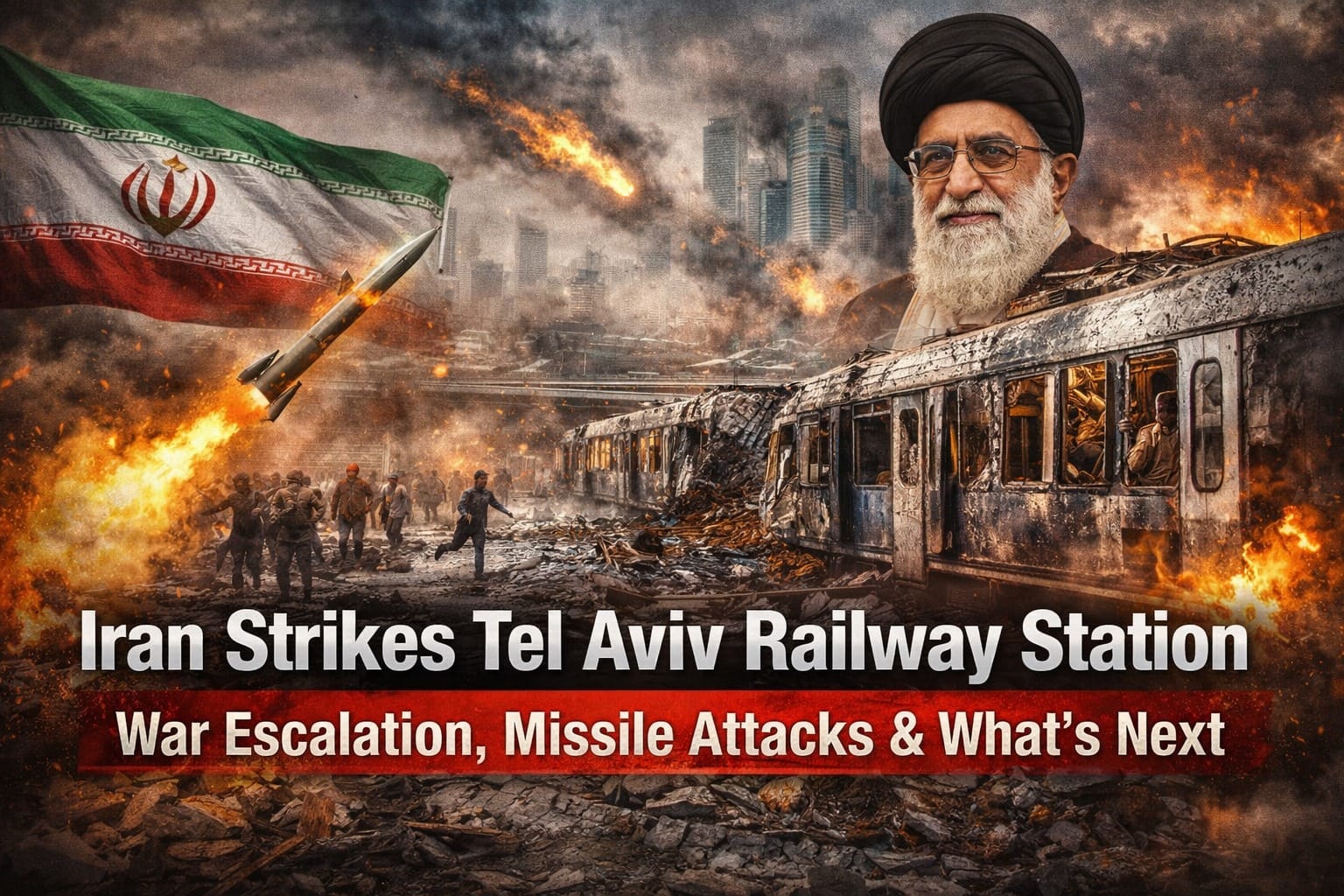
Iran Strikes Tel Aviv Railway Station
The ongoing Iran–Israel–US war in 2026 has entered a dangerous new phase after Iranian missile strikes hit a key railway station in Tel Aviv, disrupting one of Israel’s most critical transport hubs. What began as a strategic military conflict has now clearly expanded into civilian infrastructure targeting, economic disruption, and psychological warfare.
The latest attack on the Tel Aviv–Savidor Center railway station is not just another strike — it signals a shift in how Iran is approaching the war.
This article covers:
- What happened in the Tel Aviv railway strike
- Damage and impact on Israel
- Latest updates in the Iran war
- Why Iran is targeting infrastructure
- What this means for the future of the conflict
Iran Strikes Tel Aviv Railway Station: What Happened?
In one of the most significant recent developments, Iran launched a missile barrage targeting central Israel, with a direct or indirect hit reported at the Tel Aviv–Savidor Center railway station.
According to reports:
- The station suffered heavy structural damage
- Platforms were shattered and infrastructure was scorched
- Rail services were suspended nationwide
- Emergency transport systems were deployed to manage disruption
Authorities confirmed that:
- There were no casualties at the station itself
- However, the impact severely disrupted daily life in Israel
The attack highlights how the war is now affecting civilian infrastructure and economic systems, not just military targets.
Missile Strike Details: Cluster Weapons and Multiple Waves
The railway strike was part of a larger wave of Iranian missile attacks.
Reports indicate:
- Iran used ballistic missiles, some suspected to carry cluster munitions
- Multiple waves of strikes hit central Israel, including Tel Aviv and surrounding areas
- This was one of several strikes launched within hours
Cluster munitions are particularly dangerous because:
- They disperse smaller explosive fragments over a wide area
- Increase damage spread
- Raise risk to civilians
This marks a significant escalation in Iran’s offensive capability and intent.
Civilian Impact: Deaths and Injuries Near Tel Aviv
While the railway station itself reported no deaths, nearby areas were not spared.
- At least two civilians were killed in the Tel Aviv region
- Several others were injured due to missile debris and shrapnel
- Buildings and residential areas were damaged
The deaths reportedly occurred in Ramat Gan, a suburb near Tel Aviv, highlighting how even intercepted missiles can still cause fatalities.
This has intensified fear among civilians, with many now:
- Taking shelter in underground stations
- Avoiding public spaces
- Preparing for prolonged conflict
Also read – US-Reliance Energy $300 Billion Deal Explained
Why Target a Railway Station?
The strike on the railway station is strategically significant.
1. Disrupting Daily Life
Railways are a lifeline for:
- commuters
- workers
- military movement
Disrupting them creates immediate chaos.
2. Economic Impact
Transport infrastructure is critical for:
- trade
- logistics
- business continuity
By targeting it, Iran is hitting Israel’s economy indirectly.
3. Psychological Warfare
Attacks on civilian infrastructure:
- create fear
- reduce morale
- increase pressure on the government
This is a classic tactic in modern warfare.
4. Strategic Signaling
Iran is sending a message:
“No place in Israel is safe.”
How the War Reached This Point
To understand the railway attack, we need to look at the broader war timeline.
Phase 1: Israel-US Strike on Iran (February 2026)
The war began with Operation Lion’s Roar, where:
- Israel, with US support, struck Iranian military and nuclear targets
- The goal was to neutralize Iran’s capabilities
Phase 2: Iran’s Retaliation
Iran responded with:
- missile strikes on Israel
- drone attacks across the region
- threats to the Strait of Hormuz
Phase 3: Regional Expansion
The conflict quickly spread beyond Israel and Iran.
Recent developments include:
- Missile and drone attacks on UAE, Saudi Arabia, and Qatar
- Explosions reported in Gulf cities
- Attacks on US military bases in Iraq
Phase 4: Infrastructure Targeting
The Tel Aviv railway strike marks the beginning of:
direct targeting of civilian infrastructure
Iran’s Strategy: Beyond Military Targets
Iran’s recent actions suggest a shift in strategy.
1. Economic Pressure
By targeting infrastructure like:
- railways
- oil routes
- logistics hubs
Iran is increasing the economic cost of war.
2. Retaliation for Leadership Losses
Iran’s attacks are also seen as revenge for:
- assassination of top officials
- killing of security chief Ali Larijani
Iran has vowed “decisive retaliation”, which is now visible on the ground
3. Multi-Front Pressure
Iran is not just attacking Israel.
It is also:
- targeting Gulf allies
- pressuring US military presence
- expanding the war zone
4. Energy Warfare
Iran continues to threaten:
- Strait of Hormuz
- global oil supply
Oil prices have already surged above $100 per barrel due to the conflict
Israel’s Response to the Railway Strike
Israel has responded aggressively.
1. Air Defense Systems Activated
- Iron Dome and other systems intercepted many missiles
- However, some still got through
2. Retaliatory Airstrikes
Israel continues to:
- strike Iranian targets
- hit Hezbollah positions
- expand operations in Lebanon
3. Civilian Measures
- Rail services shut down
- Emergency transport deployed
- Citizens advised to stay in shelters
Global Reaction to the Escalation
The railway strike has triggered global concern.
United States
- Supports Israel’s military operations
- Continues strikes on Iranian missile sites
Middle East
- Gulf countries under threat
- Increasing defensive measures
Europe
- Divided response
- Some nations hesitant to escalate
Global Markets
- Oil prices rising
- Shipping routes under threat
- Economic uncertainty increasing
Humanitarian Impact
The war is now affecting civilians more than ever.
In Israel
- Fear of missile strikes
- Damage to infrastructure
- Daily life disrupted
In Iran
- Airstrikes destroying cities
- Leadership losses
- Rising internal pressure
In the Region
- Spillover effects in Gulf nations
- Threat to global trade routes
Why This Strike Changes the War
The Tel Aviv railway attack is a turning point.
1. Civilian Infrastructure Now a Target
This marks a shift from:
military war → total war
2. Escalation Risk Increases
Each strike now:
- invites retaliation
- raises stakes
- reduces chances of diplomacy
3. War Becomes Economic
Infrastructure damage leads to:
- financial losses
- transport disruption
- long-term impact
What Happens Next?
Several scenarios are possible.
Scenario 1: Further Escalation
- More infrastructure attacks
- Higher civilian casualties
Scenario 2: Regional War
- More countries get involved
- Conflict spreads across Middle East
Scenario 3: Diplomatic Intervention
- International pressure increases
- Ceasefire negotiations begin
Scenario 4: Prolonged Conflict
- Low-intensity but long-lasting war
- Economic and psychological toll
Conclusion
The Iran strike on the Tel Aviv railway station is more than just another attack — it represents a major escalation in the ongoing war.
By targeting a critical transport hub, Iran has shown that:
- the conflict is no longer limited to military targets
- civilian infrastructure is now part of the battlefield
- the war is entering a more dangerous phase
With rising casualties, economic disruption, and global involvement, the situation is becoming increasingly unpredictable.
The real question now is:
Is this the beginning of a wider war — or the point where the world steps in to stop it?
Subscribe to our YouTube Channel The Logic Stick for more video insights