







Ethanol 85 Explained: What E85 Fuel Means
Introduction: Why Everyone Is Suddenly Talking About Ethanol 85
India has officially entered the high-ethanol fuel conversation with the launch of E85 fuel, popularly known as Ethanol 85. The timing is important. Petrol prices continue to worry consumers, diesel remains under pressure because of emissions, EV adoption is growing but still faces charging and cost challenges, and the government is pushing cleaner, domestic alternatives to imported crude oil.
E85 is not normal petrol. It is a high-ethanol blend that contains around 85% ethanol and 15% petrol. In June 2026, India launched E85 fuel in Delhi, with the fuel priced at ₹82.12 per litre, around ₹20 cheaper than E20 petrol in the capital. However, the real debate is not just about price per litre. The bigger question is mileage, vehicle compatibility, infrastructure, environmental impact and whether Ethanol 85 can actually reduce India’s fuel burden.
This article explains everything a common car or bike owner wants to know about Ethanol 85: what it is, where it comes from, which cars can use it, whether it saves money, how it affects mileage, why India is promoting it, and what the real positives and negatives are.
Part 1: What Is Ethanol 85 and Why Is It Important?
What Is Ethanol 85 or E85 Fuel?
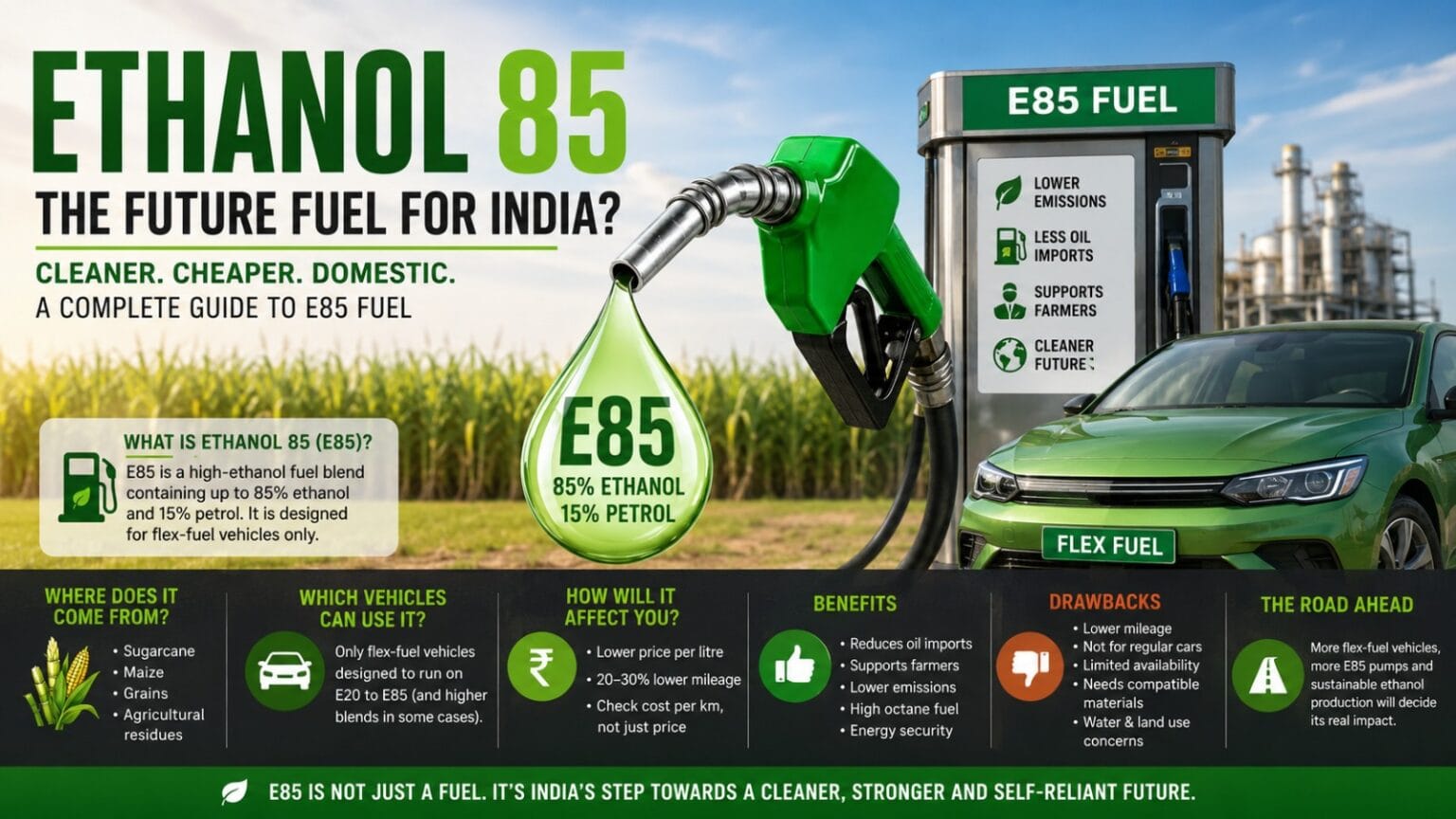
Ethanol 85, commonly called E85, is a fuel blend made with a high percentage of ethanol and a smaller percentage of petrol. In simple terms, E85 usually means a fuel blend containing up to 85% ethanol and the remaining portion petrol or gasoline. The U.S. Environmental Protection Agency defines E85 as a gasoline and denatured ethanol blend containing up to 85% ethanol, and clearly states that it is meant only for flex-fuel vehicles, not regular petrol cars.
In India’s current context, E85 has been introduced as a cleaner alternative to regular petrol blends. India is already moving from lower ethanol blends to E20 petrol, which contains 20% ethanol and 80% petrol. E85 is the next major jump because it pushes ethanol content much higher.
The word “flex fuel” is important here. A normal petrol vehicle is designed for a specific fuel blend. A flex-fuel vehicle, however, is engineered to run on different petrol-ethanol combinations, such as E20, E85 or even higher ethanol blends, depending on the vehicle’s certification.
Where Does Ethanol Come From?
Ethanol is an alcohol-based fuel produced from biological sources. It is usually made by fermenting sugar or starch-rich crops and biomass. In India, ethanol can come from:
Sugarcane juice, sugar syrup and molasses
Maize
Broken rice or damaged food grains
Other grains and biomass sources
Second-generation ethanol from agricultural residues and non-food biomass
The U.S. Alternative Fuels Data Center describes ethanol as a renewable fuel made from plant materials collectively known as biomass. It explains that feedstocks are grown, collected, transported to ethanol plants, converted into ethanol, and then supplied through terminals or directly to users.
For India, ethanol is closely linked with agriculture. The government’s ethanol-blending roadmap talks about expanding both molasses-based and grain-based ethanol production capacity. The NITI Aayog roadmap projected large capacity requirements for ethanol blending, including supplies from the sugar sector and grain or maize sources.
This is why ethanol is not just a fuel story. It is also a farmer-income story, a sugar-industry story, a rural-economy story and an energy-security story.
Why Is India Promoting Ethanol 85?
India imports a large amount of crude oil. Every litre of petrol or diesel that comes from imported crude affects foreign exchange, trade balance and energy security. Ethanol gives India a chance to replace part of imported fossil fuel with a domestically produced renewable fuel.
The Ministry of Petroleum and Natural Gas has been implementing the Ethanol Blended Petrol programme and has taken several steps since 2014, including administered pricing, opening alternate routes for ethanol production, and policies to support ethanol procurement and distillation capacity.
The reasons behind Ethanol 85 are:
It can reduce crude oil import dependence.
It creates a new market for agricultural produce.
It may reduce some emissions compared to fossil petrol.
It can support flex-fuel vehicle technology.
It gives consumers another option besides petrol, diesel, CNG and EVs.
It can help India diversify its fuel basket instead of depending on one technology.
When Maruti Suzuki launched India’s first flex-fuel car in June 2026, the company said flex-fuel vehicles can help reduce oil imports, carbon emissions and local air pollution while increasing domestic value addition and farmer incomes.
How Will Ethanol 85 Affect Current Fuel Needs?
Ethanol 85 will not immediately replace petrol or diesel for everyone. Its effect will depend on three things: vehicle compatibility, fuel availability and running cost.
In the short term, E85 will be useful mainly for flex-fuel vehicles. Regular petrol cars cannot simply start using E85. That means India’s existing fleet of petrol and diesel vehicles will continue to rely mostly on petrol, diesel, CNG and E20 petrol.
In the medium term, if more companies launch flex-fuel cars and two-wheelers, E85 can reduce the quantity of petrol consumed by each compatible vehicle. For example, if a flex-fuel car runs on E85, only about 15% of that fuel is petrol. This can reduce direct petrol demand per litre of fuel sold.
However, because ethanol has lower energy content than petrol, vehicles generally consume more E85 to travel the same distance. The U.S. Department of Energy notes that E85 can produce around 27% lower fuel economy because ethanol has less energy per gallon than petrol/gasoline.
So the impact is not a simple one-litre-for-one-litre replacement. If India replaces petrol with E85, fuel import dependence may come down, but total liquid fuel consumption by volume may rise because vehicles need more litres of E85 to cover the same distance.
E85 Price vs Mileage: Will It Actually Save Money?
This is the most important consumer question.
At launch in Delhi, E85 was priced at ₹82.12 per litre, while regular E20 petrol was around ₹102.12 per litre. That looks like a big saving of around ₹20 per litre. But E85 delivers lower mileage because ethanol has lower energy density than petrol.
Let’s understand this with a simple example.
Assume a car gives 15 km/litre on petrol priced at ₹102.12/litre.
Petrol cost per km = ₹102.12 ÷ 15 = ₹6.81 per km
Now assume the same flex-fuel car gives 27% lower mileage on E85. That means mileage drops from 15 km/litre to about 10.95 km/litre.
E85 cost per km = ₹82.12 ÷ 10.95 = ₹7.50 per km
In this example, E85 is cheaper per litre but costlier per kilometre.
If mileage drops by only 20%, E85 becomes almost equal to petrol in running cost. If mileage drops by 30%, E85 becomes clearly more expensive per kilometre unless the pump price is reduced further.
The practical rule is simple: E85 has to be significantly cheaper than petrol to make financial sense. If your car gives around 25–30% lower mileage on E85, the E85 price should ideally be around 70–75% of petrol price to become attractive. At ₹82.12 against ₹102.12, E85 is about 80% of the petrol price, which may not be enough for many users if mileage falls sharply.
Also read – Your Gut Bacteria is your second brain
Why Does E85 Give Lower Mileage?
Ethanol burns cleaner in some ways and has a high octane rating, but it contains less energy per litre than petrol. That means the engine needs to inject more fuel to produce similar energy output.
The U.S. Alternative Fuels Data Center says E85 with 83% ethanol has about 27% less energy per gallon than gasoline, and fuel economy impact reduces as ethanol content comes down. It also notes that many flex-fuel vehicles are optimized more for gasoline than high ethanol, which is why mileage may suffer.
This does not mean E85 is weak fuel. In performance cars, ethanol’s high octane can allow more aggressive tuning, cooler combustion and better knock resistance. But in normal commuter vehicles, the average owner mostly sees the mileage drop first.
Which Cars Can Use Ethanol 85?
Only flex-fuel vehicles designed and certified for high ethanol blends can use E85. Normal petrol cars, even if they are E20 compatible, should not use E85 unless the manufacturer clearly approves it.
The EPA says E85 can only be used in flex-fuel vehicles that are specifically designed to run on E85 or any gasoline-ethanol blend from E0 to E85.
In India, the most important recent example is the Maruti Suzuki Wagon R Flex Fuel, launched in June 2026 as India’s first flex-fuel car. Maruti Suzuki says the car can run on any ethanol-petrol blend from E20 to E100, while it is homologated with E85 because Indian flex-fuel rules define flex fuel as E20 to E85.
Reports also mention flex-fuel two-wheelers such as Hero Splendor+ Flex Fuel and HF Deluxe Flex Fuel, which are engineered to run on ethanol blends up to E85.
Other flex-fuel prototypes and showcases have included vehicles such as the Toyota Innova Hycross flex-fuel prototype and Hyundai Creta Flex Fuel prototype, but buyers must check commercial availability and official manufacturer certification before assuming compatibility.
Can My Existing Petrol Car Use E85?
For most people, the answer is no.
Do not use E85 in a regular petrol car unless your owner’s manual, fuel lid or manufacturer specifically says the vehicle is flex-fuel compatible. E85 can damage non-compatible fuel systems because ethanol behaves differently from petrol. It can affect rubber seals, fuel lines, gaskets, fuel pumps, injectors and other components if they are not designed for high ethanol exposure.
E85-compatible vehicles need changes such as:
Ethanol-resistant fuel lines and seals
Modified fuel pump and injector calibration
ECU mapping for different ethanol blends
Fuel sensors or software logic to detect ethanol concentration
Cold-start calibration
Material compatibility for tanks and fuel system components
Emission compliance for high ethanol blends
A normal petrol car cannot become a safe E85 vehicle simply by adding ethanol to the tank.
What Should Consumers Do Before Using E85?
Before using E85, follow this checklist:
First, check whether your vehicle is officially flex-fuel certified. Look at the owner’s manual, fuel cap label, manufacturer website or service centre guidance.
Second, do not assume that an E20-compatible car is E85-compatible. E20 means the car can handle 20% ethanol. E85 means 85% ethanol, which is a much higher concentration.
Third, calculate cost per kilometre, not just price per litre. A lower pump price does not automatically mean cheaper driving.
Fourth, use only clearly marked E85 pumps. E85 dispensers are usually separately branded so that users do not confuse them with normal petrol pumps.
Fifth, track your real-world mileage for at least two to three full tanks before deciding whether E85 is financially useful for you.
Sixth, follow the service schedule strictly. Flex-fuel vehicles may need proper maintenance because fuel quality and ethanol percentage can affect performance.
Part 2: Benefits, Drawbacks, Future and the Big E85 Question
Why Ethanol Instead of Petrol?
Petrol is convenient, energy-dense and widely available, but it comes from crude oil. For India, that means import dependence and vulnerability to global crude price shocks. Ethanol is partly domestic and renewable, so it gives India an alternative route.
The biggest advantage of ethanol over petrol is not pure mileage. Petrol still wins on energy density. Ethanol’s advantage lies in energy security, agricultural linkage, renewable origin and lower petroleum use.
If E85 adoption grows, petrol demand per vehicle can reduce because most of the fuel blend is ethanol. This can support India’s long-term goal of reducing fossil-fuel dependence.
Why Ethanol Instead of Diesel?
Diesel is more energy-dense and efficient than petrol, especially for heavy vehicles. But diesel also creates serious urban air-quality concerns, especially particulate matter and NOx emissions. India’s emission norms have already made diesel engines more expensive and complex.
E85 is not a direct diesel replacement for trucks, buses or tractors yet. It is more relevant for petrol-type spark-ignition engines and flex-fuel passenger vehicles. Diesel will continue to play a role in heavy transport, but for small cars and two-wheelers, ethanol can become an alternative to petrol.
Why Ethanol Instead of EV?
This is where the debate becomes interesting.
EVs are far more energy efficient at the vehicle level and have zero tailpipe emissions. But EV adoption depends on charging infrastructure, battery cost, electricity source, charging time and consumer affordability.
E85 is not better than EV in every way. It is better understood as a bridge fuel or parallel solution. It can reduce petroleum use in internal combustion vehicles without asking every consumer to immediately switch to electric. That matters in a country where millions of people still buy affordable petrol two-wheelers and small cars.
Maruti Suzuki’s flex-fuel launch statement also makes it clear that companies are looking at multiple technologies together: BEVs, hybrids, CNG/CBG and ethanol flex-fuel vehicles.
In short, India’s future may not be petrol vs EV vs ethanol. It may be a mix of EVs, hybrids, CNG, ethanol, biofuels and cleaner public transport.
Positives of Ethanol 85
The first positive is reduced crude oil dependence. Since E85 contains a much smaller petrol share, wider use of E85 in compatible vehicles can reduce the need for imported crude.
The second positive is domestic value creation. Ethanol production can support sugar mills, grain producers, distilleries, transport networks and rural employment.
The third positive is lower carbon potential. Ethanol is renewable because it comes from biomass. The EPA says expanding E85 use can increase renewable fuel use, reduce imported oil dependence and provide greenhouse-gas reductions compared to petroleum gasoline.
The fourth positive is fuel diversification. India should not depend only on petrol, diesel or EVs. E85 gives another pathway.
The fifth positive is high octane. Ethanol has strong knock resistance, which can be useful in properly designed engines.
The sixth positive is consumer choice. If priced correctly and supported by infrastructure, E85 can give flex-fuel owners a choice between petrol-heavy and ethanol-heavy fuel.
Negatives and Drawbacks of Ethanol 85
The biggest drawback is lower mileage. This is the issue most people will immediately feel. If the price discount does not compensate for the mileage drop, E85 may look cheaper but cost more per kilometre.
The second drawback is compatibility. E85 is not for normal petrol cars. Using it in the wrong vehicle can lead to fuel-system damage.
The third drawback is limited infrastructure. India has only started the E85 journey. Reports say the government plans to scale E85 dispensing stations, but widespread availability will take time. E85 will not become practical for everyone until pumps are available across major routes and cities.
The fourth drawback is water and land use. Ethanol from sugarcane can be water-intensive. NITI Aayog’s roadmap notes environmental concerns around sugarcane, including high water consumption, and suggests shifting some area under sugarcane to less water-intensive crops.
The fifth drawback is food-vs-fuel concern. If ethanol production depends heavily on food crops, questions arise about land use, crop prices and food security.
The sixth drawback is not-zero emissions. E85 may reduce some petroleum-linked emissions, but it still burns fuel in an engine. It is not the same as a zero-tailpipe-emission EV.
The seventh drawback is price uncertainty. Ethanol may not always remain cheap. If ethanol procurement prices rise, the pump price advantage may shrink.
Is E85 Really Cleaner?
E85 can be cleaner than petrol in some important ways, especially when considering renewable content and reduced petroleum dependence. But the final environmental benefit depends on how ethanol is produced.
If ethanol comes from efficient, low-carbon, less water-intensive feedstocks, its climate benefit improves. If it comes from highly water-intensive crops or involves high energy use in production, the benefit becomes less clear.
That is why ethanol policy must focus not only on blending targets but also on sustainable feedstock, water management, crop diversification and second-generation ethanol from agricultural waste.
Will E85 Reduce India’s Petrol Demand?
Yes, but gradually.
E85 can reduce petrol demand in compatible vehicles because only a small part of the blend is petrol. But India has a huge existing fleet of vehicles that cannot use E85. So the reduction will happen only as flex-fuel vehicles increase and E85 pumps expand.
For now, E85 is more of a future-facing fuel than a mass replacement. Its real impact may become visible when:
More affordable flex-fuel cars and bikes launch
E85 pumps become widely available
Fuel pricing makes sense on a cost-per-km basis
Consumers understand compatibility
Automakers give clear warranties and service support
The ethanol supply chain becomes stable and sustainable
Should You Buy a Flex-Fuel Car?
A flex-fuel car makes sense if you are buying a new vehicle and want future fuel flexibility. It can run on different ethanol-petrol blends, so you are not locked into one fuel type.
However, before buying, ask these questions:
Is E85 available in your city?
Will the car cost more than a normal petrol version?
What mileage does it deliver on E85?
What is the real cost per kilometre?
Does the manufacturer provide full warranty for E85 use?
Are service centres trained for flex-fuel systems?
Will you keep the car long enough to benefit from the technology?
If E85 is not available near you, a flex-fuel vehicle will mostly run on regular petrol or E20. In that case, the advantage may be limited in the beginning.
E85 vs Petrol vs Diesel vs EV: Which Is Better?
For daily city commuting, EVs are often the most efficient if charging is available and the vehicle fits your budget.
For long-distance highway use, petrol, diesel, hybrid and CNG still have stronger infrastructure.
For buyers who want flexibility and lower dependence on fossil petrol, flex-fuel vehicles can become a practical middle path.
For heavy-duty transport, diesel and future alternatives like LNG, CNG, hydrogen, biodiesel or electrification may remain more relevant than E85.
E85 is not a magic fuel. It is one piece of India’s larger energy transition.
The Final Verdict: Is Ethanol 85 Good or Bad?
Ethanol 85 is neither a miracle nor a scam. It is a promising alternative fuel with real benefits and real limitations.
It is good for India’s energy security because it can reduce crude oil dependence.
It is good for rural value chains because ethanol can support farmers and distilleries.
It can be good for emissions if produced sustainably.
It can be good for consumers only when the price discount beats the mileage loss.
But it is not good for regular petrol cars that are not designed for it.
It is not automatically cheaper per kilometre.
It is not a complete replacement for EVs.
It is not environmentally perfect if feedstock production stresses water and land resources.
The most important message for consumers is this: do not look only at the pump price. Look at compatibility and cost per kilometre.
E85 at ₹82 may sound cheaper than petrol at ₹102, but if your mileage falls by 25–30%, the savings can disappear. For Ethanol 85 to become truly attractive, India needs compatible vehicles, widespread pumps, transparent pricing, sustainable ethanol production and honest consumer education.
FAQs on Ethanol 85
What is Ethanol 85?
Ethanol 85, or E85, is a high-ethanol fuel blend containing up to 85% ethanol and the remaining portion petrol.
Can normal petrol cars use E85?
No. Only certified flex-fuel vehicles should use E85.
Is E85 cheaper than petrol?
It may be cheaper per litre, but not always cheaper per kilometre because mileage is usually lower.
Why does E85 give lower mileage?
Ethanol has lower energy content than petrol, so the engine needs more fuel to travel the same distance.
Which car in India can use E85?
Maruti Suzuki has launched the Wagon R Flex Fuel, which can run on ethanol-petrol blends from E20 to E100, while being homologated with E85 under Indian rules.
Are there E85 bikes in India?
Reports say Hero MotoCorp has launched Splendor+ Flex Fuel and HF Deluxe Flex Fuel motorcycles that can run on blends up to E85.
Is E85 better than EV?
Not overall. EVs are more efficient and have zero tailpipe emissions, but E85 can be a bridge solution for internal combustion vehicles.
Should I use E85 in my old car?
No. Unless your vehicle is officially flex-fuel certified, using E85 can damage fuel-system components.
Is Ethanol 85 the future of fuel in India?
It may become an important part of India’s fuel mix, but it will likely exist alongside EVs, hybrids, CNG, petrol and diesel rather than replacing everything immediately.
Subscribe to our YouTube Channel The Logic Stick for more video insights