







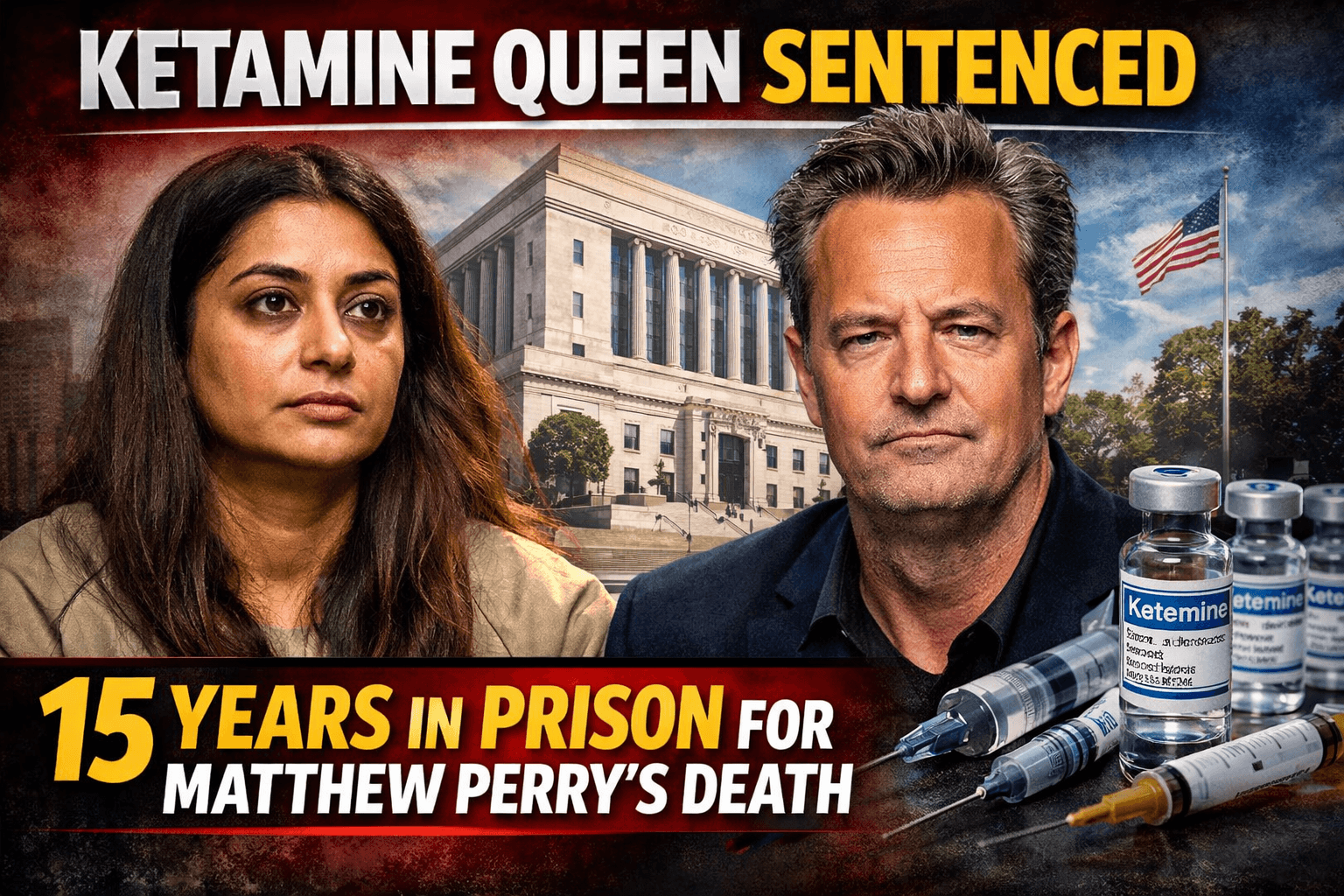
Ketamine Queen Sentenced to 15 Years: The Truth Behind Matthew Perry’s Death and the Drug Network That Shocked Hollywood
Introduction
In a case that has gripped global attention, a U.S. federal court has sentenced Jasveen Sangha—widely referred to as the “Ketamine Queen”—to 15 years in prison for her role in supplying drugs linked to the death of Friends star Matthew Perry.
The verdict marks a significant development in a complex investigation that uncovered a disturbing network of illegal drug distribution involving medical professionals, intermediaries, and close aides. Beyond the courtroom, the case raises critical questions about addiction, access to controlled substances, and systemic failures in protecting vulnerable individuals—even those in the public eye.
Matthew Perry’s Death: What Really Happened
Matthew Perry, best known for his iconic role as Chandler Bing on Friends, passed away on October 28, 2023, at the age of 54. He was found unresponsive at his Los Angeles residence.
An official autopsy later concluded that the cause of death was acute effects of ketamine, with contributing factors including drowning and pre-existing health conditions.
At the time, Perry had been undergoing legally prescribed ketamine therapy for mental health treatment, particularly for depression. However, investigations revealed that the levels of ketamine found in his system were significantly higher than what would typically be administered in a clinical setting.
This discrepancy triggered a deeper probe into how the drug was sourced.
Who Is Jasveen Sangha, the “Ketamine Queen”?
Jasveen Sangha, a dual national with links to both the United States and the United Kingdom, emerged as a central figure in the investigation.
Operating out of North Hollywood, she was allegedly involved in a high-end drug distribution network that catered to affluent and celebrity clients. Law enforcement agencies described her operation as organized, discreet, and profit-driven.
Her nickname, “Ketamine Queen,” reportedly stemmed from her reputation within underground circles as a major supplier of the drug. Authorities allege that her network extended beyond ketamine, potentially involving other controlled substances.
The Drug Supply Chain: How the Network Operated
The investigation into Perry’s death revealed a layered and coordinated drug supply chain rather than an isolated transaction.
According to prosecutors, the chain involved:
- Primary supplier: Jasveen Sangha
- Intermediary distributors: Individuals who sourced drugs from Sangha
- Medical professionals: Accused of facilitating or overlooking irregular access
- Personal assistant: Responsible for administering the drug
In the final weeks leading up to his death, Perry was allegedly receiving ketamine outside of regulated medical supervision. Reports suggest that multiple doses were administered within short intervals—far exceeding safe medical guidelines.
This network structure made it difficult to trace accountability initially, but federal authorities eventually connected the supply to Sangha.
Charges and Legal Proceedings
Jasveen Sangha faced multiple serious federal charges, including:
- Distribution of a controlled substance
- Conspiracy to distribute drugs
- Distribution resulting in death
In 2025, she entered a guilty plea as part of a legal process that avoided a prolonged trial. Prosecutors had indicated that she could face a significantly longer sentence if convicted on all counts at trial.
The case was handled under federal jurisdiction due to the severity of the charges and the broader implications of drug distribution networks operating across state lines.
The 15-Year Sentence: What the Court Considered
In April 2026, the court sentenced Sangha to 15 years (180 months) in federal prison.
Key factors influencing the sentence included:
- Direct connection to a fatal overdose
- Scale of drug distribution activity
- Evidence suggesting profit-driven motives
- Failure to prevent harm despite awareness of risks
While the prosecution pushed for a stricter penalty, the defense argued for leniency, citing cooperation with authorities and lack of prior major convictions.
The final sentence reflects a balance between acknowledging the gravity of the crime and considering mitigating circumstances.
The Role of Other Accused Individuals
The case did not involve Sangha alone. Several others were implicated:
1. Personal Assistant
Perry’s assistant was accused of administering ketamine injections, allegedly under instructions and without proper medical oversight.
2. Intermediaries
Individuals who acted as middlemen helped transport and supply ketamine from Sangha to Perry.
3. Medical Professionals
At least two doctors were investigated for their roles in prescribing or enabling access to ketamine beyond legitimate medical needs.
Some of these individuals have already faced sentencing or are awaiting final judgments.
Ketamine: A Medical Tool Turned Risk
Ketamine is a legally approved anesthetic that has gained traction in recent years for treatment-resistant depression and mental health therapies.
When administered in controlled environments, it can provide significant therapeutic benefits. However, misuse or unsupervised consumption can lead to:
- Loss of consciousness
- Respiratory complications
- Hallucinations
- Fatal overdose
The Perry case underscores the thin line between therapeutic use and dangerous abuse, particularly when access extends beyond medical supervision.
A Larger Issue: Addiction in High-Pressure Environments
Matthew Perry had been open about his struggles with addiction throughout his life. His death highlights a broader issue affecting many individuals—especially those in high-pressure industries like entertainment.
Key contributing factors include:
- Easy access to prescription drugs
- Financial ability to procure substances illegally
- Social isolation despite public visibility
- Mental health challenges
The intersection of these factors creates an environment where recovery becomes more difficult, even for those actively seeking help.
Read
Legal and Social Implications of the Case
1. Increased Scrutiny on Drug Networks
Law enforcement agencies are likely to intensify crackdowns on underground drug suppliers targeting high-profile clients.
2. Accountability in Healthcare
The involvement of medical professionals raises serious concerns about ethical prescribing practices and monitoring systems.
3. Mental Health Reform
The case highlights the need for stronger safeguards in mental health treatments involving controlled substances.
Public and Industry Reaction
The sentencing has triggered widespread reactions across media and the entertainment industry.
While many have welcomed the conviction as a step toward accountability, others argue that it does not fully address the systemic issues that allowed such a network to operate.
The case has also reignited conversations about:
- Celebrity vulnerability
- Drug culture in elite circles
- The responsibility of enablers versus suppliers
Read more on US military Draft 2026.
Timeline of Key Events
| Year | Event |
|---|---|
| October 2023 | Matthew Perry dies at his Los Angeles home |
| Late 2023–2024 | Investigation into cause of death begins |
| 2024–2025 | Arrests and charges filed against multiple individuals |
| 2025 | Jasveen Sangha pleads guilty |
| April 2026 | Sentenced to 15 years in prison |
Why This Case Matters
This case is not just about one individual or one tragic death. It represents a larger systemic issue involving:
- The misuse of medically approved drugs
- The existence of underground supply networks
- Failures in oversight and accountability
It also serves as a cautionary tale about how easily treatment pathways can turn into dangerous dependencies when proper safeguards are absent.
Conclusion
The sentencing of Jasveen Sangha, the “Ketamine Queen,” marks a critical milestone in the investigation into Matthew Perry’s death. While the legal process has reached a significant conclusion, the case leaves behind unresolved questions about addiction, responsibility, and systemic oversight.
Matthew Perry’s legacy as an actor and advocate for addiction recovery continues to resonate. His death, however, stands as a stark reminder of the risks associated with substance misuse—even in controlled therapeutic contexts.
Ultimately, this case underscores the urgent need for stronger systems, greater accountability, and a more compassionate yet structured approach to mental health and addiction treatment.