






Amazon’s Investment in Anthropic
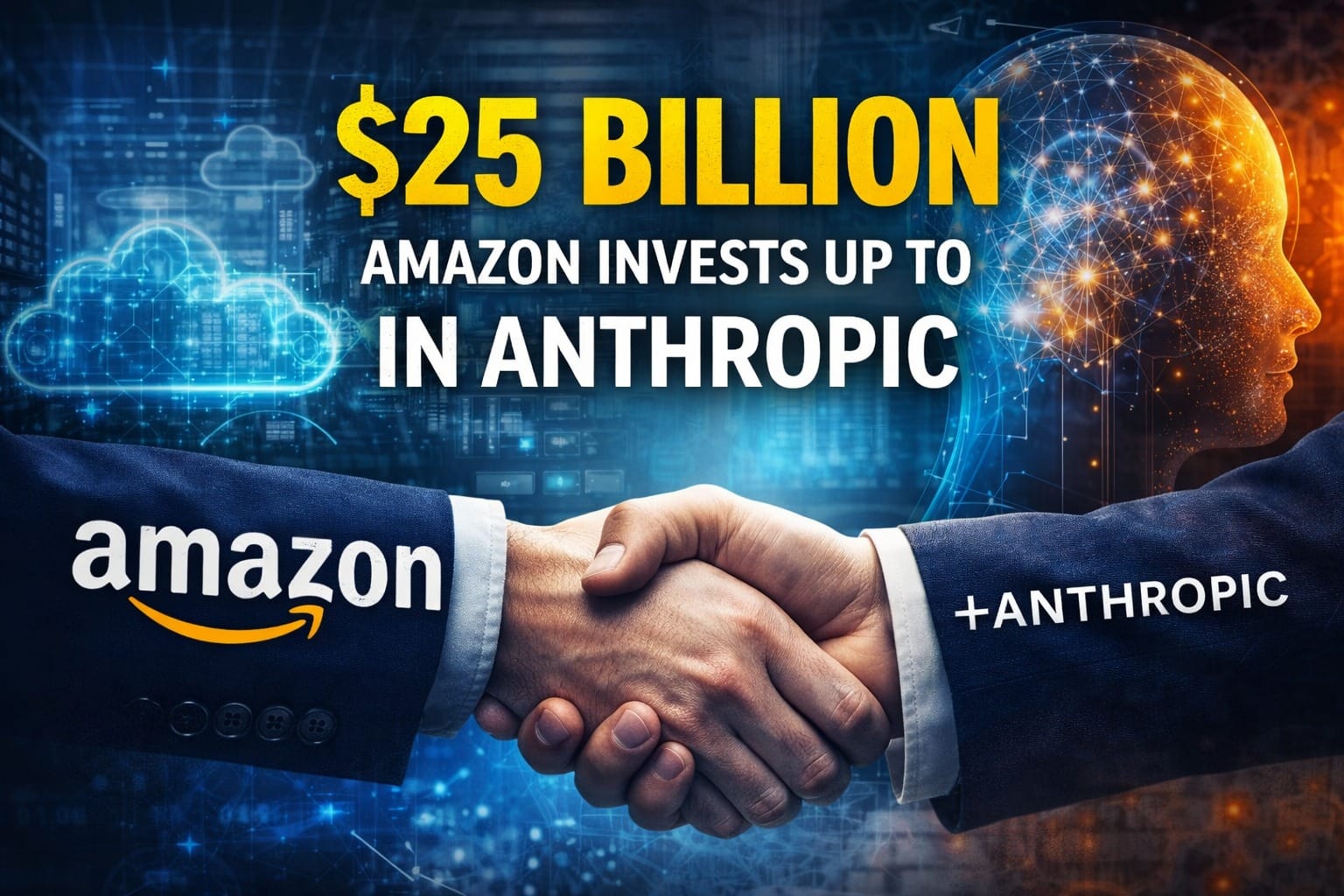
Amazon’s latest move in artificial intelligence is not just another venture bet. It is a large, strategic infrastructure deal designed to lock in cloud demand, promote Amazon’s custom AI chips, and strengthen Amazon Web Services in its fight against Microsoft Azure and Google Cloud. Under the expanded partnership announced in April 2026, Amazon said it will invest $5 billion immediately in Anthropic and up to another $20 billion in the future, taking the total new commitment to up to $25 billion. In return, Anthropic has committed to spend more than $100 billion over the next decade on AWS technologies.
This is one of the biggest cloud-and-AI tie-ups in the market because the deal is not only about equity funding. Anthropic will secure up to 5 gigawatts of capacity for training and deploying Claude models, use current and future generations of Amazon Trainium chips, and expand international inference capacity in Asia and Europe. Anthropic also said nearly 1 gigawatt of Trainium2 and Trainium3 capacity is expected to come online by the end of 2026.
What exactly is Amazon investing in Anthropic?
The headline figure can sound larger or smaller depending on what you compare it with, so it helps to break it down. Amazon is not writing a single $25 billion check today. The company said it is investing $5 billion now, with up to an additional $20 billion tied to future commercial milestones. This comes on top of the $8 billion Amazon had previously invested in Anthropic, meaning Amazon is deepening a relationship that has already been strategically important since 2023.
Anthropic, for its part, is not simply taking capital and walking away. The startup is making a very large infrastructure commitment to AWS. The company said it will spend more than $100 billion over ten years on AWS technologies, including Trainium accelerators and tens of millions of Graviton CPU cores. That means the partnership is structured less like a conventional startup financing and more like a long-term ecosystem lock-in: Amazon funds Anthropic’s growth, and Anthropic helps validate and scale Amazon’s AI cloud stack.
Also read – How AI in-car Assistants can become your personal co-pilots
Why is Amazon investing so heavily in Anthropic?
The short answer is that Amazon wants to win the infrastructure layer of the AI economy, even if it is not the loudest player at the model layer. Amazon’s own release frames the partnership around helping customers build, deploy, and scale generative AI on AWS, while CEO Andy Jassy said Anthropic’s decision to run large language models on AWS Trainium for the next decade reflects progress on custom silicon and infrastructure.
That matters because the AI race is increasingly being fought on three fronts at once. The first is models: companies want the most capable AI systems. The second is distribution: they want enterprises and developers using those systems. The third is infrastructure: they need enormous amounts of compute, networking, and energy to train and serve those models. Amazon may not dominate the headlines the way OpenAI often does, but AWS remains one of the central backbones of the AI boom, and this deal helps Amazon defend that position. Mint noted that Amazon has struggled to generate widespread buzz around some of its in-house models, even while its cloud business continues to benefit from rising AI demand.
There is another reason the investment is so important: custom chips. Amazon has spent years building alternatives to Nvidia-heavy infrastructure through its in-house silicon efforts, particularly Trainium for AI workloads and Graviton for general-purpose compute. In his 2025 shareholder letter, Andy Jassy wrote that Trainium2 offered about 30% better price-performance than comparable GPUs, that Trainium2 had largely sold out, and that Trainium3, which started shipping in early 2026, is 30–40% more price-performant than Trainium2 and nearly fully subscribed. If Anthropic commits major frontier-model workloads to Trainium, that becomes one of the strongest validations Amazon can point to when selling AI infrastructure to other enterprises and labs.
Why does Anthropic want this deal?
Anthropic needs capital, but more importantly, it needs compute. Frontier AI companies are now constrained not just by research talent, but by access to chips, power, data-center capacity, and networking. Anthropic’s official statement makes that clear: the new agreement secures up to 5 GW of capacity for training and deploying Claude, including new Trainium2 capacity and large Trainium3 deployments. That kind of reserved capacity is not a nice extra; it is a strategic necessity for a company competing with OpenAI, Google DeepMind, and xAI.
Anthropic has also been trying to scale Claude beyond being simply “another chatbot.” On Amazon’s side, the company says more than 100,000 customers run Anthropic Claude models on AWS, making Claude one of the most popular model families on Amazon Bedrock. That means Anthropic is not just building consumer-facing AI; it is becoming a serious enterprise model provider. The deeper AWS partnership gives Anthropic more certainty on training and inference capacity, more reach through Amazon’s enterprise channels, and tighter integration with a major cloud platform.
How does this change the Amazon-Anthropic relationship?
This partnership did not begin in 2026. Amazon and Anthropic had already built a close strategic relationship over the last several years. In 2023, Anthropic named AWS its primary cloud provider, and in 2024 it said AWS would become its primary training partner. Amazon also announced in November 2024 that it was investing an additional $4 billion in Anthropic, while Anthropic committed to use AWS Trainium and Inferentia for future foundation models. The 2026 agreement is therefore not a sudden pivot but a much larger second phase of a partnership already underway.
The 2026 expansion changes the scale of that relationship. Earlier, AWS was an important partner. Now it is positioned as a long-horizon infrastructure foundation for Anthropic’s most important training and deployment needs. Amazon’s release also links the partnership to Project Rainier, which it describes as one of the largest AI compute clusters in the world. That signals that Anthropic is becoming intertwined with Amazon’s largest AI infrastructure ambitions, not just renting some cloud services.
What does the $100 billion AWS commitment actually mean?
The most eye-catching number in the entire story may not be Amazon’s investment, but Anthropic’s spending commitment. A promise to spend more than $100 billion on AWS over ten years indicates the scale at which frontier AI is now operating. Training and serving cutting-edge models is no longer just a software challenge. It is a capital-intensive industrial process involving data centers, accelerators, networking fabric, electricity, and operations at truly massive scale.
For Amazon, this commitment is a powerful signal to investors and enterprise customers. It means AWS is not only hosting AI applications for others; it is winning long-duration, hyperscale commitments from one of the most important model companies in the market. For Anthropic, the commitment likely secures preferential access, planning certainty, and a deeper technical collaboration around Trainium and AWS’s broader infrastructure stack. The use of both Trainium and Graviton also shows this is not just about model training. It includes the broader compute footprint required to run a large AI business globally.
How important are Trainium and Graviton to this deal?
They are central. Amazon is not merely financing Anthropic for strategic optionality. It is using the partnership to prove that its custom chips can power top-tier AI labs at scale. Amazon’s release says Anthropic’s $100 billion AWS commitment covers current and future Trainium generations and tens of millions of Graviton cores. Anthropic’s own statement specifically mentions Trainium2 and Trainium3.
That matters because Nvidia still dominates much of the frontier AI compute landscape. Every major cloud provider is looking for ways to reduce dependence on third-party silicon, improve price-performance, and offer differentiated infrastructure. If Anthropic can successfully train and deploy Claude at very large scale on Trainium, Amazon gains a flagship case study against competitors. This could help AWS convince other AI startups, enterprises, and even governments that Amazon’s stack is not just cheaper or more available, but credible for the most demanding generative AI workloads. Jassy’s shareholder letter makes clear that Amazon sees custom silicon as a major lever in its AI strategy.
How does this fit into the larger AI race?
Amazon’s Anthropic deal should be understood in the context of a larger competitive battle involving AWS, Microsoft Azure, Google Cloud, Nvidia, and the major AI labs. Mint reported that Anthropic has also made deals with Microsoft and Google, while CNBC-referenced figures in Mint said Microsoft agreed in November to invest up to $5 billion in Anthropic, with Anthropic committing to purchase $30 billion of Azure compute capacity. Mint also reported that Anthropic expanded partnerships with Google and Broadcom for multiple gigawatts of capacity. In other words, Anthropic is not putting all of its infrastructure future in one basket.
That multi-cloud reality is strategically important. It shows two things at once. First, Anthropic needs so much compute that even a giant AWS deal does not eliminate the need for other partners. Second, cloud providers are now competing not just to host enterprise AI apps, but to become the infrastructure homes of foundation-model leaders. This means capital markets, cloud revenue, chip strategy, and AI product competition are all becoming intertwined. The winners may not simply be the companies with the best models; they may be the ones that best combine models, distribution, infrastructure, and financing.
Why are investors paying so much attention?
Because this deal says something big about where AI economics are headed. Anthropic was founded in 2021 by former OpenAI researchers and executives and has emerged as one of the most important generative AI companies, especially through its Claude family of models. Mint, citing CNBC, said Anthropic’s annualized revenue has reportedly surpassed $30 billion. If true, that level of scale would place Anthropic among the most commercially significant AI startups in the world, which is why investors see these cloud commitments not merely as expenses, but as signals of future revenue ambition and market positioning.
For Amazon investors, the upside is broader than any mark-to-market gain on an Anthropic stake. If the partnership succeeds, AWS could win enormous infrastructure revenue, improve the adoption of Trainium and Graviton, strengthen Bedrock’s model lineup, and deepen its competitive moat in enterprise AI. The market appeared to view the announcement positively: Mint reported that Amazon shares rose about 2.7% in extended trading after the news.
What does this mean for AWS customers?
The partnership is not only about Amazon and Anthropic. Amazon says more than 100,000 customers already run Claude models on AWS, especially through Amazon Bedrock. That matters because enterprise buyers increasingly want three things: access to strong models, predictable cloud infrastructure, and lower-cost inference and training options. If Amazon can offer Claude deeply integrated into AWS services, backed by custom silicon and large reserved capacity, it makes AWS more attractive to customers building serious generative AI products.
The partnership also has an international dimension. Amazon said the expanded collaboration includes a “meaningful expansion” of international inference in Asia and Europe. That means customers outside the United States may gain better regional performance, latency, and data-handling options as Claude’s footprint grows. For multinational firms, that can be as important as raw model quality.
What are the risks in Amazon’s Anthropic investment?
The strategic logic is strong, but the risks are real. The first is execution risk. It is one thing to announce that a frontier AI company will run major workloads on custom Amazon silicon; it is another to deliver performance, reliability, developer tooling, and model quality at the required scale. Anthropic and Amazon have already been collaborating on low-level kernel work and the AWS Neuron software stack, but large production deployments will still test whether Trainium can consistently compete with the dominant GPU ecosystem.
The second risk is competitive concentration. If Anthropic becomes too dependent on AWS, it could reduce bargaining leverage over time. On the flip side, if Anthropic continues to diversify heavily across Microsoft and Google as well, Amazon may not get the exclusivity benefits investors might assume. The third risk is cost intensity. AI infrastructure is becoming so expensive that even extremely large revenue numbers may still leave model companies under pressure to raise more capital or sign more long-duration commitments. The fourth is regulatory and governance risk, because large cross-holdings and deep platform-model partnerships increasingly attract scrutiny around competition and market power. These latter points are broader inferences from the structure of the industry rather than claims from any single company statement.
What does this mean for Anthropic versus OpenAI and Google?
This deal strengthens Anthropic’s position in the AI arms race because it answers one of the biggest questions any frontier lab faces: can it secure enough compute to keep training increasingly capable systems and serving rising customer demand? By locking in massive AWS capacity and infrastructure support, Anthropic reduces a key bottleneck. That does not automatically make Claude the leader in every benchmark or market segment, but it gives Anthropic a better chance to compete over a longer period.
At the same time, the deal shows how the AI market is splitting into overlapping layers. OpenAI is tightly connected to Microsoft. Anthropic is increasingly tied to AWS while still working with others. Google has its own models, chips, and cloud platform. Rather than a single winner-take-all model emerging immediately, the near-term future may look like several giant AI ecosystems, each combining model capabilities, infrastructure, and enterprise distribution in different ways. This Amazon-Anthropic partnership is one of the clearest examples of that trend.
The bottom line: why Amazon’s Anthropic investment matters
Amazon’s investment in Anthropic matters because it is not just a funding story. It is a statement about how the AI economy is being built. Frontier AI companies now need not only algorithms and talent, but also industrial-scale infrastructure. Cloud providers are no longer neutral landlords; they are strategic financiers, chipmakers, model distributors, and ecosystem builders.
By committing up to $25 billion more to Anthropic and securing a $100 billion AWS spending pledge in return, Amazon is trying to turn AWS and its custom silicon into indispensable infrastructure for the AI era. Anthropic, meanwhile, is buying itself the compute runway needed to keep Claude in the race. Whether this becomes one of the smartest AI infrastructure bets of the decade will depend on execution, model progress, and how well both companies navigate a market that is moving at extraordinary speed. But one thing is already clear: this is far bigger than a normal startup investment. It is a long-term power move in the battle to control AI’s most valuable layer—compute, deployment, and scale.
Subscribe to our YouTube Channel The Logic Stick for more video insights