






Manipur Violence 2026 Explained
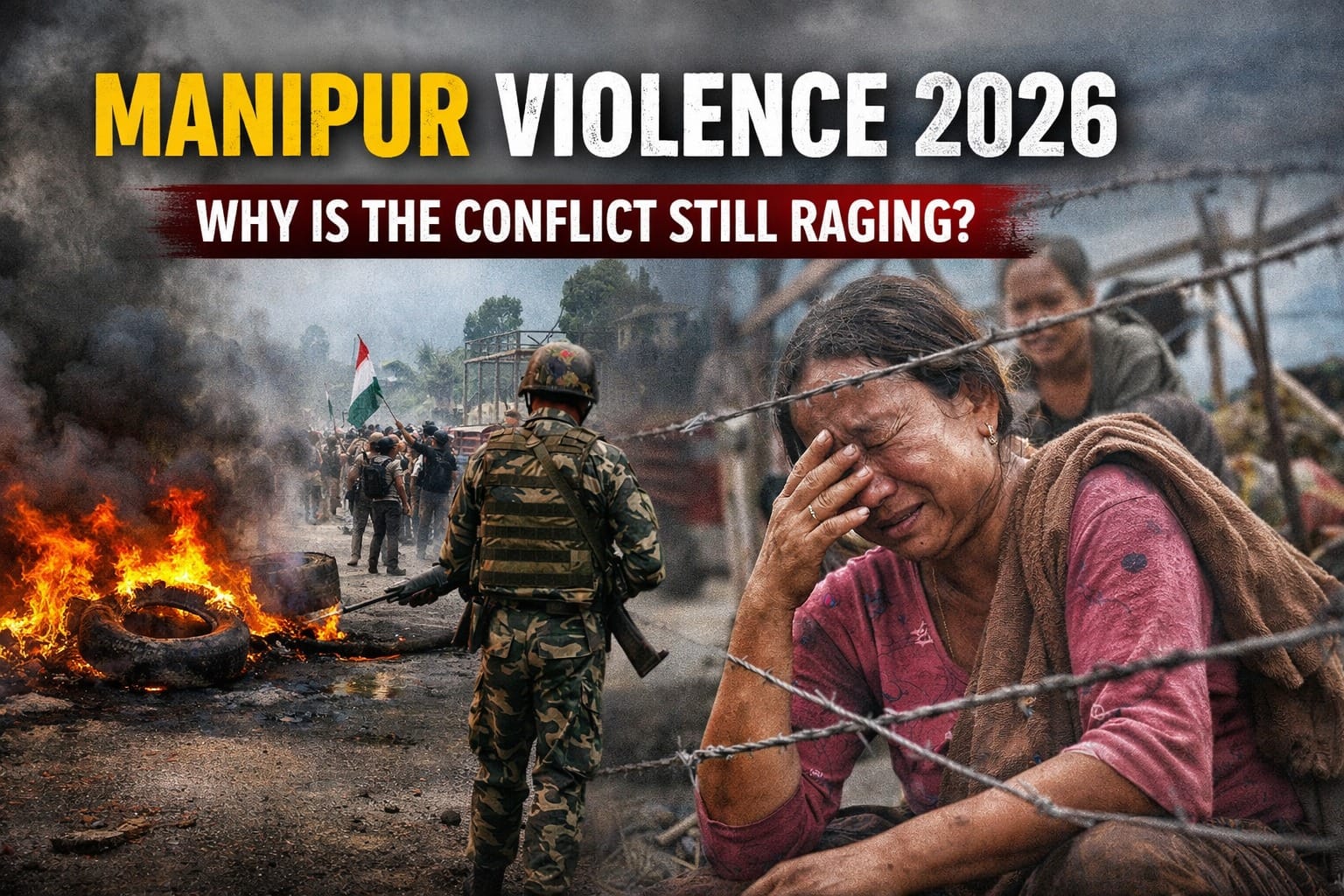
The northeastern state of Manipur is once again witnessing a surge in violence in 2026, raising serious concerns about stability, governance, and long-term peace. What makes this crisis more alarming is that it is not an isolated outbreak — it is a continuation of a deeply rooted ethnic conflict that has been simmering for nearly three years.
This article breaks down the latest Manipur violence using the 5 W’s, and explores the possible outcomes and solutions.
WHAT is happening in Manipur right now?
In April 2026, fresh violence erupted in Manipur’s Bishnupur district, marking a dangerous return of conflict after a brief period of relative calm. A bomb attack killed two children, triggering widespread protests and retaliatory violence.
Following this:
- Protesters clashed with security forces
- Police firing led to additional deaths
- Curfews and internet shutdowns were imposed
- Vehicles were burnt and public property damaged
The death toll has continued to rise, with multiple casualties reported in different incidents.
This is not just another law-and-order issue — it reflects a collapse of fragile peace built over months.
WHO is involved in the conflict?
The Manipur violence is primarily an ethnic conflict between:
1. Meitei Community
- Majority population (~53%)
- Dominates the Imphal Valley
- Mostly Hindu (with some minorities)
2. Kuki-Zo Tribal Communities
- Primarily inhabit hill districts
- Mostly Christian
- Protected under Scheduled Tribe (ST) status
The Core Tension:
The conflict is not just ethnic — it is about:
- Land rights
- Political representation
- Economic benefits
- Identity and security
WHEN did this conflict start?
Although tensions existed for decades, the current phase of violence began on:
May 3, 2023
- Triggered by protests against a High Court recommendation to grant Scheduled Tribe status to Meiteis
This escalated into:
- Full-scale ethnic clashes
- Over 260 deaths
- More than 60,000 displaced people
Since then, the conflict has continued in waves, with 2026 marking a renewed escalation.
WHERE is the violence concentrated?
The conflict is geographically divided:
Valley (Meitei-dominated)
- Imphal
- Bishnupur
Hills (Kuki-Zo dominated)
- Churachandpur
- Kangpokpi
The buffer zones between hills and valley have become highly militarized flashpoints.
The latest violence in Bishnupur is critical because it lies on this sensitive boundary.
Also read – What is driving Global Tech Layoffs: 72000 Employees have lost their job
WHY is Manipur still burning? (Deep Analysis)
This is the most important part — because the violence is not random.
1. Identity Politics & ST Status Conflict
The demand to grant Scheduled Tribe status to Meiteis triggered fear among tribal groups.
Why?
- ST status gives land protection rights
- Tribal groups fear losing land and reservation benefits
This created a zero-sum conflict.
2. Land & Geography Divide
- Meiteis dominate the valley (10% land area)
- Kukis dominate the hills (90% land area)
This imbalance fuels:
- Territorial insecurity
- Migration tensions
- Encroachment fears
3. Militarization & Weapons Looting
Thousands of weapons were looted during the 2023 violence, leading to:
- Armed civilian groups
- Militia-style retaliation
- Increased lethality of conflicts
4. Governance Failure & Trust Deficit
- Allegations of bias by the state government
- Delay in justice and accountability
- President’s Rule imposed in 2025
Even today:
- No clear resolution framework
- Low trust between communities
5. External Factors: Drugs & Border Issues
Manipur lies near the Golden Triangle, making it vulnerable to:
- Drug trafficking
- Illegal arms movement
- Cross-border insurgency
Recent violence linked to drug crackdowns further shows how law enforcement can trigger unrest.
6. Psychological Breakdown of Society
After 3 years:
- Communities live in segregated zones
- Fear has replaced coexistence
- Violence is becoming normalized
WHAT is the current situation?
- Curfews and internet shutdowns continue
- Armed tensions remain high
- Civilians are still vulnerable
- Political dialogue has started but is fragile
The biggest issue:
Peace exists only on the surface — conflict remains unresolved underneath.
WHAT could happen next? (Possible Outcomes)
Scenario 1: Prolonged Low-Intensity Conflict (Most Likely)
- Sporadic violence continues
- Segregation becomes permanent
- Economic damage worsens
Scenario 2: Full Escalation
- Larger militant involvement
- Cross-border implications
- National security threat
Scenario 3: Political Settlement (Best Case)
- Negotiated peace
- Constitutional adjustments
- Rehabilitation of displaced people
WHAT is the solution? (Realistic, Not Idealistic)
There is no quick fix. But these are necessary steps:
1. Political Dialogue (Non-Negotiable)
Even the Chief Minister acknowledged:
Dialogue is the only option
Without:
- Meitei–Kuki talks
- Central mediation
There is no path to peace.
2. Disarmament & Security Control
- Recover looted weapons
- Neutralize militant groups
- Strengthen neutral security forces
3. Land & Identity Framework
- Clear legal framework on:
- Land ownership
- ST status
- Resource sharing
This is the core issue — must be resolved structurally.
4. Rehabilitation of Displaced People
- Over 60,000 people still displaced
- Need safe return policies
- Rebuild homes and livelihoods
5. Justice & Accountability
- Fast-track courts
- Punish perpetrators
- Restore trust in governance
6. Economic & Social Integration
- Jobs
- Infrastructure
- Community programs
Peace is not just political — it’s economic stability + social healing.
Conclusion: Manipur is Not Just a State Issue — It’s a National Test
The Manipur violence is not just about two communities — it is about:
- Governance
- Identity politics
- Federal response
- National unity
After three years of unrest, the biggest risk is not violence —
it is the normalization of violence.
If unresolved, Manipur could become:
- A long-term conflict zone
- A security vulnerability
- A humanitarian crisis
But if addressed properly, it can also become:
- A model of conflict resolution in India
Subscribe to our YouTube Channel The Logic Stick for more video insights