







Introduction
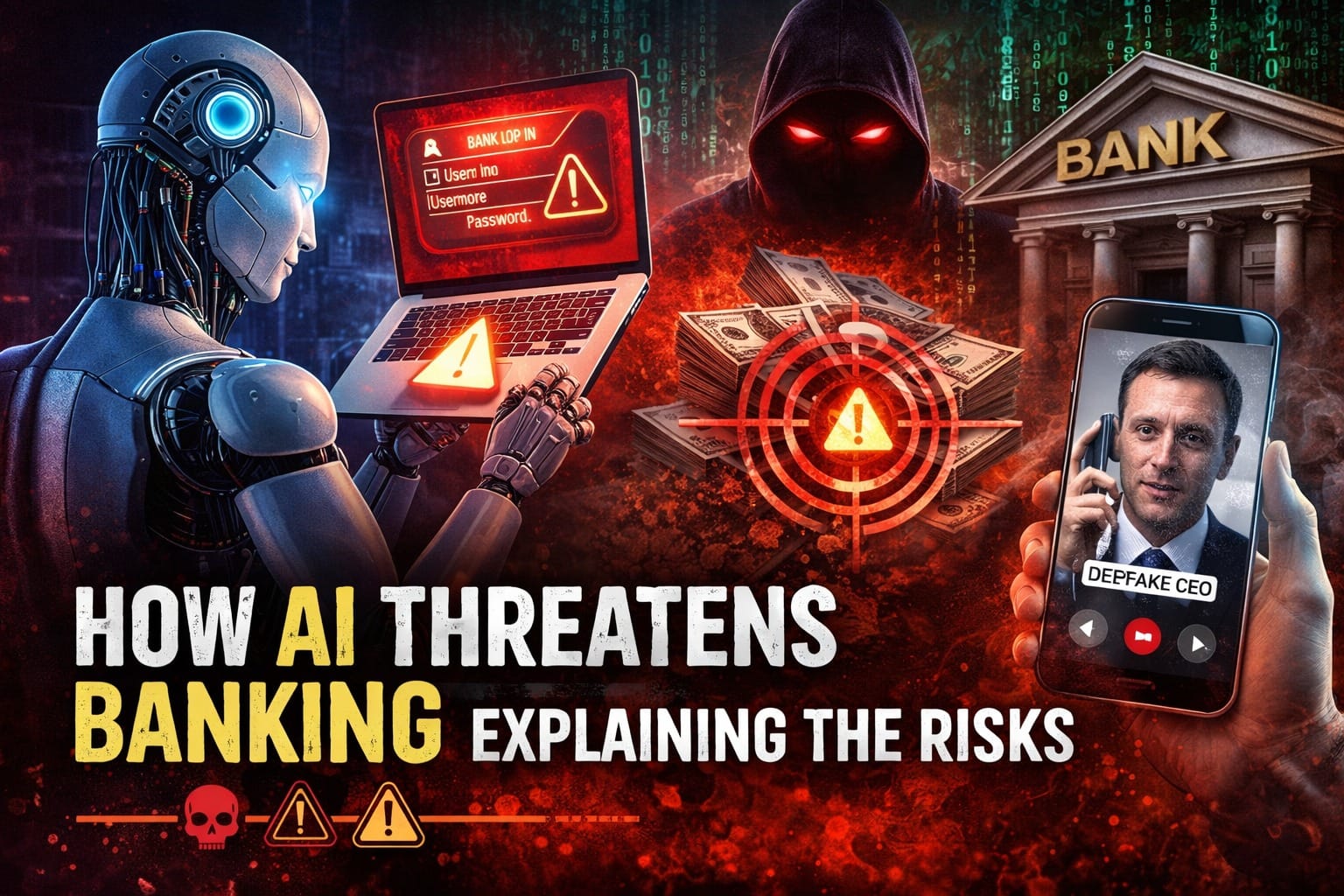
Artificial Intelligence (AI) is transforming the banking industry at a rapid pace. From fraud detection to customer service chatbots, banks are heavily investing in AI. However, the same powerful technology is also creating serious risks for financial systems.
The growing concern is that AI models can be misused by criminals, hackers, or even insiders, potentially threatening the stability, security, and trust of banks.
In this article, we break down how AI can threaten banking in simple terms, covering real risks like fraud, deepfakes, cyberattacks, and systemic instability.
What Does “AI Threat to Banking” Actually Mean?
AI threat to banking simply means:
Using artificial intelligence in a way that can hack, manipulate, steal, or destabilize financial systems.
AI is not dangerous by itself — the risk comes from how people use it.
1. AI-Powered Fraud: Smarter, Faster, Harder to Detect
What is happening?
Earlier, fraudsters used basic tricks like phishing emails. Now, AI allows them to:
- Generate realistic fake emails
- Mimic writing styles of bank officials
- Automate scams at scale
Example:
A scammer can use AI to send thousands of personalized emails that look exactly like your bank.
Why it’s dangerous:
- Harder to detect than traditional scams
- Can target millions at once
- Banks struggle to keep up
2. Deepfake Voice & Video Scams (The Biggest Threat Right Now)
What is happening?
AI can now clone voices and faces.
Example:
- A fraudster clones a CEO’s voice
- Calls the bank or employee
- Requests urgent transfer of money
This has already happened globally.
Why it’s dangerous:
- Voice = trust
- Humans are easy to manipulate
- Even trained employees can get fooled
3. AI Can Break Security Systems
What is happening?
AI can be used to:
- Crack passwords faster
- Predict security patterns
- Bypass authentication systems
Example:
AI tools can guess passwords by analyzing patterns much faster than humans.
Why it’s dangerous:
- Traditional cybersecurity becomes outdated
- Hackers become more powerful
- Banks need constant upgrades
Also read – Smart Investor Strategy When Stock Market Crashes
4. Automated Cyber Attacks at Scale
What is happening?
AI allows hackers to automate attacks like:
- Phishing
- Malware attacks
- Network intrusion
Example:
Instead of manually hacking one bank, AI can attack hundreds simultaneously.
Why it’s dangerous:
- Speed increases drastically
- Attacks become continuous
- Banks cannot respond quickly enough
5. Manipulation of Financial Markets
What is happening?
AI can analyze markets and also manipulate them.
Example:
- Fake news generated by AI
- Spread online to influence stock prices
- Automated trading bots react instantly
Why it’s dangerous:
- Markets can crash quickly
- Fake information spreads faster than truth
- Retail investors suffer the most
6. AI Models Themselves Can Be Attacked
What is happening?
Banks use AI for:
- Credit scoring
- Fraud detection
- Risk analysis
But these AI systems can be hacked or manipulated.
Example:
- Feeding false data to AI
- AI starts giving wrong decisions
Why it’s dangerous:
- Wrong loans approved
- Fraud not detected
- Financial losses increase
7. Insider Threats Become More Powerful
What is happening?
Employees inside banks can misuse AI tools.
Example:
- Use AI to extract sensitive customer data
- Automate internal fraud
Why it’s dangerous:
- Harder to detect
- Insider already has access
- Damage can be massive
8. Loss of Human Control
What is happening?
Banks are relying more on AI for decisions.
Example:
- AI decides loan approvals
- AI monitors transactions
Risk:
If AI makes a mistake:
- Thousands of wrong decisions happen instantly
Why it’s dangerous:
- No human check
- Errors scale quickly
- Trust in banking decreases
9. Systemic Risk: One Failure Can Impact the Entire System
What is happening?
Many banks use similar AI models.
Example:
If one model fails or gets manipulated:
- Multiple banks can be affected at once
Why it’s dangerous:
- Financial system becomes fragile
- Risk spreads quickly
- Could trigger larger economic issues
10. Data Privacy Risks
What is happening?
AI needs huge data to work.
Banks store:
- Personal data
- Financial history
- Identity information
Risk:
If AI systems are breached:
- Massive data leaks happen
Why it’s dangerous:
- Identity theft
- Financial fraud
- Loss of customer trust
Why This Matters More Than Ever
The combination of:
- AI + Money + Data
creates one of the most sensitive risk zones in the world.
Banking is built on trust.
AI threats directly attack that trust.
How Banks Are Trying to Protect Themselves
Banks are not sitting idle. They are:
1. Using AI Against AI
- Detect fraud using advanced models
2. Multi-Factor Authentication
- Beyond passwords (OTP, biometrics)
3. Employee Training
- Detect deepfake scams
4. Stronger Regulations
- Governments creating AI guidelines
5. Human + AI Hybrid Systems
- Keeping humans in the loop
The Future: Threat or Opportunity?
AI is both:
- A tool for growth
- A weapon if misused
The real challenge is:
“Can banks stay ahead of criminals using the same technology?”
Conclusion
AI is revolutionizing banking, but it is also introducing new-age risks that are faster, smarter, and harder to detect.
From deepfake scams to automated cyberattacks, the threat landscape is evolving rapidly.
The future of banking will depend on one key factor:
How well we control AI before it controls the system.
Subscribe to our YouTube Channel The Logic Stick for more video insights