






The hysterectomy crisis in Beed district is not a medical story. It is a labour rights story, a caste story, and an indictment of a system that treats women’s bodies as a problem to be solved.
Women in Maharashtra Are Removing Their Uteruses Before Harvest Season
What Is Happening in Beed District?
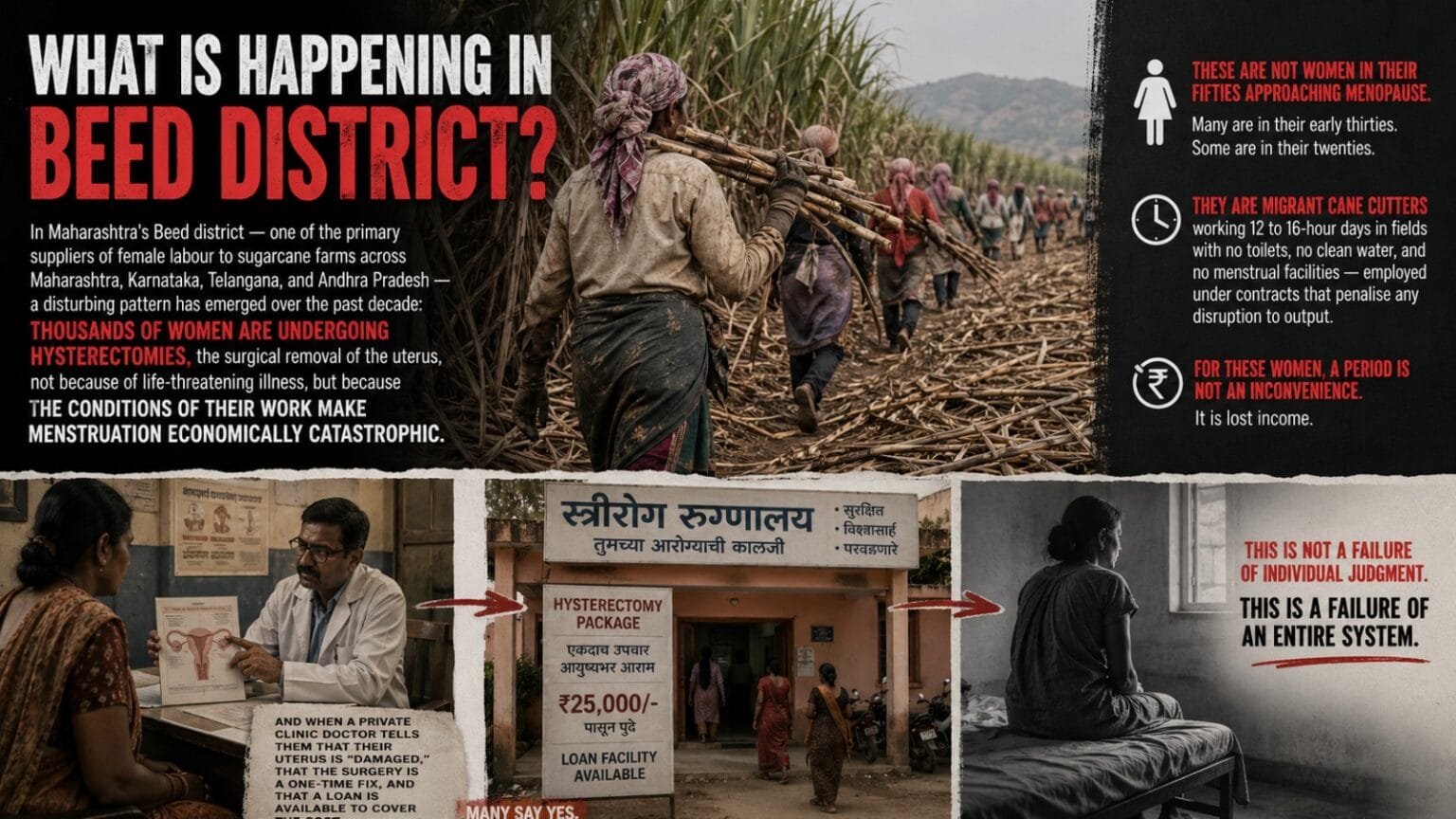
In Maharashtra’s Beed district — one of the primary suppliers of female labour to sugarcane farms across Maharashtra, Karnataka, Telangana, and Andhra Pradesh — a disturbing pattern has emerged over the past decade: thousands of women are undergoing hysterectomies, the surgical removal of the uterus, not because of life-threatening illness, but because the conditions of their work make menstruation economically catastrophic.
These are not women in their fifties approaching menopause. Many are in their early thirties. Some are in their twenties. They are migrant cane cutters working 12 to 16-hour days in fields with no toilets, no clean water, and no menstrual facilities — employed under contracts that penalise any disruption to output.
For these women, a period is not an inconvenience. It is lost income. And when a private clinic doctor tells them that their uterus is “damaged,” that the surgery is a one-time fix, and that a loan is available to cover the cost — many say yes.
This is not a failure of individual judgment. This is a failure of an entire system.
02 — The Architecture
How the Sugarcane Labour System Works
To understand why thousands of women have submitted to permanent, irreversible surgery, you first need to understand the economic architecture of Maharashtra’s sugarcane industry — because the surgery is a product of that architecture.
Maharashtra is home to roughly one-third of India’s 506 sugar factories. Each harvest season, approximately 1.75 lakh (175,000) workers migrate from Beed alone to cut cane across multiple states, including around 78,000 women. These labourers form the backbone of an industry that supplies sugar to companies including Coca-Cola and PepsiCo — both of which have confirmed they source sugar from Maharashtra.
The labour system operates through middlemen known as mukadams (also referred to as contractors), who hire husband-and-wife pairs — called jodis — to work together. Workers are not paid by the hour, or even by the day. They are paid based on the combined output of the pair — typically calculated per tonne of cane cut and loaded, roughly 2–3 tonnes expected per day.
If one partner cannot work, the pair earns less. A woman managing pain, heavy bleeding, or menstruation in a field with no bathroom facilities — using cloth soaked in pesticide residue to manage her period — is a pair falling behind quota. Contractors can refuse sick pay entirely and demand financial penalties for missed work.
Contractors cutting one- or two-days’ wage for missing work causes women to feel they have no choice but to have their wombs removed so their periods or pregnancy don’t prevent them from working.Ritu Bharadwaj, Principal Researcher, IIED
One woman worker described the sanitation conditions plainly: “I have worked in Maharashtra and Karnataka but I have not once seen a toilet or bathroom for women. Men can walk to the nearest pond and bathe. What do we do? Early in the morning, when it is still dark, we walk into dense sugarcane fields.”
Within this system, the pressure to eliminate menstruation — permanently — begins to feel rational. That is the architecture of coercion.
03 — The Data
The Numbers Behind the Crisis
17% of women workers surveyed in 2019 had undergone hysterectomy
36% rate in a targeted sample of 200 cane-cutting women
3.2% national average hysterectomy rate across India
The 2019 Government Report
In 2019, a formal inquiry led by Dr Neelam Gorhe, deputy chairperson of the Maharashtra Legislative Council, was commissioned after advocacy groups began raising alarms about the rising rate of hysterectomies among cane workers. Out of 82,309 women sugarcane workers surveyed in Beed district, 13,861 — nearly 17% — had undergone hysterectomies. Maharashtra’s state average is 2.6%. Beed’s rate among migrant cane workers was more than five times the state average — and in some samples, more than ten times.
These are not marginal differences. These are numbers that point to something systemic.
What Has Happened Since
The 2019 figures are now years old. The system has not fundamentally changed. In late 2024, an official health department screening conducted prior to the sugarcane migration season found that 843 women from Beed had undergone hysterectomies before the season began. Most were aged between 30 and 35. Of these, 477 reportedly underwent surgery at private clinics, with some receiving approvals from government doctors — raising serious questions about institutional complicity.
The same screening also found that 1,523 women were pregnant while working in the sugarcane fields — a figure that underlines the impossible choices these workers face: work while pregnant, or lose income entirely.
13,000 is not the scale of the problem today. It is a baseline from the past. The real number is almost certainly far higher — and we simply are not counting.
04 — The Mechanism
How Women Are Being Pushed Into Surgery
No one forces these women into the operating room at gunpoint. The coercion is structural, economic, and medical — and it works in stages.
1
The Physical Reality
Heavy menstrual bleeding, pelvic pain, infections, and reproductive health problems are common among women doing extreme physical labour in conditions without sanitation. Carrying tonnes of cane in pesticide-soaked fields for 12–16 hours a day creates chronic physical stress that compounds over seasons.
2
The Financial Pressure
In the pair-wage system, any disruption to the woman’s ability to work directly reduces the couple’s income. In communities already pushed to the financial edge by drought and debt, missing even two or three workdays a month can tip a family further into arrears.
3
The Medical Encounter
When a woman seeks help at one of the roughly 120 private clinics in Beed district, the advice she frequently receives — according to multiple investigations and survivor testimonies — is not conservative care. It is surgery. Women report being told their uterus was “damaged,” that it might lead to kidney damage or cancer if left intact, and that hysterectomy was the only solution. One woman said: “I didn’t know what a uterus was — only that it had to be taken out.”
4
The Loan
Contractors offer loans to cover the surgery cost — typically ₹30,000 or more. This debt is added to the worker’s existing advance, creating a new financial obligation that binds the woman more tightly to the contractor and the fields.
5
The Return to Work
After surgery, women are expected to return to work quickly. There is no mandated recovery period. No compensation. No follow-up care. The surgery was not a path to rest — it was a path to continued labour, just without the monthly disruption. One woman reflected: “I just went back to work, because the debt had to be paid and no one rested in the fields.”
When Consent Isn’t Really Consent
Consent, in a legal and ethical sense, requires that a person understands what they are agreeing to, is not under coercive pressure, and has genuine alternatives. In the context of Beed’s sugarcane belt, none of these conditions consistently hold. Women often do not understand the long-term consequences. The financial pressure constitutes coercion. And because menstrual leave is not protected, and sick pay is not guaranteed, there is no real alternative.
This is what researchers and activists mean when they use the term economic coercion: the conditions created by a labour system make an irreversible surgical procedure feel like the rational choice. The body becomes negotiable because survival demands it.
05 — Medical Evidence
The Medical Consequences Nobody Warns Them About
A hysterectomy is not a minor procedure. It is a major, irreversible surgery with consequences that compound over decades — particularly for women who undergo it in their thirties or younger.
Cardiovascular Risk
Heart Disease & Coronary Artery Disease
Mayo Clinic researchers found that hysterectomy — even with both ovaries preserved — significantly increases cardiovascular and metabolic risk. For women under 35, the findings are severe.
4.6× increased risk of congestive heart failure (under age 35) · 2.5× increased risk of coronary artery disease
Bone Health Risk
Osteoporosis & Vertebral Fracture
Multiple large-scale peer-reviewed studies confirm significantly elevated osteoporosis and fracture risk post-hysterectomy. A PLOS One study tracking 9,189 hysterectomised women found a striking result.
2.26× higher risk of osteoporosis or bone fracture · 4.92× higher risk of vertebral fracture
Hormonal Impact
Early Menopause & Ovarian Failure
Even without ovary removal, hysterectomy disrupts blood supply to the ovaries, accelerating hormonal decline. Studies show an almost twofold increased risk of early ovarian failure versus non-hysterectomised women.
1.92× increased risk of early ovarian failure within 4 years of surgery (Prospective Research on Ovarian Function Study)
Mental Health
Depression, Anxiety & Cognitive Risk
A Mayo Clinic cohort study of nearly 2,100 women found hysterectomy is associated with increased long-term risk of depression and anxiety. Emerging research also links surgery before natural menopause to elevated dementia risk.
Increased risk of depression, anxiety, and potential cognitive decline — documented in peer-reviewed cohort studies
The women of Beed undergo these surgeries in their early thirties. They will live for potentially five more decades with the consequences. They cut cane to survive poverty now. They will manage heart disease, brittle bones, and hormonal disruption for the rest of their lives — still in poverty, now also in chronic illness.
The surgery does not solve their financial problem. It defers their physical collapse while giving contractors uninterrupted labour in the short term.
06 — Climate Dimension
The Role of Climate Change
This crisis has a dimension that has only recently been fully documented: climate change is one of its accelerants. Research published by the International Institute for Environment and Development (IIED) in 2024 drew a direct line between worsening droughts in Beed and the decision to migrate for sugarcane work — and therefore, to face the conditions that lead to hysterectomies.
Beed has historically been drought-prone. But IIED analysis found that during the 30 years to 2011, the district experienced rainfall deficits once every five years. In the decade ending in 2022, that number doubled. More frequent, more severe droughts are decimating subsistence farming in the region, pushing more and more families off their land and into seasonal migration.
IIED Research Finding — 423 Households Surveyed in Beed
Migration into the sugarcane system — driven by climate-induced drought — is not just an economic hardship. It is a direct health risk. Women who migrate for cane work face hysterectomy rates more than three times higher than those who stay.
55.7%Hysterectomy rate among women who migrated for cane work
17.1%Hysterectomy rate among women who stayed in Beed
2×Increase in drought frequency in Beed over the last decade
“Hysterectomies are a symptom of economic distress in the region that is exacerbated by the climate crisis,” said Bharadwaj of IIED. The hysterectomy crisis in Beed is, in part, a climate crisis made visible in women’s bodies.
07 — Accountability
Who Is Profiting — And Who Is Accountable?
Actor 01The Contractors (Mukadams)
Mukadams benefit from a workforce that never takes sick days. The pair-wage system, with its financial penalties for absence, creates pressure that contractors actively exploit. By offering loans to fund surgery, they simultaneously increase their labour force’s reliability and deepen the debt bondage that keeps workers tied to them across seasons.
Actor 02Private Clinics
Beed district has approximately 120 private hospitals. Advocates and investigators have raised serious concerns that a significant number of these institutions rely heavily on hysterectomy revenue — charging fees that, relative to the income of migrant workers, are substantial. One regulatory measure — requiring civil surgeons to approve hysterectomies — was introduced after 2019. But women simply began travelling to private hospitals in adjacent districts to circumvent it. The regulation treated a symptom; it did not touch the cause.
Actor 03Sugar Companies — Coca-Cola & PepsiCo
Maharashtra’s sugar reaches global supply chains. Both Coca-Cola and PepsiCo have confirmed they purchase sugar sourced from Maharashtra. Following a New York Times investigation in 2024, Coca-Cola stated it was “deeply troubled” by the hysterectomy crisis and committed to investigating further. Women and advocates say the problem has continued regardless. Each link in the supply chain points to another, and no single actor bears direct accountability.
Actor 04The State
The Maharashtra government has not been entirely passive — mandatory reproductive health checkups, health cards, and Women Health Action Groups in over 1,100 villages are among the measures introduced since 2019. A 2024 health screening covered 46,231 women prior to migration. But the fundamental architecture — no guaranteed sick pay, no menstrual protection in labour law, no cap on contractor-provided debt — remains unchanged.
08 — Structural Context
Caste, Gender, and Silence
This is not simply a labour story. It is a caste story. A significant proportion of the women undergoing these procedures are Dalit-Bahujan women — at the intersection of caste marginalisation, gender discrimination, and economic precarity. These are not three separate burdens. They are interlocking systems that compound one another.
Child marriage adds another layer. According to the National Family Health Survey, over 23% of women aged 20–24 in India were married before 18. In Maharashtra’s seasonal worker communities, marriage before 15 is not uncommon — and girls are pushed into early marriage partly because working as a jodi pays more than a man working alone. The sugarcane system thus incentivises child marriage as a productivity strategy.
The community’s role in maintaining silence is significant. Women who have undergone hysterectomies often describe being unable to speak openly about their experience. Menstruation and reproductive health are treated as shameful in many of these communities. “Unproductive” women carry stigma that discourages disclosure or complaint.
What is happening in Beed is a violent coordination — where caste, labour, and gender intersect to extract maximum value from the most marginalised bodies, while evading any accountability.Countercurrents Analysis, July 2025
Also read – 10 of the Oldest Religions in the World
09 — Policy
What Policy Has — and Has Not — Done
The Maharashtra government’s 2019 report made specific recommendations, including mandatory health check-ups, regulation of hysterectomy procedures, and health camps for migrant workers. Some of these measures have been implemented, at least partially.
But as IIED researchers observed, the action taken “did not stop hysterectomies because it was only trying to treat the symptom, not the root cause.”
The root cause is a labour system that pays workers based on combined output, making individual illness financially punishing; offers no statutory sick leave or menstrual leave; enables contractors to penalise absence and offer debt as a solution; operates largely outside formal employment protections; is supplied by a medical ecosystem in which private clinics profit from unnecessary procedures; and exists within communities where reproductive health is not discussed openly and women have little access to second opinions or independent medical advice.
Regulating hysterectomies without addressing these conditions is like treating a wound while leaving the blade in place.
10 — Solutions
What Needs to Change
Addressing the hysterectomy crisis in Maharashtra’s sugarcane belt requires action at multiple levels simultaneously. The following are the minimum interventions identified by researchers, advocates, and the IIED as necessary:
- 01Wage ProtectionStatutory sick leave that covers menstrual health and pregnancy, independent of the pair-wage system. Women must not face financial penalties for biological processes.
- 02Labour Law EnforcementThe pair-wage (jodi) system must be examined for its coercive effects. Workers need access to formal grievance mechanisms and protection from contractor-imposed penalties.
- 03Medical OversightPrivate clinics performing hysterectomies on women below 40 must face rigorous, independent review. Informed consent protocols must be enforced. Approval chains that include the same government doctors embedded in a compromised system must be reformed.
- 04Corporate AccountabilitySugar companies that benefit from this labour system cannot outsource ethical responsibility. Supply chain accountability must include enforceable labour standards with transparent monitoring — not just statements of being “deeply troubled.”
- 05Community Health InfrastructureAccess to menstrual hygiene products, clean water, toilets, and reproductive healthcare in migrant worker settlements is not optional. It is a baseline that has not been met for decades.
- 06Climate Adaptation FundingThe IIED has recommended the global loss and damage fund be used to strengthen social protection programmes in drought-prone regions like Beed — reducing the economic desperation that drives migration into exploitative labour.
11 — Data
Key Facts at a Glance
| Metric | Figure |
|---|---|
| Women surveyed in 2019 government inquiry | 82,309 |
| Women found to have undergone hysterectomy (2019) | 13,861 (17%) |
| Hysterectomy rate in targeted sample of 200 cane-cutting women | 36% |
| National average hysterectomy rate (India) | 3.2% |
| Maharashtra state average hysterectomy rate | 2.6% |
| Women who underwent hysterectomy pre-season (late 2024) | 843 |
| Age range of most 2024 cases | 30–35 years |
| Women found pregnant while working in cane fields (2024) | 1,523 |
| Annual migrant workers from Beed (approx.) | 175,000 |
| Women among annual Beed migrants | ~78,000 |
| Hysterectomy rate — Beed women who migrated (IIED survey) | 55.73% |
| Hysterectomy rate — Beed women who did not migrate (IIED) | 17.06% |
| Increased risk of coronary artery disease (hysterectomy under 35) | 2.5× |
| Increased risk of congestive heart failure (hysterectomy under 35) | 4.6× |
| Increased osteoporosis risk (hysterectomy, ages 40–44) | 1.84× |
| Increased vertebral fracture risk post-hysterectomy | 4.92× |
12 — FAQ
Frequently Asked Questions
Is the hysterectomy crisis in Beed still ongoing?
Yes. The most recent health department data, from late 2024, confirmed 843 women underwent hysterectomies in a single pre-migration window. Advocates confirm the conditions driving the crisis have not fundamentally changed. The 2024 figure of 843 cases in one season alone illustrates that the cumulative total far exceeds the widely cited 13,000 figure from the 2019 inquiry.
Are these hysterectomies medically necessary?
The overwhelming consensus among researchers, government inquiry findings, and advocates is that the vast majority are not medically necessary. They are driven by labour conditions, financial coercion, and misinformation from private clinics — not by genuine medical diagnosis.
What is a hysterectomy and why is it serious for young women?
A hysterectomy is the surgical removal of the uterus. It is an irreversible procedure. Even when performed on women who retain their ovaries, peer-reviewed research — including studies from Mayo Clinic, the American Journal of Obstetrics & Gynecology, and PLOS One — confirms dramatically increased long-term risk of cardiovascular disease, osteoporosis, early onset menopause, and mental health conditions. The risks are severest for women under 35.
Which companies are connected to this supply chain?
Both Coca-Cola and PepsiCo have confirmed they purchase sugar from Maharashtra. Following New York Times reporting in 2024, Coca-Cola said it was “deeply troubled” and would investigate. Women and advocates say the problem persists, and no structural change to supply chain accountability has been made public.
What has the Maharashtra government actually done?
Following the 2019 inquiry, the government introduced mandatory pre-migration health checkups, health cards for migrant workers, and Women Health Action Groups in over 1,100 villages. A 2024 screening covered 46,231 women. However, researchers and advocates consistently state these measures do not address the structural causes — the pair-wage system, absence of menstrual leave, debt bondage through contractor loans, and lack of private clinic oversight.
Can this crisis actually be fixed?
Yes — but not by regulating hysterectomies alone. Fixing it requires statutory sick leave for menstrual health, reformed labour contracts that do not penalise individual absence, genuine corporate supply chain accountability, investment in sanitation for migrant workers, and climate adaptation funding for drought-affected communities like Beed. Every element of the solution requires political will that has, so far, not materialised at the necessary scale.
Sources & References
British Safety Council India (2025)
PLOS One — Hysterectomy & Bone Fracture Study
IIED — Women Paying the Cost of Climate Crisis
American Journal of Obstetrics & Gynecology
Context / Thomson Reuters Foundation (2024)
Osteoporosis International (Springer Nature)
More to Her Story — Investigative Report
European Journal of Endocrinology
Countercurrents — Caste, Gender & Exploitation (2025)
Mayo Clinic News Network
Free Press Journal — Beed Health Data (2025)
Maharashtra Government Inquiry Report (2019)
The Guardian, New York Times, Indian Express
Oxfam India — Field Conditions Report
This article is not paid, sponsored, or affiliated with any organisation. All data has been independently verified against primary sources. Not a medical advice publication.
Subscribe to our YouTube Channel The Logic Stick for more video insights