







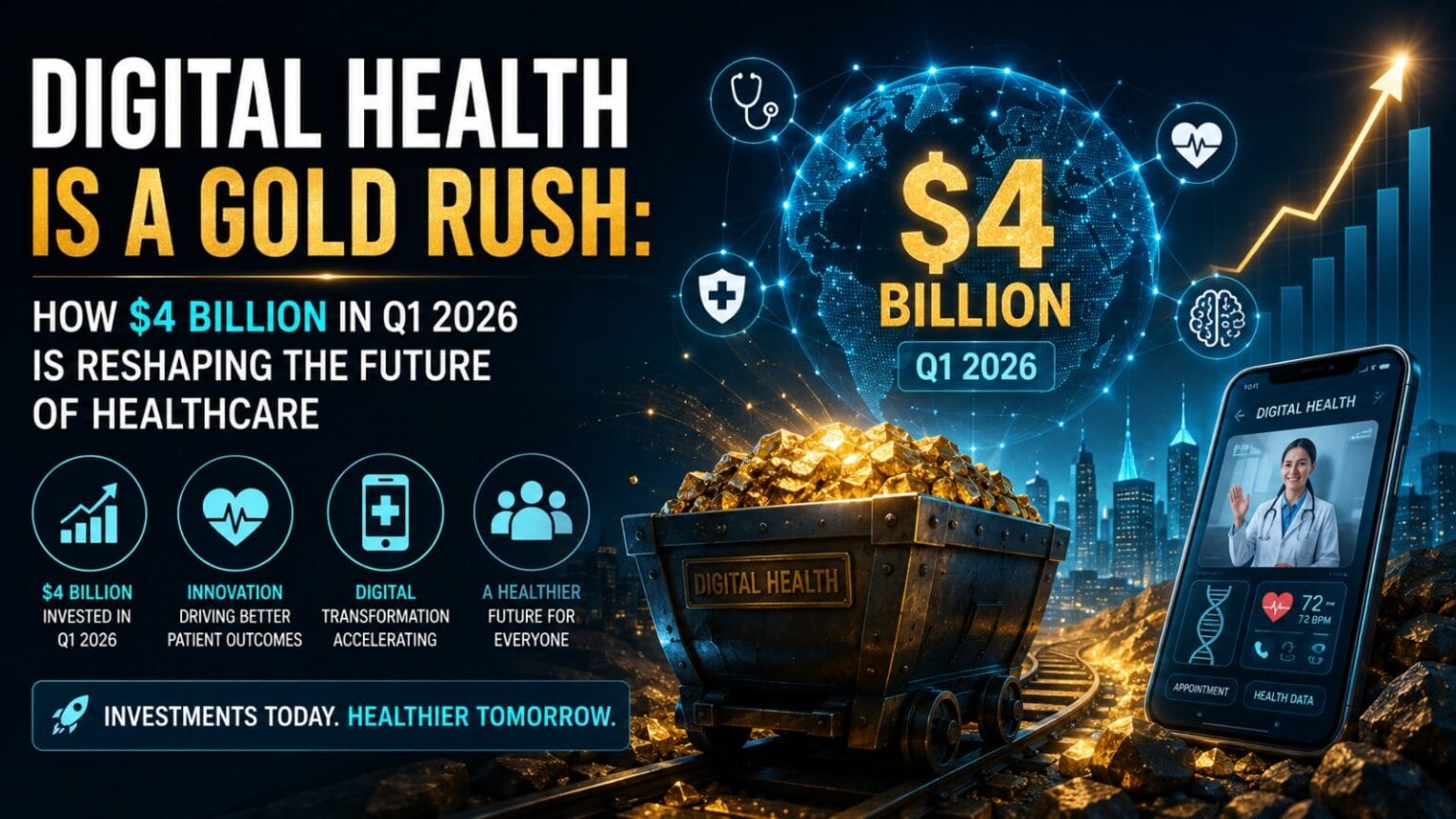
The digital health sector is booming — and the numbers don’t lie. In the first quarter of 2026 alone, digital health startups raised $4 billion in venture capital funding, marking the strongest Q1 since the pandemic peak. If you’ve been watching the intersection of technology and healthcare, you already know this space is exploding. But what’s really driving this surge, where is the money going, and what does it mean for the future of healthcare, investors, and everyday patients? Let’s break it all down.
What Just Happened: The Q1 2026 Digital Health Funding Snapshot
According to Rock Health’s Q1 2026 funding recap, digital health startups raised $4 billion across 110 deals between January and March 2026 — a $1 billion increase compared to the same quarter last year, when companies had raised $3 billion across 122 deals.
That’s not just a bigger number. It’s a fundamentally different market dynamic.
While the total number of deals actually dropped by 10% year-over-year, the average deal size climbed to $36.7 million — the highest average Rock Health has tracked in a single quarter since Q4 2021. In simple terms: fewer companies are raising money, but the ones that are raising are raising a lot more.
The most striking data point? Just 12 companies captured 59% of all capital deployed in the quarter — one of the highest funding concentrations Rock Health has ever recorded. These were all deals worth $100 million or more, a category now being called “mega-deals.”
Also read – The Rise of FD Rates in India
The Mega-Deals Driving the Market
The Q1 2026 mega-deal list reads like a who’s who of health tech:
Whoop — the wearable fitness and health tracker — raised a staggering $575 million Series G round, valuing the company at $10.1 billion as it reportedly eyes an IPO. OpenEvidence, an AI-backed medical information platform, closed a $250 million Series D — its third major round in under a year. Verily, Alphabet’s precision health company, pulled in $300 million in a late-stage round. Talkiatry, an online psychiatry platform, raised $210 million in its Series D.
These aren’t early-stage bets. These are institutional investors placing large, high-conviction wagers on companies that have already proven market fit, clinical value, and — increasingly — AI integration at their core.
If Q1’s mega-deal pace holds throughout 2026, the year would close with nearly 50 mega-deals — almost double last year’s total.
The “Haves and Have-Nots” Problem
Here’s where it gets complicated. While the headline numbers look spectacular, Rock Health is calling this a market of “haves and have-nots.”
The 12 mega-deals captured the lion’s share of capital. Remove those 12 rounds from the total, and the remaining 98 companies split roughly $1.6 billion — a much less glamorous picture. Early-stage digital health startups are finding it significantly harder to raise institutional capital in 2026.
The reason? Investor behavior has shifted dramatically since the 2022 correction. Venture firms are no longer deploying capital across a wide basket of bets. Instead, they are concentrating firepower on companies with contracted revenue, clinical evidence, regulatory experience, and — above all — a clear and defensible AI value proposition. The spray-and-pray era of digital health investing is firmly over.
For founders in the early-stage tier, this creates both a challenge and an opportunity. The competition for smaller rounds is lower, valuations are more rational, and there’s less noise in the market. A $3 million seed round for a clinical workflow automation tool may not make headlines, but it also won’t collapse when the AI narrative inevitably shifts.
AI Is Now Table Stakes — Not a Feature
One of the most significant announcements from Rock Health this quarter was quietly buried in the methodology section of their report: they have officially retired the “AI deal” as a separate tracking category.
Why? Because in 2026, virtually every digital health startup is AI-enabled in some form. The lines between AI and non-AI companies have become too blurred to track meaningfully. Artificial intelligence is no longer a differentiator — it is an expectation.
This has massive implications. It means investors are no longer impressed by AI as a selling point alone. They are now asking harder questions: Does the AI actually improve margins? Does it reduce customer acquisition costs? Does it create switching costs and defensible moats? Does it clear regulatory pathways like FDA 510(k) clearance?
Companies that can answer yes are commanding premium valuations. Those that cannot — even if they have “AI-enabled” in their pitch deck — are struggling to raise.
Consumer AI Enters Healthcare
Another major trend from Q1 2026 is the aggressive entry of consumer AI platforms into the healthcare space. OpenAI and Perplexity both launched healthcare-specific consumer experiences and features that are beginning to function as a new front door to care — bypassing traditional patient portals and hospital websites entirely.
These platforms are connecting to health records via platforms like b.well Connected Health and HealthEx, and pulling in wellness and biometric data through partnerships with wearable companies. The result is a new kind of AI-powered health interface: personalized, longitudinal, and built around the consumer rather than the provider.
For digital health startups, this is both a threat and an opportunity. The same dynamic that turned iOS and Android into duopolies could play out in healthcare AI — with OpenAI and Perplexity becoming the gatekeepers through which millions of patients access digital health tools. Startups that partner strategically with these platforms early could gain enormous reach. Those that ignore the shift may find their distribution channels disrupted.
M&A Activity: Selective but Steady
On the mergers and acquisitions front, Q1 2026 saw 43 digital health deals — a slight uptick from the previous quarter’s 30. Acquihires were a notable theme: OpenAI acquired Torch, and Headway picked up the Tezi team, both moves aimed at bringing specialized health tech talent in-house.
However, not all consolidation went smoothly. New Mountain Capital’s ambitious plan to combine five portfolio companies into a $32 billion AI-focused health tech platform called Thoreau collapsed in March over unresolved concerns about debt structure and governance — a reminder that bigger is not always better in health tech integration.
The public exit window remains narrow. Companies like Hinge Health and Omada Health set a high bar in 2025 by building clear growth trajectories and financial discipline before stepping into the public markets. Most companies waiting in the wings are still watching and waiting for market conditions to stabilize before making their move.
Global Picture: The US Is the Epicentre
While the Rock Health report focuses on US activity, the global picture reinforces America’s dominance in digital health investment. Global digital health venture funding reached $7.1 billion across 216 deals in Q1 2026, with the United States capturing 76% of all global VC capital deployed. The average global deal size surged 83% year-over-year to $38.4 million.
Europe remains active but is being left behind in the mega-deal race. Asia-Pacific markets are growing but remain constrained by regulatory complexity and fragmented payer systems. For global founders and investors looking for the deepest pool of capital and the most mature ecosystem, the US market remains the destination of choice.
What’s Fuelling Digital Health’s Gold Rush?
Several macro forces are converging to drive this boom:
Aging populations. By 2030, one in six people worldwide will be over the age of 60. The demand for scalable, technology-driven healthcare solutions is not a trend — it’s a demographic inevitability.
Healthcare system pressure. Shifting federal priorities, Medicaid funding changes, and rising administrative costs are pushing hospitals and payers to embrace technology-driven efficiency at an unprecedented scale. AI-powered tools that cut costs and improve outcomes are no longer nice-to-haves — they are survival strategies.
Wearable and biometric data. Companies like Whoop are demonstrating that consumers are willing to pay for continuous, real-time health monitoring. The data these devices generate is becoming the foundation for personalized medicine, insurance underwriting, and early disease detection.
GLP-1 and metabolic health. The explosion of GLP-1 medications for weight management and metabolic health is creating downstream demand for digital health tools that support nutrition, behavioral coaching, and medication management for the millions of new patients entering this category.
Precision diagnostics. The US precision diagnostics market was valued at $6.9 billion in 2023 and is projected to reach $21.5 billion by 2030. Digital health companies that sit at the intersection of genomics, microbiome science, and AI-driven diagnostics are among the most exciting investment stories of the decade.
What This Means for You
Whether you are an investor, a healthcare professional, a startup founder, or simply a curious consumer, the digital health gold rush of 2026 carries clear signals:
For investors, the opportunity is real but the bar is rising. Capital is concentrating in companies with proven clinical value, regulatory experience, and genuine AI integration — not just AI buzzwords. The early-stage tier offers rational valuations and less competition for those willing to do the diligence.
For founders, the message is clear: focus on defensibility. Regulatory moats, hospital contracts, and clinical evidence are worth more than a sleek AI demo. Build revenue before chasing a mega-round.
For healthcare professionals, the tools available to you are about to improve dramatically. AI-powered clinical decision support, ambient scribing, and precision diagnostics are moving from experimental to standard of care faster than most institutions are prepared for.
For consumers, personalized health is becoming accessible. Wearables, at-home diagnostics, and AI-powered health interfaces are putting data and insights in your hands that were previously available only in clinical settings.
The Bottom Line
Digital health is not a bubble. It is a structural shift in how the world delivers, accesses, and pays for healthcare. The $4 billion raised in Q1 2026 is not irrational exuberance — it is institutional capital following a clear and compounding opportunity.
The gold rush is real. The question is not whether digital health will transform healthcare. The question is which companies, which technologies, and which investors will define that transformation.
Watch this space closely. The next few quarters will tell us a great deal about which momentum is durable — and which is just temporary.
Sources: Rock Health Q1 2026 Funding Recap | Fierce Healthcare | MedCity News | Healthcare Dive | MedTech Dive | Galen Growth | Angel Investors Network | PYMNTS
Subscribe to our YouTube Channel The Logic Stick for more video insights