






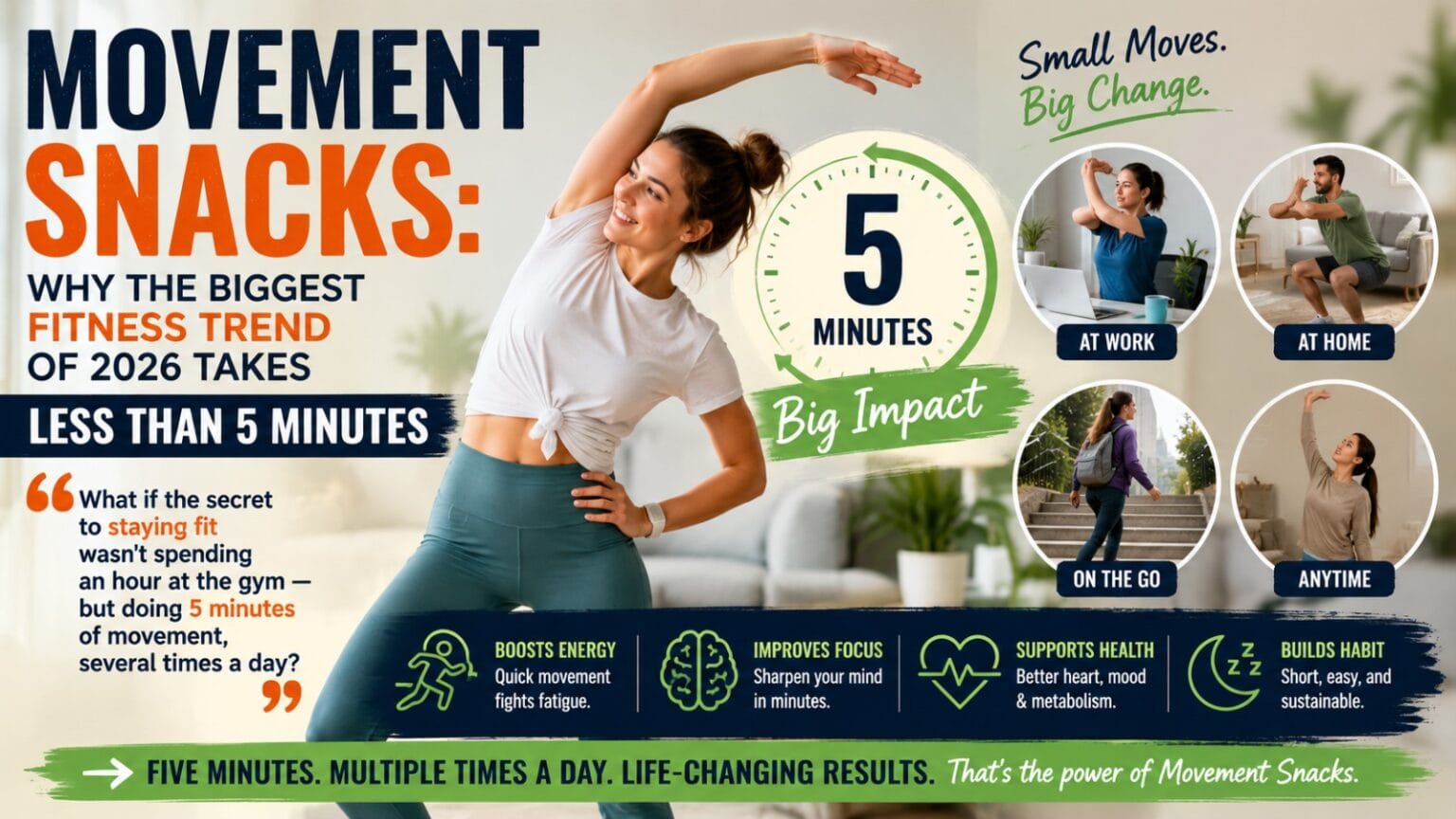
What if the secret to staying fit wasn’t spending an hour at the gym — but doing 5 minutes of movement, several times a day? That’s the idea behind “movement snacks,” the fitness concept that has taken over wellness conversations in 2026 — and the science behind it is more compelling than you might expect.
If you’ve ever felt guilty for skipping the gym, or told yourself you’d “start Monday,” this article is for you. Movement snacks are rewriting the rules of what counts as exercise — and they’re making fitness accessible to people who never thought they had the time.
What Are Movement Snacks?
Movement snacks — also called exercise snacks, micro-workouts, or activity snacks — are short, intentional bursts of physical activity lasting anywhere from 30 seconds to 5 minutes, spread across the day rather than concentrated into a single workout session.
Think: 10 squats before your morning coffee. A brisk walk around the block after lunch. A set of push-ups between meetings. Climbing two flights of stairs instead of taking the lift. That’s it. That’s a movement snack.
The concept is deceptively simple, but the research behind it is anything but.
Why Is This Trending in 2026?
Movement snacks aren’t entirely new — exercise scientists have been studying brief bouts of activity for years. But 2026 is the year the idea crossed from research papers into mainstream culture, and several forces are driving that shift.
We are sitting more than ever. Remote and hybrid work has become the norm for hundreds of millions of people worldwide. The average desk worker now spends 9 to 10 hours per day seated. Research consistently shows that prolonged sitting is associated with poor cardiometabolic health outcomes — even among people who meet the standard weekly exercise guidelines. Sitting for long uninterrupted stretches is harmful in its own right, separate from how much you exercise.
The WHO changed the rules. The World Health Organisation removed the old “10-minute minimum” rule from its global activity guidelines, officially acknowledging that any duration of movement counts toward health benefits. This was a significant moment — it gave scientific legitimacy to the idea that short bouts of activity are genuinely valuable, not just better than nothing.
People are time-poor and overwhelmed. The Global Wellness Summit’s 2026 trends report identified “snack-sized workouts” as one of the defining wellness themes of the year, noting that wellness in 2026 is moving away from extreme protocols and toward approaches that fit real lives. When 50% of people abandon their New Year’s fitness resolutions by the end of January, the problem is not motivation — it is friction. Movement snacks reduce friction to almost zero.
Also read – Digital Health is a Gold Rush in 2026
What Does the Science Actually Say?
This is where it gets genuinely interesting — because the research backing movement snacks is robust and growing rapidly.
A BMJ Sports Medicine meta-analysis found meaningful improvements in cardiorespiratory fitness and muscular endurance from brief bouts of movement performed multiple times daily, with notably high adherence rates compared to traditional workout programmes. The key insight: people actually stick to movement snacks, which makes them more effective in practice even if a single session is less intense than a gym workout.
A study published in the Journal of the American College of Nutrition found that shorter workout bouts delivered measurable cardiovascular benefits — comparable in several markers to longer continuous sessions. Research from 2026 specifically confirmed that exercise snacks boost cardiorespiratory fitness among people who are otherwise inactive — the population that arguably needs it most.
Breaking up sedentary time with short movement bouts has been shown to improve blood sugar control, blood pressure, strength, and cognitive function. A 2025 study found that even brief, repeated movements throughout the day improve plasma metabolomic profiles in sedentary adults — meaning the benefits go all the way down to the cellular and metabolic level.
Perhaps most strikingly, research published in PMC suggests that three 10-minute sessions spread throughout the day can achieve similar effects to a 60-minute traditional workout in terms of metabolic conditioning. That is a paradigm shift for how we think about exercise.
The Benefits of Movement Snacks: A Full Picture
1. Cardiovascular Health Short, repeated bouts of movement keep the heart rate elevated multiple times throughout the day, supporting heart and lung function without requiring a dedicated cardio session.
2. Blood Sugar Regulation Every time you move, your muscles take up glucose from the bloodstream. Spreading movement across the day helps keep blood sugar levels stable — particularly important in a world where metabolic health conditions like insulin resistance and Type 2 diabetes are rising sharply.
3. Joint Health and Mobility Staying sedentary for hours at a time causes joints to stiffen and muscles to shorten. Regular movement snacks keep joints lubricated, improve mobility, and reduce the stiffness that leads to long-term musculoskeletal problems.
4. Mental Health and Energy Multiple studies report that people who practise movement snacking experience boosts in both energy and mood throughout the day. Even a 2-minute walk improves focus and reduces mental fatigue — something that sitting in another hour-long meeting simply cannot do.
5. Metabolism Short, intense bursts of activity — especially those that incorporate resistance or bodyweight exercises — boost metabolism for hours after the activity ends. This effect, known as excess post-exercise oxygen consumption (EPOC), means movement snacks continue working long after you’ve sat back down.
6. Longevity The Global Wellness Summit’s 2026 report notes that strength training and regular movement are increasingly being embraced as tools for longevity — not just aesthetics. Movement snacks complement this shift perfectly, making daily physical activity a natural part of life rather than a scheduled obligation.
What Do Movement Snacks Look Like in Practice?
Here’s the practical reality — this does not require a gym, equipment, or workout clothes. Here are examples of movement snacks you can do right now:
At your desk:
- 10 squats every hour
- 20 calf raises while on a phone call
- A 2-minute stretching routine between tasks
- Standing up and doing shoulder rolls every 30 minutes
Around the house:
- Walk up and down the stairs twice instead of once
- Do a set of push-ups before your morning shower
- 30 seconds of jumping jacks while waiting for the kettle
Outside:
- A 5-minute brisk walk after every meal
- Take the long route to any destination
- Walk to a colleague’s desk instead of sending a message
The research suggests that 2 to 3 short bouts on at least 3 days per week for 4 to 12 weeks — often using stair climbing or bodyweight movements — produces meaningful fitness gains. Starting small and scaling up gradually is the recommended approach.
Movement Snacks vs. Traditional Workouts: Do You Still Need the Gym?
Here is an important nuance that gets lost in the trend coverage: movement snacks are not designed to replace structured training. They complement it.
Sports scientists and registered dietitians are clear that exercise snacking is particularly valuable for sedentary populations — people who currently do very little movement at all. For those individuals, movement snacks can be transformational. For athletes or those with specific performance goals, movement snacks are a useful addition but should not replace progressive strength training or dedicated cardio sessions.
The danger — and it is worth naming — is that people with structured fitness goals abandon evidence-based training for a trendy “hack” without understanding its limitations. Movement snacks are a tool in the toolkit, not the whole toolkit.
That said, for the vast majority of the population — people who sit at desks all day, who struggle to find an hour for the gym, who have tried and failed to maintain workout routines — movement snacks may be the most realistic and sustainable path to meaningful health improvement.
Movement Snacks and the Workplace Wellness Revolution
One of the most exciting applications of the movement snack concept is in workplace wellness — and companies are beginning to take notice.
As remote and hybrid work became the norm, fitness started blending into the workday. Walking pads — compact treadmills that fit under standing desks — have gone from a niche productivity tool to a full-blown workplace wellness trend. The appeal is obvious: log thousands of steps while answering emails or sitting through a Zoom call.
The Global Wellness Summit’s 2026 report even notes that gyms and fitness studios of the future may double as community spaces, and that the “festivalization of wellness” — making movement playful, inclusive, and culturally relevant — is redefining health as something that happens throughout the day, not just during a designated workout window.
For employers, the business case is straightforward: employees who move more throughout the day report better focus, lower stress, and higher energy. A team that takes movement snack breaks is a more productive team.
How to Start: A Simple Movement Snack Routine for Beginners
If you are completely new to this, here is a beginner-friendly structure to build from:
Morning (before work): 10 bodyweight squats + 10 push-ups (or wall push-ups) — 2 minutes
Midmorning (after your first meeting): Walk up and down one flight of stairs twice — 2 minutes
Lunchtime: A 5-minute brisk walk outside — 5 minutes
Afternoon (after a long sitting stretch): 20 calf raises + 10 shoulder rolls + a full body stretch — 3 minutes
Evening (before dinner): A 5-minute walk around the block — 5 minutes
Total time: roughly 17 minutes of movement distributed across the day. That is it. No gym membership required.
The Bottom Line
Movement snacks are not a fitness gimmick. They are a science-backed, barrier-free approach to physical activity that fits the reality of how most people actually live in 2026 — time-pressed, desk-bound, and looking for sustainable solutions rather than extreme protocols.
The research is clear: moving more throughout the day — in whatever increments you can manage — is significantly better for your health than sitting still and waiting for the perfect time to do a full workout. And the WHO has confirmed what exercise scientists have been saying for years: every minute of movement counts.
You do not need an hour. You do not need a gym. You just need to start snacking.
Sources: BMJ Sports Medicine | Journal of the American College of Nutrition | Psychology Today | Global Wellness Summit 2026 Trends Report | PMC / NCBI | Ancient Nutrition | Vital Earth Minerals | NASM Top Fitness Trends 2026 | WHO Global Activity Guidelines
Subscribe to our YouTube Channel The Logic Stick for more video insights