






Complete Timeline of the Gen Z Movement
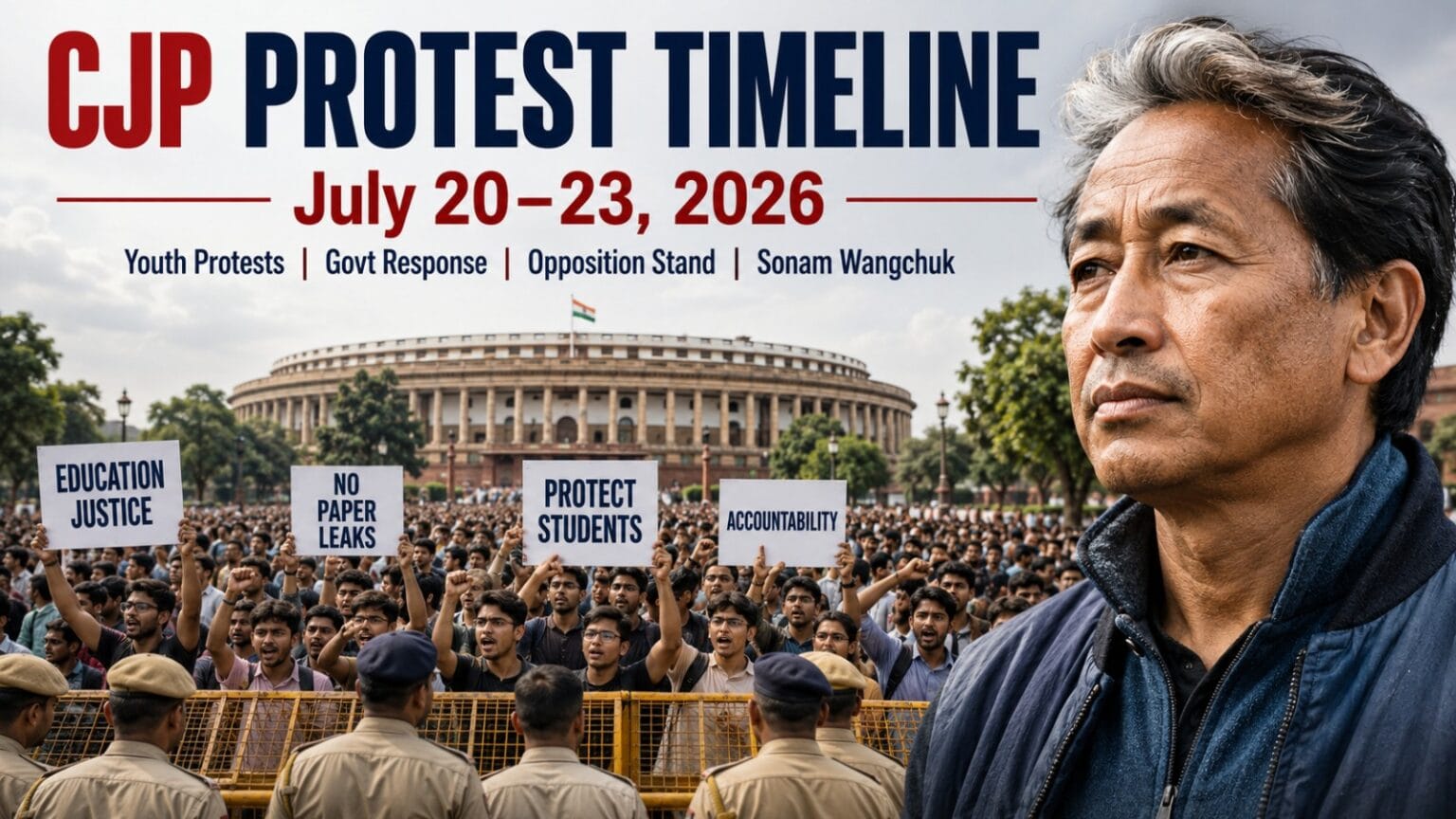
Between July 20 and July 23, 2026, India witnessed one of the most significant youth-led protest escalations in recent years.
What began as anger over alleged examination leaks, irregularities in national-level tests and repeated failures in the education system grew into a wider confrontation involving students, the Cockroach Janta Party, opposition leaders, the Union government and police forces.
At the centre of the movement was a direct demand: Union Education Minister Dharmendra Pradhan should accept political responsibility and resign.
But by July 23, the protest was no longer only about one minister or one examination.
It had expanded into a national debate about accountability, student mental health, police action against protesters, unemployment, competitive examination failures and whether India’s political establishment truly understands the frustrations of its young population.
The movement was primarily organised by the Cockroach Janta Party, commonly known as the CJP—a youth-oriented satirical political movement led by Abhijeet Dipke. The group’s unusual name reportedly emerged from the appropriation of an insulting comparison involving unemployed young people. The movement converted the label “cockroach” into a symbol of young citizens who felt ignored, humiliated and pushed aside by the system.
The protests received additional moral and national attention after environmentalist and education reformer Sonam Wangchuk joined the agitation through an indefinite hunger strike.
This article documents the key events between July 20 and July 23, explains what the protesters demanded, examines the government’s response, and analyses the position taken by the opposition, student organisations and supporters of the ruling party.
PART ONE: WHY THE CJP PROTEST BEGAN
From examination irregularities to a crisis of confidence
The immediate trigger behind the CJP protest was anger over alleged irregularities surrounding competitive examinations, particularly the 2026 NEET controversy and reported problems associated with CBSE’s on-screen marking process.
Also read – Twisha Sharma Case Explaines with Timeline
The National Eligibility-cum-Entrance Test is one of India’s most consequential examinations. A student’s score can determine whether years of preparation, coaching expenses and parental sacrifices result in admission to medical education.
Reports that the examination process may have been compromised therefore created something much larger than an administrative controversy. For affected students, it represented the possible loss of an entire academic year and, in some cases, the collapse of a lifelong ambition.
The protests had reportedly been continuing at Delhi’s Jantar Mantar since June 6, 2026. Demonstrators demanded an investigation into examination failures, reforms in the system used to conduct national tests and accountability from the Union Education Ministry.
The CJP gradually emerged as one of the most visible organisations within this mobilisation.
It was joined or supported at different stages by student groups, activists and individuals linked to organisations such as the Students’ Federation of India, the All India Students’ Association and the All India Students’ Federation. However, the agitation remained broader and less formally structured than a conventional party-led demonstration.
Its energy came primarily from students, examination aspirants, young professionals and social-media users who did not necessarily identify with any established political party.
Why Gen Z connected with the movement
The CJP protest July 2026 movement gained momentum because it spoke in a language familiar to India’s digital generation.
Instead of depending only on conventional press conferences, printed posters or political speeches, organisers used Instagram videos, memes, live streams, short clips and ironic slogans.
This approach made the movement accessible to young people who often avoid traditional political organisations but remain deeply concerned about education, employment and economic security.
The protest reflected several overlapping frustrations:
- Repeated reports of question-paper leaks.
- Delays, cancellations and uncertainty around examinations.
- The rising cost of coaching and education.
- Limited employment opportunities despite high qualifications.
- The emotional and financial pressure placed on aspirants.
- A belief that powerful officials rarely accept responsibility.
- Anger over the government’s initial communication on the examination controversy.
The CJP therefore succeeded in connecting one examination controversy with a broader feeling of generational insecurity.
For many young people, the question was no longer simply, “Was one paper leaked?”
The larger question became, “Can students trust the institutions that decide their future?”
The principal demands of the protesters
Although slogans and demands evolved during the movement, the main points raised by CJP representatives and supporters included:
1. Resignation of Dharmendra Pradhan
The most visible and consistently repeated demand was the resignation of Union Education Minister Dharmendra Pradhan.
Protesters argued that administrative arrests and promises of investigation were not enough. According to them, repeated failures under a ministry should produce political consequences at the highest level.
They maintained that ministerial responsibility does not necessarily require proof that a minister personally participated in wrongdoing. In a parliamentary democracy, they argued, the minister responsible for a department should answer for systemic failures within that department.
2. Transparent investigation into examination leaks
The protesters sought a credible investigation into the alleged NEET paper leak and other examination irregularities.
They demanded that the government identify not only lower-level operators and middlemen but also those who may have protected, funded or benefited from organised examination fraud.
3. Reforms in the conduct of public examinations
The movement called for structural changes to protect future examinations.
These included demands for stronger security systems, transparent evaluation, faster resolution of student complaints, independent oversight and accountability for testing agencies.
4. Compensation and support for affected families
CJP representatives also raised the issue of students who reportedly died by suicide amid examination-related distress.
Protesters sought compensation and government support for bereaved families. Reports differed on the exact number of deaths attributed by organisers to the controversy, and the causal connection between individual deaths and examination irregularities required case-specific verification.
Nevertheless, student mental health became one of the movement’s most emotionally powerful themes.
5. Protection of protesters from retaliatory cases
Following clashes and detentions, another demand became increasingly important: protesters should not face punitive legal action merely for participating in the movement.
This later became a central condition attached by Sonam Wangchuk to ending his hunger strike.
Sonam Wangchuk enters the movement
Sonam Wangchuk’s participation gave the protest a figure who carried credibility beyond party politics.
Wangchuk is widely known for his work in education and environmental innovation in Ladakh. His public image as an education reformer made his involvement especially relevant to a protest centred on students and institutional credibility.
He began an indefinite hunger strike at Jantar Mantar on June 28, according to reports documenting the protest timeline.
By July 20, his fast had continued for roughly three weeks. His deteriorating health became a growing concern among supporters.
His removal from the protest site and transfer to hospital before the Parliament march became another major point of anger. Protest organisers described the intervention as forced, while authorities maintained that medical action was necessary because of his health.
Images and videos of Wangchuk being taken away helped transform the issue from an education protest into a larger debate over the treatment of peaceful dissent.
The CJP’s Parliament march was announced in the aftermath of this intervention.
PART TWO: JULY 20, 2026 — THE SANSAD CHALO MARCH
Police deny permission for the Parliament march
Ahead of the Monsoon Session of Parliament, CJP organisers announced a “Sansad Chalo” march for July 20.
Delhi Police stated on July 19 that the organisation had neither sought nor received permission for the proposed march. Police warned that unauthorised gatherings and attempts to move towards Parliament would invite legal action.
From the government and police perspective, the restriction was based on security concerns.
The Parliament complex and surrounding central Delhi areas operate under strict security arrangements, especially during a parliamentary session. Authorities argued that allowing thousands of demonstrators to move towards Parliament without permission could create serious law-and-order risks.
The protesters saw the issue differently.
They argued that citizens must be able to peacefully march towards democratic institutions when repeated demonstrations at designated locations fail to produce meaningful action.
This conflict—between the state’s security justification and the protesters’ claim to democratic space—defined the events of July 20.
Thousands gather in Delhi and other cities
Despite police restrictions, large numbers of protesters gathered in Delhi.
Estimates varied across reports. International and Indian media described crowds ranging from several thousand to tens of thousands, while later reports referred to more than 10,000 people being present in parts of central Delhi.
The participants were predominantly young.
Many were students, competitive-examination aspirants and first-time protesters. Others were supporters who had followed the movement online and travelled to Delhi to participate.
Parallel demonstrations or solidarity gatherings were reported in cities including Mumbai, Bengaluru, Goa and locations in Gujarat.
The decentralised nature of these protests was important.
The movement did not rely entirely on buses organised by established political parties or traditional unions. Social media, online communities and peer networks played a major role in mobilisation.
What the protesters said
The central slogan remained the demand for Dharmendra Pradhan’s resignation.
Protesters said the Education Minister could not simply remain in office while students continued to suffer from alleged leaks, administrative confusion and loss of trust in the examination process.
Many participants framed the protest as a demand for dignity.
Students spoke about years of preparation, expensive coaching, family loans and the emotional consequences of examinations being cancelled or questioned after they had already appeared for them.
Another major message was that young people should not be treated merely as an electoral category.
Speakers argued that political parties frequently celebrate India’s demographic dividend and young population but fail to respond when young citizens demand transparent examinations, jobs and accountability.
Police barricades and the attempted march
Police erected barricades and deployed personnel to prevent demonstrators from proceeding towards Parliament.
As protesters attempted to move beyond the designated area, confrontations began.
Visuals from the day showed protesters pushing against barricades and police using batons to disperse crowds. Tear gas was also reported in parts of central Delhi.
The exact sequence of events became politically contested.
Protesters accused police personnel of using excessive force against peaceful students, including women.
Police and government-aligned accounts pointed to stone-pelting, damage to public property and injuries suffered by officers.
A PTI report cited by ThePrint stated that 118 police personnel were injured and approximately 70 protesters were detained after the demonstration turned violent.
These figures reflected the police account and should be understood within the wider dispute over responsibility for the clashes.
Organisers argued that isolated confrontations did not represent the overwhelmingly peaceful character of the gathering. Police maintained that force was used to prevent an unauthorised march from breaching security arrangements around Parliament.
The viral video of a woman protester being slapped
One of the most damaging visuals for Delhi Police showed a senior officer slapping a woman protester.
The video circulated widely and intensified allegations of police brutality.
The officer, identified in reports as Sandeep Lamba, was subsequently removed from deployment at the Jantar Mantar protest site. A police complaint was also filed in connection with the incident.
For protesters, the video became proof that the state had responded to student grievances with physical force instead of dialogue.
For the government, it created an additional political challenge. Even those who questioned the legality of the Parliament march found it difficult to justify an officer striking a woman protester.
The incident became one of the most widely discussed moments of the CJP protest July 2026.
Detentions and FIRs
Several protesters were detained during the day.
Delhi Police also registered a case relating to violence, alleged vandalism and other offences during the attempted march.
Opposition politicians who reached or attempted to reach the protest were also reportedly detained briefly during the wider unrest.
The police position was that legal action was necessary because demonstrators had attempted to conduct an unauthorised march in a high-security area.
CJP representatives feared that FIRs could be used to intimidate young participants, particularly students who were concerned about future employment, passports or background verification.
This fear later shaped Sonam Wangchuk’s demand for an assurance that peaceful protesters would not face retaliation.
Meeting with J.P. Nadda
One of the most important political developments of July 20 was the opening of dialogue between CJP representatives and senior government figures.
CJP representatives met Bharatiya Janata Party president and Union minister J.P. Nadda.
Reports indicated that Nadda agreed to discuss the movement’s demands, including examination reforms and other concerns raised by the protesters. However, the meeting did not result in an immediate agreement on the resignation of Dharmendra Pradhan.
CJP leaders described the interaction as a beginning rather than a resolution.
The government could point to the meeting as evidence that it was willing to listen. Protesters could equally argue that dialogue without a concrete decision did not answer their central demand.
Government’s position after July 20
The government’s approach during the first phase appeared to rest on four points:
First, wrongdoing in examination leaks should be investigated and punished.
Second, the examination system could be reformed without requiring the Education Minister’s resignation.
Third, protesters had a right to raise concerns, but an unauthorised march to Parliament could not be permitted.
Fourth, violence, stone-pelting or damage to public property would invite legal action regardless of the cause being raised.
This position placed the emphasis on criminal accountability and administrative reform rather than ministerial responsibility.
The distinction became central to the dispute.
The government was prepared to punish those who physically leaked papers. The movement wanted accountability for those who politically supervised the system.
PART THREE: JULY 21–22 — THE PROTEST CHANGES DIRECTION
July 21: Gen Z Movement return despite police action
The police response on July 20 did not end the agitation.
On July 21, demonstrators again gathered in Delhi and continued demanding education reforms and Dharmendra Pradhan’s resignation. Reports described thousands returning to the streets despite the previous day’s baton charge and detentions.
However, CJP leaders announced that they would not immediately organise another march towards Parliament.
This was an important tactical shift.
The movement did not withdraw its demands, but it sought to avoid another direct confrontation with police. Leaders indicated that the campaign would continue through sit-ins, speeches, social-media mobilisation and protests at Jantar Mantar rather than another attempt to breach barricades in central Delhi.
The decision allowed CJP to present itself as committed to peaceful protest while continuing to hold the government under pressure.
The movement spreads beyond Delhi
While Delhi remained the main centre, mobilisation continued in other cities.
Mumbai emerged as an important location, with protests and detentions reported over successive days.
By July 23, reports indicated that approximately 2,000 people had gathered at Shivaji Park, while demonstrations also occurred in Chembur and Powai. Organisers and participants were briefly detained, and police cases were reportedly registered in connection with earlier gatherings.
Videos from Mumbai also went viral, including one purportedly showing detained protesters leaving a police vehicle after someone opened its rear door.
The CJP’s social-media account treated the incident humorously, reflecting the movement’s characteristic use of memes and satire even during serious confrontations.
This combination of humour and anger helped the movement maintain online engagement.
How Gen Z protested differently
The CJP protest was notable not only for its demands but also for its methods.
Traditional political protests often depend on party flags, senior leaders and centrally managed messaging.
The CJP movement used a more fluid model.
Participants carried handmade posters, used ironic slogans, uploaded first-person videos and challenged official narratives in real time.
A single clip of police action could become more influential than an hour-long televised press conference.
Memes were used not merely for entertainment but also as political communication.
The word “cockroach,” originally intended as an insult, was turned into an identity. Protesters presented themselves as citizens who had survived poor systems, unemployment, examination delays and political neglect.
The symbolism suggested that the youth could be ignored but not eliminated.
This communication style made the movement particularly relatable to Gen Z, for whom humour, irony and political frustration often coexist in the same online space.
July 22: Concern grows over Sonam Wangchuk’s health
By July 22, the health of Sonam Wangchuk had become one of the most urgent dimensions of the protest.
Wangchuk had been fasting for weeks. He was transferred to hospital after his health became a concern, but reports indicated that his protest continued under medical supervision.
CJP leaders publicly appealed to him to end the fast.
They said that his life was too valuable to be placed at risk and assured him that the younger generation would continue the movement.
This appeal demonstrated that the protest had entered a morally sensitive phase.
If Wangchuk’s health deteriorated further, the government risked being blamed for failing to resolve the crisis. At the same time, organisers did not want their campaign to be defined by a possible medical tragedy.
Wangchuk sets a condition for ending the fast
Wangchuk reportedly said he was prepared to end his hunger strike if the government gave a clear assurance that young protesters would not face retaliatory legal action.
His position shifted attention from the original examination demands to the democratic rights of participants.
The condition reflected the fear among students that FIRs and criminal cases could damage their futures even if they had participated peacefully.
Wangchuk’s message was that the government should not punish the same young people who were already protesting because they believed their futures had been compromised.
He called for protection from punitive action rather than personal concessions.
However, reports used inconsistent expansions of the initials “CJP,” with some erroneously referring to Citizens for Justice and Peace. In the context of these July 2026 demonstrations, CJP referred to the Cockroach Janta Party.
The opposition enters more visibly
As the protest escalated, opposition parties increased their support.
Rahul Gandhi and other opposition leaders expressed solidarity with students and criticised the use of force.
The Congress position focused on three themes:
- The Education Minister should accept responsibility.
- Students demanding justice should not be beaten or detained.
- Examination failures reflected a wider government failure to protect young people’s futures.
Rahul Gandhi’s involvement increased the movement’s national visibility but also created an internal tension.
Some participants welcomed opposition support because it amplified their demands inside and outside Parliament.
Others worried that established parties might take over a protest built independently by students and Gen Z organisers.
This produced allegations—particularly in public and social-media commentary—that Rahul Gandhi was attempting to “hijack” or claim the political credit for the movement.
There was no single unified position among protesters on his involvement.
Some saw him as an ally.
Others wanted political leaders to stand behind the students rather than move to the front of the movement.
Why opposition support became controversial
Opposition parties had an obvious political reason to support the protests.
The agitation placed the BJP-led government under pressure over education, youth unemployment and police conduct—three issues that could affect a large electoral constituency.
The government and BJP supporters argued that opposition leaders were using genuine student concerns for political gain.
Government-aligned student organisations warned against the political exploitation of the movement.
The Akhil Bharatiya Vidyarthi Parishad acknowledged the need for examination reform and action against those responsible for irregularities, but argued that dialogue should take priority over confrontation. It also warned against forces allegedly attempting to politically manipulate students.
This created three broad political positions.
The CJP demanded resignation and structural reform.
The opposition supported the demand for accountability and criticised police action.
The BJP and associated organisations accepted the need for reform and punishment but rejected what they viewed as politicisation and escalation.
Akhilesh Yadav, Arvind Kejriwal and other opposition voices
Samajwadi Party leader Akhilesh Yadav warned that the movement reflected growing public anger and used language suggesting that a wider call for change was emerging.
Arvind Kejriwal said there should be no crackdown on the youth.
Other opposition figures focused on the alleged police assault on students and called for accountability.
Their interventions helped nationalise the protest.
However, opposition support did not produce an immediate negotiated settlement. The central government continued to resist the resignation demand, while CJP organisers refused to withdraw it.
PART FOUR: JULY 23 — PRIME MINISTER RESPONDS, BUT THE PROTEST CONTINUES
Prime Minister Modi announces fast-track courts
On July 23, Prime Minister Narendra Modi publicly responded to the examination-leak controversy.
He announced that fast-track courts would be established to ensure swift and stringent punishment for those involved in paper leaks.
The Prime Minister stated that nothing was more important than the welfare and future of India’s youth and said those attempting to harm young people’s futures would not be spared.
This was the government’s most important public intervention during the July 20–23 escalation.
The announcement addressed one of the protesters’ concerns: delays in punishing paper-leak networks.
Fast-track courts could potentially reduce the time required to prosecute accused individuals and provide a deterrent against future examination fraud.
However, the announcement did not include the resignation of Dharmendra Pradhan.
It also did not immediately provide a detailed framework for compensating affected students, protecting protesters from cases or establishing independent oversight of examination agencies.
CJP says the response is insufficient
The CJP welcomed the fact that the Prime Minister had finally responded but said the announcement was not enough.
Its representatives pointed out that the movement had been protesting for nearly one and a half months.
They argued that fast-track courts dealt with the people who executed paper leaks but did not answer the political accountability question.
The CJP therefore renewed its demand: Dharmendra Pradhan must resign.
A spokesperson said the protesters would not leave Jantar Mantar until the resignation demand was accepted.
This response clarified the fundamental disagreement.
The government viewed the crisis mainly as a criminal and administrative problem.
The CJP viewed it as a political and institutional failure.
Why the resignation demand matters
To understand the persistence of the protest, it is necessary to understand why the resignation became symbolic.
For protesters, the resignation would establish that ministers cannot remain untouched when systems under their authority repeatedly fail.
They argued that without political accountability, every scandal ends with the arrest of a few middlemen while senior decision-makers continue in office.
The government’s position was that resignation should not be demanded merely because allegations or failures occurred within a large system. It emphasised investigation, prosecution and reforms.
Supporters of the Education Minister also argued that removing him would not automatically solve the structural problems within India’s examination system.
The debate therefore extended beyond Dharmendra Pradhan as an individual.
It became a debate about how responsibility should work in Indian democracy.
Security restrictions and metro station closures
As protests continued on July 23, security was tightened across central Delhi.
The Delhi Metro Rail Corporation announced the temporary closure of 16 stations for security reasons.
The affected stations reportedly included Lok Kalyan Marg, Rajiv Chowk, Patel Chowk, Ramakrishna Ashram Marg, Barakhamba Road, Supreme Court, Janpath, Mandi House, Central Secretariat, ITO, Delhi Gate, Indraprastha, Khan Market, Jor Bagh, Shivaji Stadium and another central Delhi station listed in reports.
The closures demonstrated the scale of the state’s security response.
They also affected thousands of ordinary commuters, adding another public dimension to the agitation.
Supporters of the restrictions argued that precautionary measures were necessary after the July 20 clashes.
Critics said shutting multiple metro stations inconvenienced the public and effectively restricted access to central Delhi in response to a political protest.
Police action and the battle over narratives
By July 23, two competing narratives had solidified.
Protesters’ narrative
The protesters described the agitation as a peaceful youth movement seeking accountability for institutional failures.
They alleged that police used excessive force, slapped women, beat students and filed cases to intimidate participants.
They argued that images of isolated disorder were being used to discredit thousands of peaceful protesters.
Police and government narrative
Police said the July 20 Parliament march was unauthorised.
They cited injuries to officers, alleged stone-pelting, damaged barricades and threats to security.
From this perspective, police were not suppressing a demand but enforcing restrictions around a sensitive government zone.
The unresolved question
The key question was whether the use of force was proportionate.
Even where a protest is unauthorised, police conduct remains subject to legal and ethical scrutiny.
The removal of an officer from the protest site after he was filmed slapping a woman indicated that at least one highly visible act was considered serious enough to require administrative action.
Misinformation surrounding the protest
As the movement expanded, misleading content also circulated online.
One viral video was shared with claims that CJP protesters had attacked or pelted stones at a newly launched hydrogen train.
A fact-check by Alt News found that the footage was older and related to unrest at Patliputra railway station involving Bihar Police constable aspirants. It was not evidence of CJP protesters attacking a hydrogen train.
This incident highlighted the danger of misinformation during politically charged protests.
False or decontextualised videos can be used to portray an entire movement as violent.
At the same time, protest supporters must also verify videos alleging police brutality before sharing them.
Accurate reporting is especially important because social-media content can influence legal action, public opinion and political responses within hours.
The opposition’s stance by July 23
By July 23, the opposition had broadly consolidated around the following position:
Dharmendra Pradhan should accept political responsibility.
The government should order transparent examination reforms.
Police violence against peaceful protesters should be investigated.
Cases against students should not be used as instruments of intimidation.
Parliament should debate the examination crisis and youth unemployment.
Rahul Gandhi’s involvement remained the most visible because of his national profile.
His supporters argued that, as Leader of the Opposition, it was his constitutional and political responsibility to raise student concerns.
Critics accused him of attempting to occupy the centre stage after students and independent organisers had built the movement.
The most balanced interpretation is that opposition involvement had two simultaneous effects.
It gave the protest greater national and parliamentary visibility.
It also risked changing the public perception of the movement from an independent youth uprising into another government-versus-opposition confrontation.
For the CJP, maintaining organisational independence became essential.
Government and BJP counter-position
The BJP’s counter-position focused on the distinction between legitimate student concerns and alleged political exploitation.
Party supporters argued that the Modi government had responded through arrests, examination action, proposed reforms and the announcement of fast-track courts.
They said the opposition was focusing on the minister’s resignation because it offered greater political value than technical reforms.
The ABVP called for transparency and punishment while urging dialogue over confrontation. It warned that students should not be turned into political instruments.
Prime Minister Modi’s statement was intended to show that the government stood with students against paper-leak networks.
However, the delayed timing of the statement allowed protesters to argue that the government had acted only after nationwide mobilisation and damaging images of police action.
Sonam Wangchuk’s fast as of July 23
By July 23, Wangchuk’s fast had continued for approximately 26 days, according to statements from protest representatives.
He remained under medical care or observation after being moved from the protest site.
CJP representatives urged him to end the hunger strike, saying they would continue the movement until its demands were met.
Wangchuk’s reported condition remained stable in some accounts, but a hunger strike of that duration carries serious health risks regardless of immediate vital signs.
His demand for protection of young protesters became a test of whether the government could provide a face-saving path towards de-escalation.
An assurance against indiscriminate legal action could allow Wangchuk to end the fast without appearing to abandon the students.
However, the government would likely avoid offering blanket immunity for actions involving alleged violence or destruction of property.
A possible compromise would distinguish peaceful participants from individuals against whom specific evidence of criminal conduct exists.
What makes the CJP protest politically significant?
The CJP protest matters because it combines several issues that are particularly sensitive for India’s younger population.
Education
Competitive examinations are presented as gateways to social mobility.
When students believe those gateways are compromised, trust in merit itself begins to weaken.
Employment
Examination aspirants are often also unemployed or underemployed.
Their anger therefore connects education failures with a wider shortage of secure opportunities.
Mental health
Students face extreme pressure from families, coaching systems and social expectations.
Irregularities can make years of sacrifice feel meaningless.
Accountability
The movement is demanding consequences at the ministerial level, not merely arrests at the operational level.
Political independence
The CJP’s satirical identity allows young participants to reject both government authority and conventional opposition politics.
Digital mobilisation
The movement demonstrates how quickly a decentralised online community can become a national street protest.
Is this India’s biggest Gen Z protest?
Some international reports described the agitation as one of the largest youth challenges faced by the Modi government since it came to power in 2014.
Such comparisons should be treated cautiously.
India has witnessed several major student, farmer, citizenship and employment protests over the past decade.
However, the CJP movement is distinct because it is explicitly shaped by Gen Z communication, satire and platform-based mobilisation.
It does not resemble a conventional student union movement.
Its supporters are connected less by formal membership and more by shared frustration, digital culture and distrust of institutions.
What could happen next?
Several outcomes remained possible after July 23.
The government could announce a formal package of examination reforms, including independent oversight, improved cybersecurity and time-bound grievance mechanisms.
It could also offer compensation or counselling support to affected families.
Parliament could hold a detailed debate on paper leaks and examination administration.
The government might open further dialogue with CJP representatives while continuing to reject the resignation demand.
The protest could remain active at Jantar Mantar without another Parliament march.
Alternatively, continued detentions or police action could trigger further demonstrations in other cities.
The future of the movement would depend heavily on whether the organisers could remain peaceful, politically independent and focused on specific achievable demands.
Conclusion: More than an examination protest
The events between July 20 and July 23 transformed the CJP protest from an education-sector agitation into a wider national conversation.
The Sansad Chalo march exposed the depth of youth anger.
Police action created images that intensified the movement.
The participation of opposition leaders brought national visibility but also raised concerns about political appropriation.
Sonam Wangchuk’s hunger strike gave the protest moral weight and created urgency around the treatment of young demonstrators.
Prime Minister Modi’s announcement of fast-track courts marked a significant response, but it did not satisfy the CJP’s central demand for Dharmendra Pradhan’s resignation.
The government believes punishment and reform can restore confidence.
The protesters believe confidence cannot return without political accountability.
That disagreement remains unresolved.
The most important lesson of the CJP protest July 2026 is that India’s young people are no longer willing to treat repeated examination failures as isolated administrative mistakes.
For them, these failures affect careers, family finances, mental health and faith in merit-based opportunity.
Whether one supports the resignation demand or considers it politically excessive, the anger behind the movement cannot be dismissed.
A country that repeatedly calls its youth a demographic dividend must also provide them with institutions they can trust.
The protesters are asking the government to prove that an honest student’s years of preparation matter more than the networks that profit from a leaked paper.
The government’s next steps will determine whether the movement ends through dialogue and reform—or grows into a deeper crisis of confidence between India’s political establishment and its youngest citizens.
Frequently Asked Questions
What is the CJP protest?
The CJP protest is a youth-led movement organised primarily by the Cockroach Janta Party. It demands accountability over alleged examination leaks and irregularities, education reforms and the resignation of Union Education Minister Dharmendra Pradhan.
What happened during the July 20 Sansad Chalo march?
Thousands of protesters gathered in Delhi and attempted to march towards Parliament despite police saying that permission had not been granted. Barricades were erected, clashes occurred, protesters were detained and police used batons and tear gas. Police also reported injuries among personnel.
Why are protesters demanding Dharmendra Pradhan’s resignation?
Protesters argue that the Education Minister should accept political responsibility for repeated failures within the examination system. The government has instead emphasised arrests, prosecution and administrative reforms.
What did Prime Minister Modi announce?
On July 23, Prime Minister Narendra Modi announced plans to establish fast-track courts for paper-leak cases and promised stringent punishment for those responsible.
Did the CJP accept the government’s announcement?
No. The organisation welcomed the Prime Minister’s response but said it was insufficient and renewed its demand for Dharmendra Pradhan’s resignation.
Why did Sonam Wangchuk begin a hunger strike?
Wangchuk joined the students’ agitation to demand accountability and education reform. He later indicated that he could end the fast if the government assured that peaceful young protesters would not face retaliatory legal action.
What is Rahul Gandhi’s position?
Rahul Gandhi and the Congress supported the student demands, criticised police action and called for accountability. Some protesters welcomed the support, while others expressed concern that established political parties could overshadow the independent youth movement.
Is the CJP a registered political party?
The Cockroach Janta Party began as a satirical youth political movement rather than a conventional mainstream party. Its influence has largely come through social-media mobilisation and protest organisation.
Were the protests peaceful?
A large number of participants protested peacefully. However, clashes, alleged vandalism, stone-pelting, injuries and police force were reported during the July 20 march. The responsibility and proportionality of the actions remain politically contested.
What are the protesters demanding now?
The principal demand remains the resignation of Dharmendra Pradhan. Protesters are also seeking examination reforms, transparent investigations, support for affected families and protection of peaceful participants from retaliatory cases.
Subscribe to our YouTube Channel The Logic Stick for more video insights