





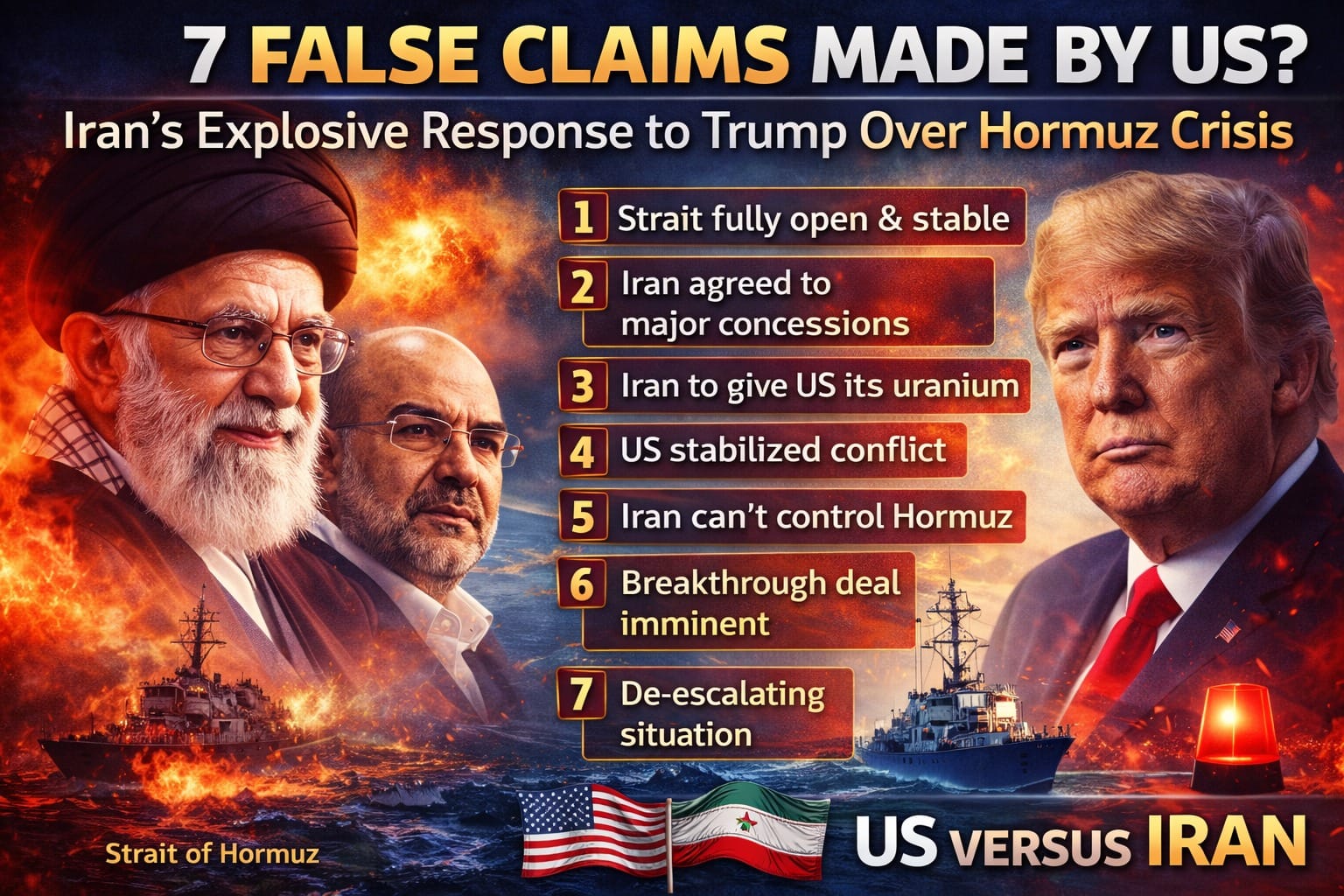
The ongoing tensions between the United States and Iran have taken a sharp turn after Tehran publicly accused Washington of spreading misinformation during the 2026 Strait of Hormuz crisis. In a dramatic statement, Iran’s Parliament Speaker Mohammad Bagher Ghalibaf claimed that the United States made “seven false claims in one hour”, rejecting statements made by former US President Donald Trump regarding the conflict, negotiations, and control over the crucial oil route.
This confrontation is not just political rhetoric—it reflects a deeper struggle over global energy control, war narratives, and international credibility.
Let’s break down everything in detail: the claims, Iran’s response, what is actually happening in the Strait of Hormuz, and why this matters globally.
What Triggered the “7 False Claims” Controversy?
The controversy began after Donald Trump made a series of statements about the Iran situation, including claims about:
- The status of the Strait of Hormuz
- Progress in negotiations
- Iran’s nuclear program
- Control over maritime routes
Iran responded almost immediately, calling these statements false, misleading, and politically motivated, while warning that such narratives could escalate tensions further.
This back-and-forth comes at a time when the US has imposed a naval blockade on Iran, one of the most aggressive geopolitical moves in recent years.
The 7 Claims Iran Says Are False (Explained in Detail)
While Iran did not list all claims in a single official document, multiple reports and statements help reconstruct what Tehran is pushing back against.
1. Claim: The Strait of Hormuz Is Fully Open and Stable
Trump suggested that the Strait of Hormuz was “completely open” and functioning normally.
Iran’s Response:
Iran clarified that while commercial movement may be allowed temporarily, all shipping is controlled, routed, and authorized by Iran, not freely open.
This is a critical distinction. Iran is essentially saying:
The Strait is open—but only on our terms.
2. Claim: Iran Has Agreed to Major Concessions
The US suggested that Iran had agreed to key concessions, including:
- Reducing tensions
- Cooperating with international demands
Iran’s Response:
Iran denied any such agreement, stating that no final deal has been reached, and negotiations remain inconclusive.
3. Claim: Iran Will Hand Over Its Uranium Stockpile
Trump claimed that Iran had agreed to transfer enriched uranium to the US.
Iran’s Response:
Iran rejected this outright, calling it false and baseless, with no official confirmation or agreement in place.
4. Claim: The US Has Won or Stabilized the Conflict
Statements from the US implied that the situation was under control and moving toward resolution.
Iran’s Response:
Iran dismissed this narrative, arguing that:
- The conflict is still active
- Tensions remain high
- No decisive outcome has been achieved
This aligns with broader reports that the region remains volatile.
5. Claim: Iran Cannot Control the Strait of Hormuz
US narratives suggested that Iran’s influence over the Strait is limited.
Iran’s Response:
Iran strongly countered this, stating:
- The Strait operates under Iranian authorization
- Passage depends on designated routes controlled by Tehran
- Iran can close the Strait again if needed
Also read – GLP-1 Drugs Explained: Research & Fatloss
6. Claim: A Breakthrough Deal Is Imminent
Trump indicated that talks were progressing toward a final agreement.
Iran’s Response:
Iran rejected this optimism, stating:
- Talks are ongoing but unresolved
- Major differences still exist
- No timeline for agreement has been finalized
7. Claim: The Situation Is De-escalating
The US projected that tensions were reducing and stability was returning.
Iran’s Response:
Iran warned the exact opposite:
- The Strait of Hormuz may shut again
- The US blockade could trigger further escalation
- The situation remains fragile and unpredictable
Why the Strait of Hormuz Matters So Much
To understand why these claims matter, you need to understand the importance of the Strait of Hormuz.
- It carries nearly 20% of the world’s oil supply
- It is the most critical maritime chokepoint globally
- Any disruption affects fuel prices, global trade, and economies
Even a temporary closure or restriction can:
- Spike oil prices
- Disrupt supply chains
- Trigger global economic instability
The US Blockade: The Real Game-Changer
The US naval blockade of Iran has escalated the situation significantly.
- Ships entering and leaving Iranian ports are being restricted
- Military presence has increased in the region
- Iran has called the move illegal and provocative
This blockade is the central reason why:
- Iran is asserting control over Hormuz
- Tensions are rising
- Misinformation claims are intensifying
The War of Narratives: Who Controls the Truth?
This conflict is no longer just military—it is also informational.
US Narrative:
- Situation under control
- Iran weakening
- Progress in negotiations
Iran Narrative:
- US spreading misinformation
- No agreement reached
- Iran still controls key routes
This creates a global perception battle, where:
- Markets react to statements
- Media amplifies narratives
- Public opinion is shaped in real-time
What Happens Next?
The situation remains highly volatile.
Possible Scenarios:
- De-escalation Through Negotiations
If both sides reach a deal, tensions could ease. - Escalation and Strait Closure
Iran may shut Hormuz again if pressure continues. - Prolonged Standoff
A long-term geopolitical conflict affecting global markets.
Final Analysis: More Than Just 7 Claims
The “7 false claims” controversy is not just about statements—it is about:
- Control over global energy routes
- Narrative dominance in international politics
- Strategic positioning between two global powers
At this point, the truth lies somewhere between:
- Political messaging
- Strategic exaggeration
- Ground realities on the battlefield
And until there is a formal agreement, one thing is certain:
The Strait of Hormuz will remain the most dangerous and important waterway in the world.
Subscribe to our YouTube Channel The Logic Stick for more video insights