







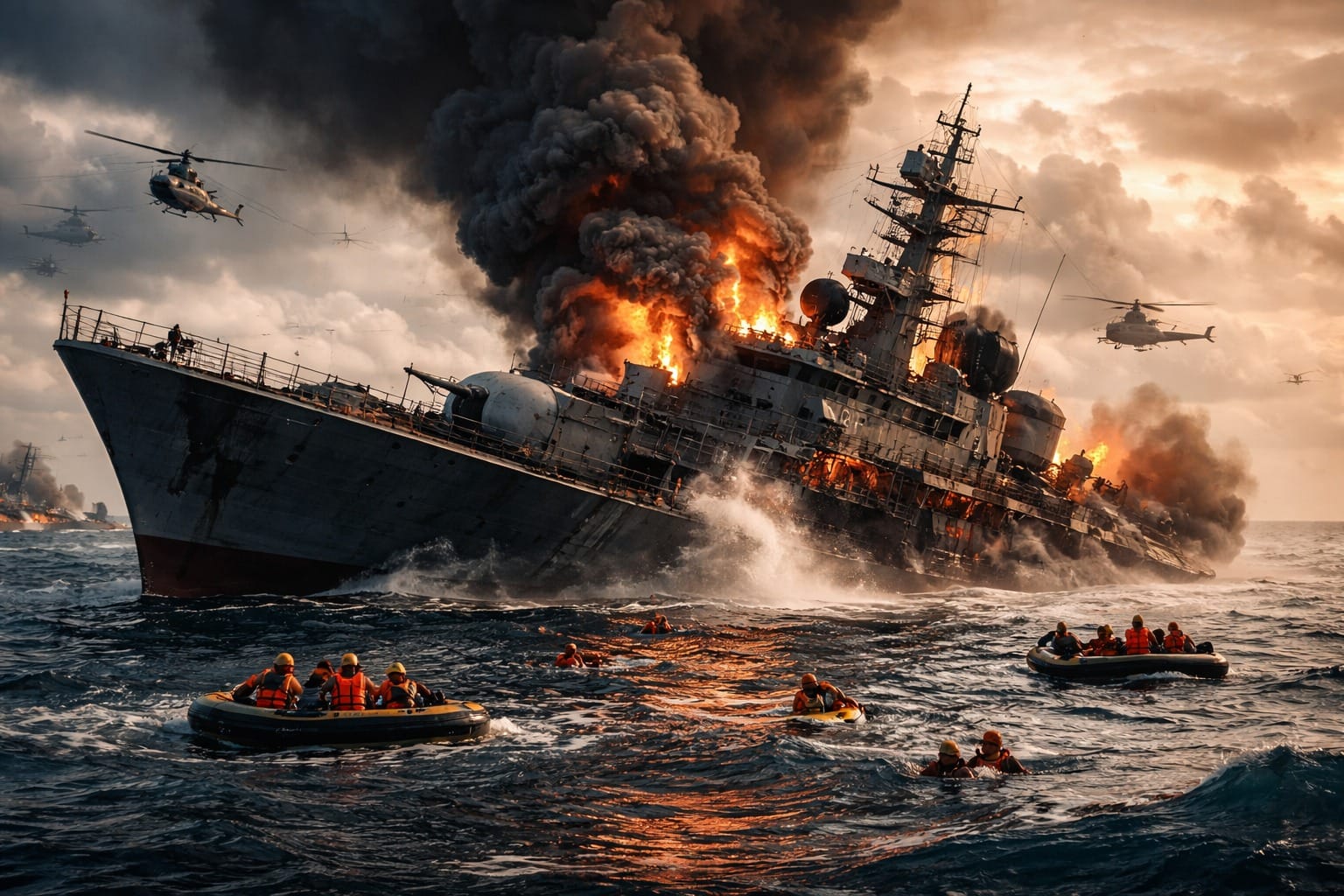
Iranian Warship Attack Near Sri Lanka
Introduction
On 4 March 2026, a dramatic and potentially escalatory military incident unfolded in the Indian Ocean near Sri Lanka when an Iranian naval vessel was struck in what authorities describe as a suspected submarine attack. The incident left over 100 crew members missing and dozens injured, triggering emergency rescue operations and raising concerns about widening hostilities in the region.
Preliminary reports indicate that the vessel involved was the Iranian Navy frigate IRIS Dena, which sank approximately 40 nautical miles south of Galle, Sri Lanka after suffering catastrophic damage. The attack has quickly become one of the most significant naval incidents linked to the ongoing 2026 Iran conflict, drawing global attention and speculation over who carried out the strike.
U.S. Behind the Iranian Warship Attack Near Sri Lanka
New revelations from U.S. officials confirmed that the Iranian Warship attack near Sri Lanka was carried out by the United States military, marking one of the most significant naval strikes in the ongoing Iran–Israel–U.S. war.
According to three U.S. officials who spoke to Reuters, an American submarine launched the strike that sank the Iranian naval vessel in the Indian Ocean. The attack took place off Sri Lanka’s southern coast, triggering a large-scale rescue operation led by the Sri Lanka Navy, which managed to save dozens of Iranian sailors from the water.
The strike is believed to have been part of the widening military campaign against Iran, which has expanded from the Middle East into strategic maritime zones including the Indian Ocean.
Strategic Timing of the Strike
The Iranian Warship attack occurred during the fifth day of the Iran–Israel–U.S. war, a conflict that has rapidly escalated across the region.
On the same day as the naval strike:
- Iran declared that it had total control over the Strait of Hormuz, one of the most critical oil transit chokepoints in the world.
- The Strait of Hormuz handles nearly 20% of global oil shipments, making any disruption a major concern for global markets.
- Israel launched fresh airstrikes inside Iran, targeting strategic infrastructure and military installations.
These simultaneous developments suggest that the naval attack near Sri Lanka was part of a broader strategic attempt to weaken Iran’s military capabilities and maritime presence.
Political Shockwaves Inside Iran
The war has also triggered major political upheaval inside Iran.
Iranian state television confirmed that the state funeral for Supreme Leader Ayatollah Ali Khamenei, originally scheduled for Wednesday evening in Tehran, had been postponed due to expectations of an unprecedented turnout.
Khamenei was reportedly killed during U.S.–Israeli strikes on Tehran, a development that dramatically escalated the conflict and sent shockwaves through Iran’s political establishment.
Iran Searching for a New Supreme Leader
Amid the ongoing bombardment and political turmoil, Iranian authorities are reportedly rushing to appoint a successor to Ayatollah Ali Khamenei.
Iranian state media said the leadership transition process has begun despite the war. However, the situation has become even more volatile after Israel’s Defence Minister Israel Katz issued a stark warning, threatening that any newly appointed Iranian supreme leader could become a target for assassination.
This statement signals that the conflict may intensify further as leadership changes unfold in Tehran.
Expanding Battlefield
The Iranian Warship attack highlights how the conflict is no longer limited to West Asia. Military analysts say the war is rapidly expanding across:
- The Persian Gulf
- The Levant region
- The Indian Ocean
With naval forces now actively engaging thousands of kilometers away from the Middle East, the sinking of the Iranian warship near Sri Lanka represents a dangerous expansion of the battlefield into global maritime trade routes.
The Iranian Warship: IRIS Dena
The ship involved in the incident was the IRIS Dena, a modern warship belonging to the Islamic Republic of Iran Navy (IRIN).
Key details about the ship
- Class: Moudge-class frigate (sometimes described as a destroyer in Iranian terminology)
- Commissioned: 2021
- Displacement: Approximately 1,300–1,500 tons
- Length: About 95 meters
- Crew capacity: Around 140 personnel
- Armament:
- Anti-ship missiles (Noor / C-802)
- Surface-to-air missiles
- Torpedoes
- Naval guns
- Aircraft capability: Helicopter landing deck
The vessel was considered one of the more advanced ships in Iran’s domestically produced naval fleet, equipped with modern radar and electronic warfare systems.
Also read – Supreme Leader Ayatollah Khamenei Killed in Israel USA Attack
Where the Attack Happened
The attack occurred in the Indian Ocean near Sri Lanka, specifically:
- Around 40 nautical miles south of Galle
- In international waters but close to Sri Lankan territorial waters
- A region heavily used by commercial shipping routes
The ship reportedly sent a distress signal early in the morning, prompting Sri Lanka’s navy and air force to begin an emergency rescue mission.
What Happened During the Strike
According to preliminary reports and naval sources:
- The Iranian warship was hit by torpedoes fired from a submarine.
- The impact caused severe structural damage, leading to rapid flooding.
- Multiple explosions were reported on board.
- The vessel sank before rescue forces could reach the site.
The attack reportedly occurred shortly after dawn, giving the crew very little time to abandon ship.
Casualties and Missing Crew
Initial rescue reports revealed significant casualties among the Iranian sailors.
Latest reported figures
- 101 crew members missing
- 78 sailors injured
- 32 critically wounded
- At least one confirmed death
Sri Lankan rescue teams managed to pull 32 sailors from the water, who were transported to Karapitiya Teaching Hospital in Galle for treatment.
However, with the ship sinking quickly, many crew members were unable to escape before it went underwater.
Search operations remain ongoing as authorities continue scanning the area for survivors.
Why the Ship Was Near Sri Lanka
The presence of the Iranian warship near Sri Lanka was not accidental.
The IRIS Dena had recently participated in naval events in India, including:
- International Fleet Review 2026
- Exercise MILAN, a multinational naval exercise
- Meetings between Iranian and Indian naval leadership
After these engagements in Visakhapatnam, the ship was reportedly returning to Iran when the attack occurred.
This detail is significant because it indicates the ship was not on a combat mission, but rather transiting after international naval diplomacy and exercises.
Who Was Behind the Attack?
One of the most controversial questions surrounding the incident is who carried out the submarine strike.
Suspected perpetrator: United States Navy
Military sources and early intelligence reports suggest that:
- The attack may have been conducted by a U.S. Navy submarine
- The strike was allegedly part of the broader confrontation between Iran and a U.S.–Israel coalition
Some reports state that U.S. officials confirmed the submarine strike, although official public statements remain limited as investigations continue.
However, Sri Lankan authorities initially avoided confirming the attacker, stating only that the vessel was struck by what appeared to be a submarine-launched weapon.
Connection to the 2026 Iran Conflict
The sinking of IRIS Dena appears to be linked to a larger geopolitical escalation involving Iran, Israel, and the United States.
Key developments in the conflict include:
- Israeli strikes on Iranian targets
- Iranian retaliation against U.S. interests
- Drone attacks across the Middle East
- Growing naval deployments in the Indian Ocean
Within this context, the attack on the Iranian ship is seen as a major expansion of the conflict into South Asian waters, far beyond the Persian Gulf.
Sri Lanka’s Role in Rescue Operations
Although Sri Lanka was not involved in the conflict, it played a crucial role in rescue operations.
Emergency response
The Sri Lanka Navy and Air Force responded quickly to the distress signal.
Actions taken included:
- Deploying naval vessels to the sinking site
- Launching air surveillance flights
- Coordinating with hospitals in Galle
- Beginning search-and-rescue missions for missing sailors
Rescue teams recovered several survivors from lifeboats and floating debris in the water.
Sri Lankan authorities emphasized that the mission was strictly humanitarian, focused on saving lives.
Strategic Importance of the Incident
The sinking of the IRIS Dena carries significant geopolitical implications.
1. Expansion of naval warfare
The attack marks one of the first major naval confrontations in the Indian Ocean linked to the Iran conflict.
2. Escalation of submarine warfare
Submarines are among the most covert and powerful weapons in naval warfare, making such attacks extremely difficult to detect or prevent.
3. Threat to global shipping routes
The region near Sri Lanka sits close to:
- Major oil shipping lanes
- Critical Asia-Europe trade routes
Any escalation here could impact global maritime commerce.
Why This Incident Matters Globally
The attack raises several important questions for international security:
1. Risk of wider war
If the attack is confirmed to involve the United States or its allies, it could intensify tensions with Iran.
2. Naval escalation
Iran may respond by increasing naval operations in:
- The Persian Gulf
- The Arabian Sea
- The Indian Ocean
3. Regional security concerns
Countries such as:
- India
- Sri Lanka
- Pakistan
may now face increased military activity near their maritime borders.
The Future of the Investigation
Authorities are still working to determine:
- The exact weapon used
- The submarine responsible
- The sequence of events leading to the sinking
Satellite imagery, naval radar data, and survivor testimonies will play key roles in reconstructing the incident.
Iran is also expected to conduct its own military investigation into the loss of the ship.
Conclusion
The submarine attack on the Iranian warship IRIS Dena near Sri Lanka represents a major escalation in the 2026 Iran conflict. With over 100 sailors missing and dozens injured, the incident stands as one of the most serious naval losses suffered by Iran in recent years.
Beyond the immediate humanitarian tragedy, the attack highlights the growing risk of naval warfare spreading into the wider Indian Ocean, potentially affecting international shipping, regional security, and geopolitical stability.
As rescue operations continue and investigations unfold, the world is watching closely to determine who carried out the strike and how it may reshape the balance of power at sea.
Subscribe to our YouTube Channel The Logic Stick for more video insights