






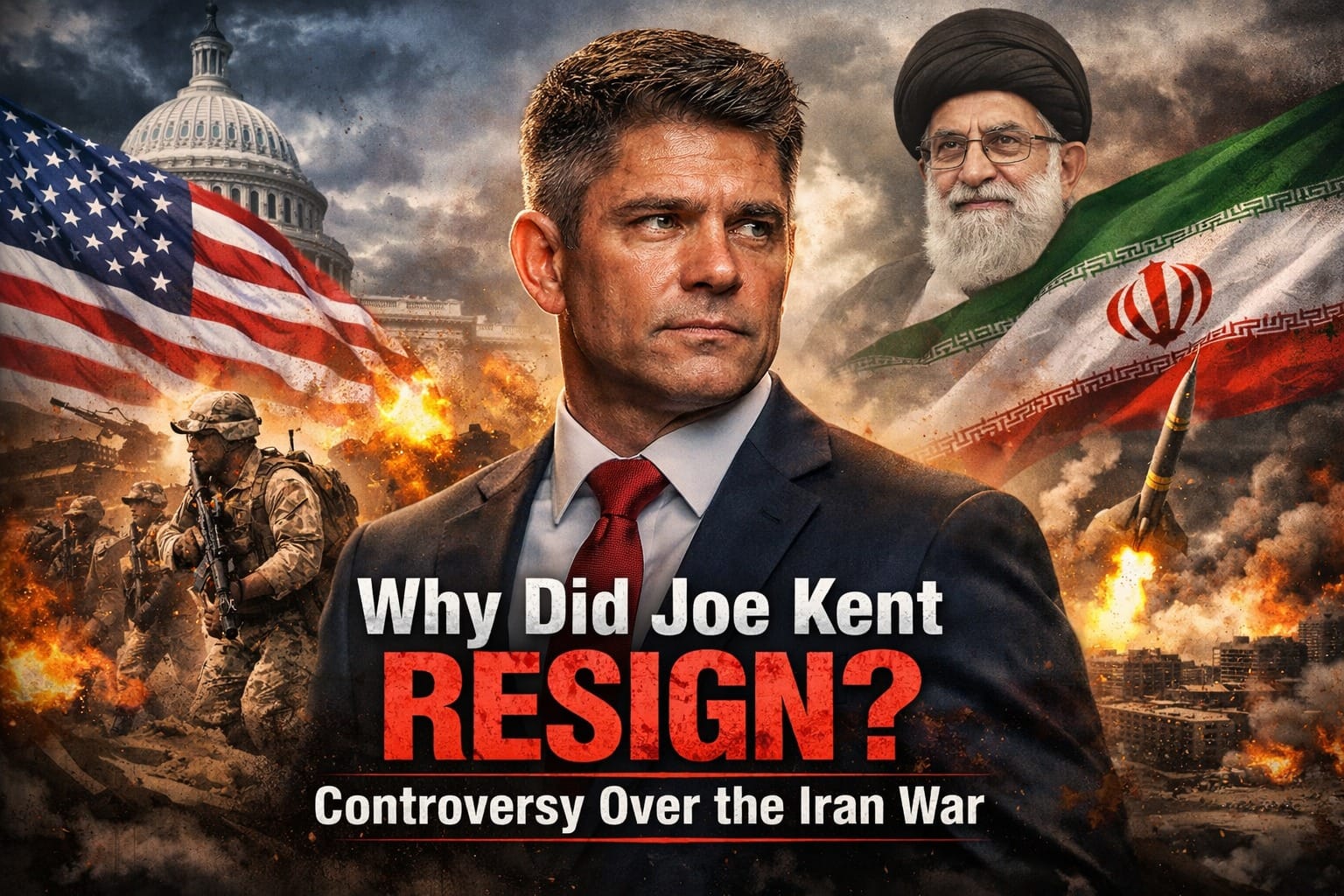
The ongoing US–Iran war in 2026 has not only shaken global geopolitics but also exposed deep divisions within the United States government itself. One of the most shocking developments came when Joe Kent, Director of the National Counterterrorism Center (NCTC), resigned from his position in protest of the war.
His resignation is being seen as a major turning point — not just because of his senior role, but because of the strong and controversial reasons he cited for stepping down.
This article explores:
- Who Joe Kent is
- His military and intelligence background
- His political journey
- Why he resigned
- Why he did not support the Iran war
- What his resignation means for global geopolitics
Who Is Joe Kent? A Career Built on War and Intelligence
Joe Kent is not a typical political figure. His career spans military combat, intelligence operations, and politics.
Early Life and Military Career
Joe Kent (full name Joseph Clay Kent) was born in 1980 in Oregon, USA.
He joined the United States Army in 1998 and served for nearly two decades. During this time:
- He became a Green Beret (Special Forces soldier)
- Served in elite units like the 75th Ranger Regiment and Intelligence Support Activity
- Participated in major operations during the War on Terror and Iraq War
Kent completed multiple combat deployments (over 10 missions), making him one of the most experienced combat veterans in US intelligence circles.
CIA and Intelligence Work
After his military career, Kent transitioned into intelligence:
- Worked as a CIA paramilitary officer
- Focused on counterterrorism operations
- Played roles in covert missions across the Middle East
His experience gave him deep insight into how wars are planned, justified, and executed behind the scenes.
Personal Tragedy
Kent’s personal life also shaped his worldview.
His wife, Shannon Kent, a US Navy cryptologist, was killed in a suicide bombing in Syria in 2019.
This event:
- Deepened his involvement in national security issues
- Strengthened his anti-terror stance
- But also contributed to his skepticism of prolonged wars
Political Career and Rise in Trump’s Administration
After leaving intelligence, Kent entered politics.
Congressional Runs
- Ran for Congress in Washington state in 2022 and 2024
- Lost both elections but gained national attention
- Supported strongly by Donald Trump
His campaigns were controversial due to:
- Far-right associations
- Strong anti-establishment views
- Opposition to traditional foreign policy
Appointment as Counterterrorism Chief
In 2025:
- Donald Trump nominated him as Director of the National Counterterrorism Center (NCTC)
- He was confirmed by the Senate in a 52–44 vote
As NCTC Director, Kent’s role included:
- Analyzing global terror threats
- Coordinating intelligence across agencies
- Advising the President on national security
This made him one of the most powerful intelligence officials in the United States.
Also read – Pakistani Airstrikes on Kabul Hospital Kills 400
The Iran War Context
The US–Iran war began in early 2026 after:
- US and Israeli strikes on Iranian infrastructure
- Escalation involving missile attacks and regional instability
- Rising tensions in the Strait of Hormuz
The Trump administration justified the war as:
- A response to Iranian threats
- A preemptive move to prevent escalation
However, not everyone within the system agreed.
Why Joe Kent Resigned
Joe Kent resigned on March 17, 2026, becoming the first senior US official to step down over the Iran war.
His resignation letter and public statements revealed multiple reasons.
1. “Iran Posed No Imminent Threat”
The most critical reason Kent cited was:
Iran did not pose an immediate threat to the United States
This is extremely significant.
Under international law, military action is generally justified only if:
- There is an imminent threat
- Or self-defense is required
Kent argued that this condition was not met, making the war unjustified.
2. Opposition to “America First” Policy Violation
Kent strongly supported Trump’s earlier “America First” doctrine, which focused on:
- Avoiding endless foreign wars
- Reducing military intervention abroad
He believed the Iran war:
- Contradicted these principles
- Represented a return to interventionist policies
3. Blaming External Pressure (Israel Lobby Claim)
One of the most controversial parts of his resignation was his claim that:
- The war was driven by pressure from Israel and its US lobby
Kent argued that:
- The US was influenced into conflict
- Public perception was shaped by media and political pressure
- The decision was not purely based on US national interest
This statement sparked intense debate globally.
4. “I Cannot in Good Conscience Support This War”
Kent’s resignation was also framed as a moral decision.
He clearly stated:
“I cannot in good conscience support the ongoing war in Iran”
This highlights:
- Ethical disagreement
- Personal accountability
- Internal dissent within the administration
5. Concerns Over Misinformation and Intelligence
Kent also suggested that:
- Intelligence narratives were manipulated
- The situation resembled past conflicts like the Iraq War
- Decisions may have been based on flawed or exaggerated threats
This is critical because intelligence justification is the backbone of modern warfare decisions.
Why Joe Kent Did Not Support the Iran War
Beyond the official reasons, Kent’s stance can be understood through his background.
1. Experience With “Endless Wars”
Kent spent decades in conflict zones.
He has seen:
- Long-term consequences of war
- Human and economic costs
- Failures of military interventions
This likely shaped his belief that:
War should be the last option — not the first.
2. Strategic Realism
As a counterterrorism expert, Kent understood:
- Iran is a complex regional power
- Military action could escalate uncontrollably
- Retaliation was inevitable
Reports suggest intelligence assessments already indicated:
- Iran would not collapse easily
- The war would become prolonged
3. Economic and Geopolitical Risks
Kent was aware of:
- Impact on oil markets (Strait of Hormuz)
- Rising global instability
- Risk of broader regional war
He likely saw the conflict as:
high-risk with limited strategic benefit.
4. Political Ideology
Kent belongs to a group within US politics that believes:
- America should avoid foreign entanglements
- Focus should be domestic
- Military intervention should be minimal
This ideology directly conflicts with large-scale wars.
What His Resignation Means
Joe Kent’s resignation is not just a personal decision — it has wider implications.
1. Internal Divide in US Government
His exit shows:
- Not everyone supports the war
- Even top intelligence officials disagree
This weakens the perception of unified strategy.
2. Credibility Questions Around the War
When a counterterrorism chief says:
- There was no imminent threat
- The war was influenced externally
It raises serious questions about:
- justification
- intelligence credibility
- policy decisions
3. Political Fallout
Kent’s resignation has triggered:
- Debate within Republican circles
- Support from anti-war groups
- Criticism from pro-war factions
4. Global Impact
Internationally, this development signals:
- uncertainty in US strategy
- potential policy shifts
- weakening of diplomatic clarity
Controversies Around Joe Kent
Kent himself is a controversial figure.
His career includes:
- Links to far-right political movements
- Claims about election fraud
- Criticism for intelligence positions
Despite this, his resignation has been taken seriously because of:
- his role
- his experience
- the timing of his exit
The Bigger Picture: A War Being Questioned From Within
Joe Kent’s resignation reflects a deeper issue:
Modern wars are no longer universally supported — even within governments.
His departure highlights:
- ethical dilemmas in warfare
- challenges of intelligence-based decisions
- tension between politics and strategy
Conclusion
Joe Kent’s resignation as the US Counterterrorism Chief is one of the most significant internal challenges to the Iran war.
From a decorated soldier and intelligence officer to a political figure, Kent’s journey reflects deep experience in warfare — and his decision to step down signals a strong disagreement with the direction of US policy.
His key message is clear:
- Iran was not an imminent threat
- The war was avoidable
- The cost may outweigh the benefits
Whether one agrees with him or not, his resignation raises an important question:
If even the people who plan wars are stepping away — what does that say about the war itself?
Subscribe to our YouTube Channel The Logic Stick, for more video insights