






Twisha Sharma Case Updates
Introduction: Why The Twisha Sharma Case Has Shocked India
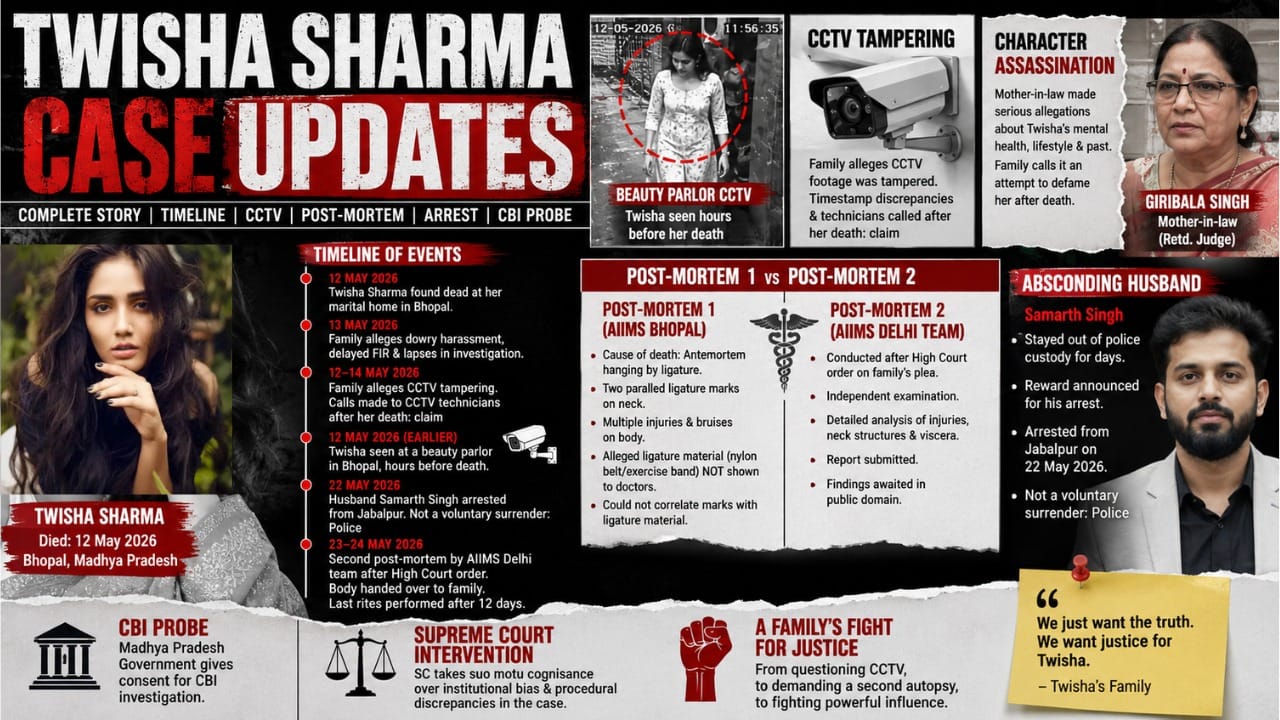
The Twisha Sharma case has rapidly become one of the most disturbing and closely watched alleged dowry death cases in India. What began as the reported death of a young woman inside her matrimonial home in Bhopal has now turned into a larger national story involving allegations of dowry harassment, domestic abuse, suspicious CCTV footage, possible evidence tampering, delay in police action, questions over the first post-mortem, a second autopsy by AIIMS Delhi doctors, the arrest of her husband after days of being out of police custody, and Supreme Court intervention.
Twisha Sharma, a 33-year-old woman from Noida, was found dead at her marital home in Bhopal on May 12, 2026. She had married lawyer Samarth Singh in December 2025. Her mother-in-law, Giribala Singh, is a retired judge. Because of the legal background of the accused family, Twisha’s family has repeatedly alleged that influence, pressure and procedural lapses affected the early investigation. The Supreme Court has taken suo motu cognisance of the case under a matter concerning alleged institutional bias and procedural discrepancies in the unnatural death of a young woman at her matrimonial home.
As of May 25, 2026, the case has entered a crucial phase. Samarth Singh has been arrested and sent to police custody. The Madhya Pradesh government has consented to a CBI probe. A second post-mortem has been conducted by an AIIMS Delhi team. Twisha’s last rites were performed after nearly 12 days. But many questions remain unanswered: Was the CCTV footage tampered with? Why were CCTV technicians allegedly contacted after Twisha’s death? Why was the alleged ligature material not shown to doctors during the first post-mortem? What will the second post-mortem reveal? And was Twisha’s character attacked after her death to shift public attention away from the core allegations?
This detailed report traces everything that happened from the day after Twisha Sharma’s death, based on available media reports, police statements, court developments and family allegations.
Who Was Twisha Sharma?
Twisha Sharma was not just another name in a crime report. She was a young woman with a public-facing background, described in media reports as a former Miss Pune, an actor-model, an MBA graduate and a corporate professional. According to NDTV, she came from Noida and had earlier been associated with modelling, acting and professional work before her marriage. She reportedly met Samarth Singh through a dating app in 2024, and the couple got married in December 2025.
On the surface, it appeared to be a modern urban love marriage between two educated individuals. But according to Twisha’s family, trouble began soon after marriage. Her father, Navnidhi Sharma, has alleged that the relationship started showing signs of control, humiliation and emotional pressure early on. In interviews, the family has claimed that Twisha was slowly isolated and mentally tortured at her marital home.
The family has also alleged dowry-related harassment. According to their statements reported by media, the demands were not always made directly in the old-fashioned way. Instead, they allegedly came through rituals, expectations, gifts and pressure around financial assets. These allegations are now part of the larger investigation and remain to be tested through evidence.
The Day Of Death: May 12, 2026
Twisha Sharma was found dead at her matrimonial home in Bhopal on May 12, 2026. Early reports described the death as an alleged suicide by hanging. The case was initially handled by local police, but soon after, Twisha’s family began raising serious doubts about the sequence of events, the crime scene, the medical examination and the conduct of the accused family.
According to reports, the first post-mortem was conducted at AIIMS Bhopal. The first autopsy reportedly concluded that the cause of death was antemortem hanging by ligature. However, the same report also recorded multiple injuries on Twisha’s body, including blunt-force injuries described as simple in nature.
This became one of the earliest red flags for the family. If it was a straightforward case of suicide, they asked, why were there multiple injuries? Why was the alleged ligature material not given to the medical board? Why was the family not satisfied with the pace and direction of the investigation?
These questions became the foundation of the family’s demand for a second post-mortem and an independent investigation.
Also read – Cockroach Janta Party Explained
Day After Death: Family Begins Questioning The Investigation
From the day after Twisha’s death, her family started alleging that the case was not being treated with the urgency and neutrality expected in a suspicious death at a matrimonial home. The family claimed that the FIR was delayed and that the accused side was getting time to manage the narrative.
Media reports state that the FIR named Twisha’s husband Samarth Singh and mother-in-law Giribala Singh. The case involved allegations linked to dowry harassment and cruelty. However, while Giribala Singh secured anticipatory bail, Samarth Singh allegedly remained out of police custody for several days.
This period became highly controversial because the family alleged that instead of quick custodial questioning, the investigation was slowed down by influence and legal manoeuvring. The fact that Giribala Singh is a retired judge and Samarth Singh is a lawyer added to public concern about whether the case was being treated like an ordinary dowry death investigation.
The family refused to accept Twisha’s body for final rites until a second post-mortem was conducted. This was not just an emotional decision. It was also a legal and forensic strategy. Once cremation was done, the possibility of a fresh physical examination would be lost forever. That is why the family insisted that the body should not be released for last rites until an independent medical board re-examined it.
First Post-Mortem: What It Reportedly Found
The first post-mortem was conducted at AIIMS Bhopal. According to Indian Express, the autopsy report said Twisha died due to “antemortem hanging by ligature.” Doctors observed two parallel ligature marks on her neck. The report also recorded multiple injuries on the body, including abrasions, bruises and contusions.
The injuries reportedly included reddish abrasions on the front of the neck, bruising on the arm, contusion on the forearm and contusion on the right ring finger. The report also stated that the injuries were antemortem, meaning they occurred before death, and were possible due to blunt force.
This created a key question: if Twisha died by hanging, what caused the other injuries? Were they accidental? Were they connected to a struggle? Were they old injuries? Were they related to domestic violence? These are questions that only a detailed forensic and investigative process can answer.
But the biggest issue was not just the injuries. The biggest procedural lapse, according to reports, was that the alleged ligature material was not produced before the medical board during the first post-mortem.
Watch: TWISHA SHARMA’s First Film
The Ligature Material Controversy
One of the most important details in the Twisha Sharma case updates is the controversy around the alleged ligature material.
In hanging cases, the ligature material is extremely important. The marks on the neck must be compared with the object allegedly used for hanging. This comparison can help forensic experts understand whether the marks match the object, whether the hanging is consistent with the scene, and whether the death appears suicidal, homicidal or staged.
According to Indian Express, the alleged nylon belt or exercise band recovered from the scene was not produced before the AIIMS Bhopal medical board at the time of the first post-mortem. Because of this, the doctors could not scientifically correlate the ligature marks with the alleged material.
This became one of the strongest reasons for the family’s distrust. If the most critical object in an alleged hanging case was not shown to the doctors, how could the first autopsy be considered complete? Police reportedly acknowledged that the material was seized but was not presented during the post-mortem process.
For Twisha’s family, this was not a minor clerical error. It was a major forensic gap. This is why they pushed for a second post-mortem by an outside medical team.
CCTV Footage Controversy: The Timeline That Raised More Questions
The CCTV angle is among the most controversial parts of the Twisha Sharma case.
One set of CCTV footage from the residence reportedly showed Twisha moving towards the terrace staircase. Other reports said that later visuals allegedly showed Samarth Singh, a neighbour and a househelp trying to revive her through CPR before she was taken downstairs. These visuals were used by some to support the theory of suicide.
But Twisha’s family has alleged that CCTV footage may have been selectively released, manipulated or used to build a defence narrative. They also raised questions about the timestamps, missing context and the role of CCTV technicians after the death.
The issue became more complicated when reports emerged that Twisha was also seen in CCTV footage from a beauty parlour on the same day.
Beauty Parlour CCTV: Twisha Seen Hours Before Death
A major twist came when CCTV footage from a beauty parlour surfaced. According to Times of India and India Today, Twisha Sharma was seen visiting a salon in Bhopal on May 12, hours before she was found dead. The footage reportedly showed her getting a head massage and spending time at the salon.
NDTV also reported that the salon owner made claims about Twisha’s visit, which became part of the larger investigation into her final hours.
This footage became important for two reasons.
First, it helped establish Twisha’s movements on the day of her death. Second, it raised questions about her emotional state. Some reports said she appeared calm in the salon visuals. However, it is important to be careful here. A person appearing calm in CCTV footage does not prove their mental state. People under distress may still appear normal in public. Similarly, calm behaviour cannot be used to conclusively prove or disprove suicide, abetment or foul play.
But the beauty parlour CCTV did create fresh questions about the timeline. If residential CCTV footage had timestamp issues, and salon CCTV showed her at a specific time, investigators would need to reconcile both sets of footage. This is why the family’s demand for preservation and forensic examination of CCTV footage became crucial.
Alleged CCTV Tampering: Why The Family Raised Alarm
The family’s allegation of possible CCTV tampering is one of the most sensitive aspects of the case. According to media reports, Twisha’s family questioned why CCTV technicians were allegedly contacted after her death. Times of India reported that the family flagged multiple alleged phone calls made by Giribala Singh to influential people and CCTV technicians between May 12 and May 14.
Reports also stated that Giribala Singh claimed there were timestamp discrepancies in the residential CCTV footage and that the cameras were maintained by a private company. She reportedly cited a discrepancy of “two days, two hours and 20 minutes” due to improper maintenance.
For the family, this explanation did not resolve the concern. Instead, it deepened suspicion. Their questions were simple: if the CCTV timestamp was faulty, when was it discovered? Who had access to the system? Were technicians called before or after police sealed the evidence? Was the footage copied, deleted, edited or selectively shared? Were original DVRs preserved? Were hash values or forensic digital signatures taken?
These are technical questions, but in a modern death investigation, they matter deeply. CCTV footage can either clarify a timeline or distort it if it is incomplete, edited or taken out of context.
The Madhya Pradesh government later told the High Court that Giribala Singh was suspected of trying to tamper with evidence. Times of India reported that the High Court issued notice to her on the state’s plea to cancel her anticipatory bail on grounds of suspected evidence tampering.
At this stage, it is important to note that these remain allegations and legal claims. A court or investigating agency must establish whether tampering actually happened. But the fact that the issue reached the High Court shows the seriousness of the concern.
Character Assassination Allegations Against Twisha Sharma
One of the most painful developments in the Twisha Sharma case has been the alleged character assassination of Twisha after her death.
Instead of the public conversation staying focused only on the circumstances of death, dowry allegations, forensic lapses and police procedure, several counter-allegations emerged about Twisha’s personal life, mental health, lifestyle and past.
According to media reports, Giribala Singh denied wrongdoing but made allegations about Twisha’s mental health, alleged drug use, past relationships and family background. Economic Times reported that Giribala Singh claimed Twisha’s father pushed her into the glamour world, gave her weight-loss medicines, and that Twisha allegedly consumed marijuana during pregnancy. Twisha’s family strongly denied these claims.
NDTV also reported that Twisha’s family saw this as an attempt to malign her image after death.
This part of the case is important because in many dowry death and domestic violence cases, the deceased woman’s character becomes a battleground. Allegations about mental health, relationships, lifestyle, ambition, clothing, career, pregnancy or family upbringing are often used to shift the public narrative. The deceased person is not alive to defend herself. That is why such allegations must be treated with extreme caution unless backed by verified evidence.
Twisha’s family has described these claims as false and defamatory. They have argued that the focus should remain on what happened inside the matrimonial home, what the forensic evidence says, why the husband was not immediately arrested, why CCTV evidence is under question, and why the first post-mortem had procedural gaps.
Absconding Husband: Samarth Singh Out Of Police Custody For Days
Another major development in the case was the conduct of Twisha’s husband, Samarth Singh, after the FIR.
Reports said that Samarth Singh remained out of police custody for several days. Police announced a reward for information leading to his arrest. According to Times of India, the reward was increased to ₹30,000.
This created public anger because in many dowry death cases, immediate custodial questioning of the husband is seen as crucial. The husband is often the person closest to the deceased in the matrimonial home. His conduct before and after the death, phone records, messages, injuries, location data and statements can become critical evidence.
Samarth Singh’s anticipatory bail proceedings also became part of the legal drama. Reports said he withdrew his anticipatory bail plea. There were reports that he was going to surrender, but later police clarified that he did not voluntarily surrender and was instead arrested from Jabalpur.
This distinction matters. A surrender suggests voluntary submission before the court or police. An arrest suggests police action. According to Times of India, police said Samarth Singh was arrested from Jabalpur and did not surrender as earlier suggested.
Husband’s Arrest And Police Custody
On May 22, 2026, Samarth Singh was taken into custody in Jabalpur. Reports say he had appeared near or at court premises in Jabalpur when police arrested him. The case then moved into the custodial interrogation phase.
This was a major breakthrough because until then, Twisha’s family and many observers were questioning why the husband had not been arrested. After his arrest, he was brought into the investigation process, and a court later granted police custody.
Custodial interrogation is important in such cases because investigators may confront the accused with call records, CCTV footage, witness statements, forensic findings, medical reports, domestic chats, alleged dowry-related messages and inconsistencies in his version of events.
However, it must also be remembered that arrest does not mean conviction. Samarth Singh remains an accused, and the charges must be proved in court. But from the family’s point of view, his arrest was a necessary step toward a fair investigation.
Second Post-Mortem: Why It Became Necessary
The demand for a second post-mortem became one of the defining moments of the case.
Twisha’s family refused to conduct the last rites until an independent second autopsy was done. Their concerns included the injuries noted in the first post-mortem, the absence of proper correlation with the alleged ligature material, and alleged lack of detailed examination of neck and cervical structures.
The Madhya Pradesh High Court allowed the second post-mortem to be conducted by a team from AIIMS Delhi. NDTV reported that a four-member AIIMS Delhi team conducted the second autopsy in Bhopal.
The second post-mortem was not merely a symbolic exercise. It was meant to address the family’s concerns and create a more independent medical record. Since the first autopsy had already happened, the second post-mortem had limitations. But it could still examine external and internal injuries, neck structures, preserved viscera, forensic samples and inconsistencies in the first report.
As of the latest public reports, the second autopsy had been completed, but the full detailed findings were not yet publicly available. This means one must be careful while claiming “differences” between the first and second post-mortem. The confirmed difference so far is procedural: the first was done by AIIMS Bhopal, while the second was conducted by AIIMS Delhi doctors after court approval. The full medical comparison can only be made once the second report is officially available.
First Post-Mortem vs Second Post-Mortem: What We Know
Here is what is publicly known so far.
The first post-mortem reportedly concluded that the death was due to antemortem hanging by ligature. It recorded two parallel ligature marks and multiple antemortem injuries. But the alleged ligature material was not shown to doctors, preventing scientific correlation between the material and the marks.
The second post-mortem was ordered after the family challenged the completeness and reliability of the first process. It was conducted by AIIMS Delhi doctors in Bhopal after the High Court’s approval.
The most important point is this: as of May 25, 2026, reliable public reports confirm that the second post-mortem has been conducted, but they do not yet provide a full public medical report comparing the two autopsies in detail. Therefore, any article claiming final medical differences without the official second report would be irresponsible.
The known differences are:
- Medical team: First by AIIMS Bhopal, second by AIIMS Delhi team.
- Reason: First was routine post-death examination; second was court-approved after family objections.
- Concern: First report could not correlate ligature marks with alleged ligature material because the material was not presented.
- Purpose of second autopsy: To address alleged gaps, injury examination concerns and questions raised by the family.
- Public status: Second autopsy completed, full findings awaited in public domain.
Last Rites After 12 Days
Because the family insisted on a second post-mortem, Twisha Sharma’s body remained in the mortuary for nearly 12 days. This was emotionally devastating for the family, but they believed it was necessary for justice.
After the second post-mortem was completed, Twisha’s body was handed over to the family and cremated in Bhopal. Times of India reported that her brother, Major Harshit Sharma, performed the last rites.
The family also expressed pain that the delay disrupted traditional Hindu mourning rituals. Reports quoted family members saying that the delay forced them to violate the usual 13-day mourning process.
This detail shows the emotional cost of the legal battle. For the family, the fight for a second post-mortem meant delaying closure. But they chose forensic clarity over immediate rituals.
CBI Probe: Why The Case Moved Beyond Local Police
The Madhya Pradesh government has given consent for a CBI probe into the Twisha Sharma case. This is significant because the family had repeatedly raised concerns about local influence, procedural lapses and possible evidence tampering.
A CBI investigation would mean central agency scrutiny of the case diary, police actions, forensic evidence, digital evidence, CCTV systems, call records, statements, medical reports and the conduct of accused persons.
The case’s movement toward a CBI probe reflects the seriousness of the allegations. It also shows that the matter is no longer limited to a local police investigation. It has become a test of institutional credibility.
Supreme Court Intervention: Institutional Bias And Procedural Discrepancies
The Supreme Court taking suo motu cognisance of the case is one of the most important developments.
According to LiveLaw, the matter was registered as a case concerning alleged institutional bias and procedural discrepancies in the unnatural death of a young woman at her matrimonial home.
This framing is crucial. The Supreme Court is not only looking at the death itself but also at the systems around the death. Was the investigation fair? Were procedures followed? Did the status of the accused influence police action? Were forensic steps properly taken? Was digital evidence preserved? Was there delay? Did the family have to fight too hard for basic investigative fairness?
These questions go beyond Twisha Sharma alone. They touch the larger issue of how India investigates deaths of married women, especially when the accused family is powerful, educated or legally connected.
Why This Case Has Become A National Conversation
The Twisha Sharma case has become a national conversation because it combines several issues that disturb Indian society at once.
First, it involves the death of a woman within months of marriage. That immediately raises concerns under India’s dowry death and cruelty laws.
Second, it involves an educated urban couple, challenging the assumption that dowry harassment is limited to rural or less educated families.
Third, the accused family has legal influence: the husband is a lawyer, and the mother-in-law is a retired judge. This has triggered public concern about institutional bias.
Fourth, the case involves digital evidence. CCTV footage, timestamps, salon footage, residential footage, call records and alleged technician calls have all become central to the investigation.
Fifth, the first post-mortem itself has come under scrutiny due to the alleged ligature material not being produced before doctors.
Sixth, Twisha’s character became part of the public debate after her death, raising concerns about victim-shaming and posthumous defamation.
Together, these factors have made the case much bigger than one family’s tragedy.
Key Unanswered Questions In The Twisha Sharma Case
Despite several developments, many questions remain unanswered.
Was the residential CCTV footage original, complete and untampered?
Why were there timestamp discrepancies in the CCTV footage?
Who had access to the CCTV system after Twisha’s death?
Were CCTV technicians contacted, and if yes, why?
Was any footage deleted, edited, copied or selectively leaked?
Why was the alleged ligature material not shown to the first post-mortem board?
What caused the additional injuries recorded in the first autopsy?
What will the second post-mortem report conclude?
Why was Samarth Singh not arrested immediately?
Were there dowry-related messages, calls or financial demands?
Did Twisha face sustained mental cruelty or domestic abuse?
Were allegations about her mental health and lifestyle supported by evidence or used to damage her image after death?
Did institutional influence affect the early stages of the investigation?
These questions will determine the future of the case.
Conclusion: The Fight Is Now For Evidence, Not Narrative
The Twisha Sharma case updates show how a young woman’s death can become a battle between evidence and narrative. On one side is the family’s allegation of dowry harassment, cruelty, evidence tampering and institutional influence. On the other side are counterclaims by the accused side, including allegations about Twisha’s personal life and mental health.
But the truth of this case cannot be decided by public emotion, selective CCTV clips or character attacks. It must be decided through forensic evidence, call records, digital audit trails, medical findings, witness statements and a fair investigation.
As of May 25, 2026, the confirmed developments are clear: Twisha Sharma died at her matrimonial home on May 12; her husband Samarth Singh and mother-in-law Giribala Singh are under serious legal scrutiny; Samarth Singh has been arrested; the first post-mortem found death by antemortem hanging but also recorded injuries and suffered from a key ligature-material gap; a second post-mortem has been conducted by AIIMS Delhi doctors; the family performed her last rites after nearly 12 days; the Madhya Pradesh government has consented to a CBI probe; and the Supreme Court has taken suo motu cognisance of alleged institutional bias and procedural discrepancies.
The next crucial stage will be the second post-mortem findings, forensic analysis of CCTV footage, call record examination, CBI action and Supreme Court oversight.
For now, Twisha Sharma’s case stands as a painful reminder that justice in matrimonial death cases depends not only on law, but on the courage to question every gap, every delay and every attempt to bury the truth under narrative.
Subscribe to our YouTube Channel The Logic Stick for more video insights