





Introduction: Why Marco Rubio’s India Visit Matters
US Secretary of State Marco Rubio’s India visit has become one of the most important diplomatic developments in India-US relations in 2026. At first glance, it may look like another high-level foreign policy meeting. But the timing, agenda and political context make it much bigger.
Rubio arrived in India at a time when the world is dealing with serious geopolitical pressure: the Iran conflict, the instability around the Strait of Hormuz, energy market uncertainty, India’s balancing act between the US, Russia and Iran, Washington’s push for a stronger trade deal, and President Donald Trump’s continuing effort to keep Prime Minister Narendra Modi close despite tariff tensions.
During his visit, Rubio met Prime Minister Narendra Modi and External Affairs Minister S Jaishankar in New Delhi. The discussions covered trade, energy, defence cooperation, visas, maritime security, Middle East tensions and the broader India-US strategic partnership. Reuters reported that Rubio said progress had been made in the past 48 hours on efforts to resolve the Iran conflict, especially around the Strait of Hormuz, a critical oil route for the global economy.
But the visit was not only about Iran or oil. It was also about one larger question: Can Trump and Modi keep the India-US relationship strong despite trade disputes, Russia oil concerns, Pakistan outreach and America’s pressure-based diplomacy?
The answer is complicated. The Trump-Modi equation has always mixed friendship, optics, strategic ambition and hard bargaining. Rubio’s India visit showed exactly that.
Rubio’s India Visit: The Official Agenda
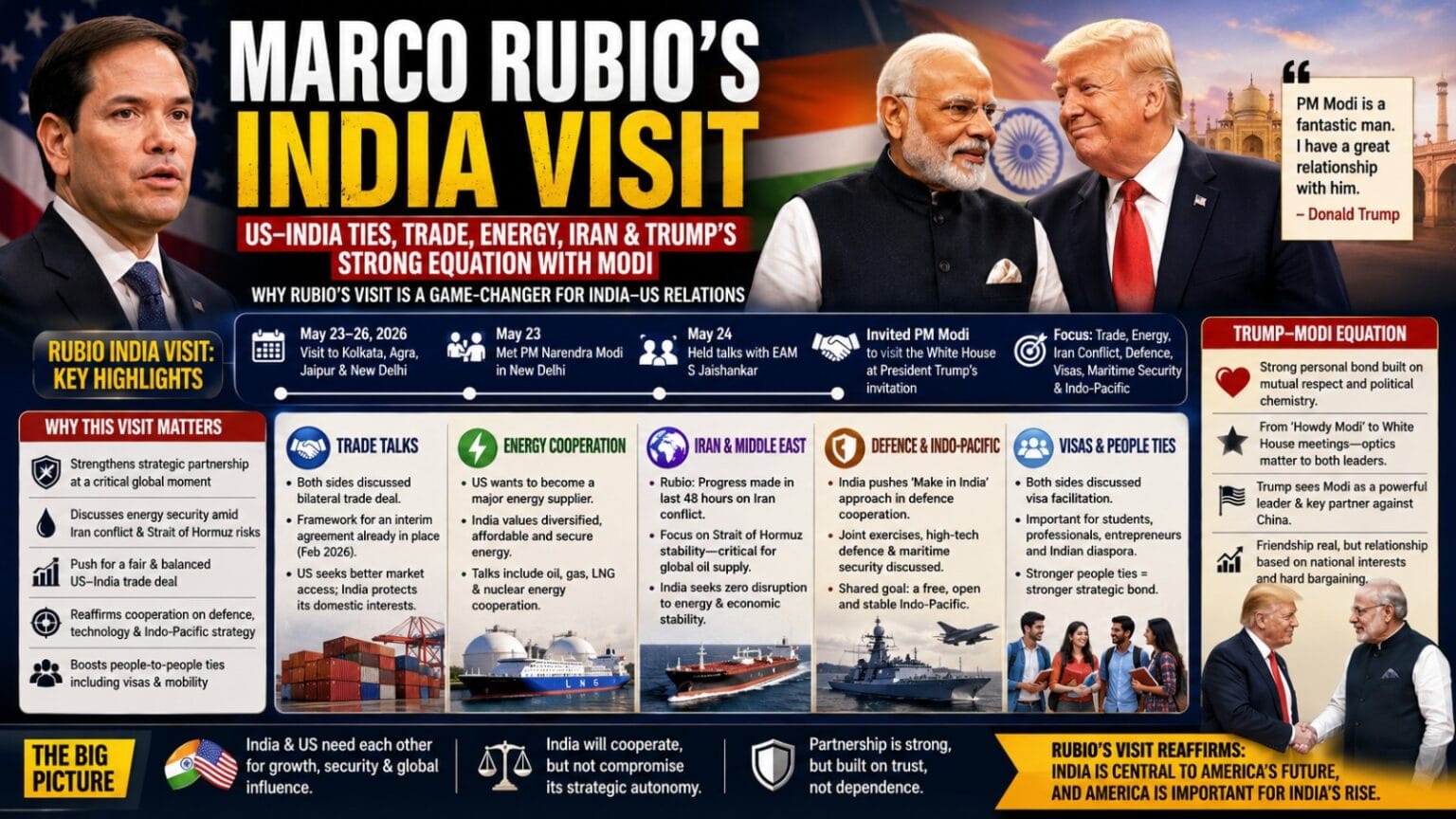
Marco Rubio’s India visit was scheduled from May 23 to May 26, 2026, with stops in Kolkata, Agra, Jaipur and New Delhi. Reuters reported before the visit that the agenda included energy security, trade and defence cooperation.
In New Delhi, Rubio met PM Modi on May 23. According to the US State Department, Rubio discussed the “full breadth” of the US-India relationship with Modi and specifically raised trade, energy, defence, counterterrorism and the Indo-Pacific. The State Department also said Rubio emphasised that the US would not allow Iran to “hold the global energy market hostage” and argued that US energy products could help diversify India’s energy supply.
On May 24, Rubio met External Affairs Minister S Jaishankar. The two leaders discussed the Middle East, trade, visas, maritime security and energy supplies. Reuters reported that Jaishankar said the United States had emerged as a reliable energy source for India, while Rubio said the US wanted to sell more energy to India.
The Indian Ministry of External Affairs transcript of the joint press conference shows that energy diversification, nuclear energy cooperation, bilateral trade, defence and strategic coordination were all part of the discussion. Jaishankar said diversified supplies are central to India’s energy security and that the two sides also discussed nuclear energy cooperation.
So, officially, Rubio’s visit was about five major issues:
- US-India trade negotiations
- Energy security and US energy exports to India
- Iran conflict and Strait of Hormuz security
- Defence and Indo-Pacific cooperation
- Trump-Modi political engagement
The Iran Conflict And Strait Of Hormuz: Why India Was Watching Closely
One of the biggest reasons Rubio’s India visit became strategically important was the Iran conflict. The Strait of Hormuz is one of the world’s most important oil chokepoints. Any disruption there can immediately affect oil prices, shipping, inflation and energy security for countries like India.
Reuters reported that Rubio said progress had been made on an outline that could help resolve the situation around the Strait of Hormuz. He made these comments during his India visit, while discussing Middle East tensions with Indian officials.
For India, this matters deeply. India imports a large share of its energy needs. Any major disruption in the Gulf region can increase fuel prices, widen the current account deficit and raise inflationary pressure at home. This is why India has always followed developments in the Middle East with extreme caution.
The US wants India to rely more on American energy. Rubio’s message was clear: if India wants energy diversification, the United States is ready to become a bigger supplier. In an interview released by the US State Department, Rubio said India wants to diversify its energy sources and the US wants to diversify the countries it exports to, making energy cooperation a “logical” fit between close partners.
This is also where the Russia factor comes in. India has continued buying Russian oil because it serves India’s economic interests. But the US has repeatedly pushed India to reduce dependence on Russia. The problem for Washington is that the Iran conflict and global energy instability make it harder to pressure India aggressively. If the market is unstable, India will prioritise affordable, secure energy over political signalling.
That is why Rubio’s visit was not just diplomacy. It was energy geopolitics.
Trade Talks: Trump’s Pressure And India’s Caution
Trade was another major part of Rubio’s India visit. The Trump administration has often used tariffs and trade pressure as tools of foreign policy. India has been both a strategic partner and a tariff target.
In January 2025, Trump and Modi held a call in which they discussed expanding cooperation and moving toward a “fair bilateral trading relationship.” The White House readout said Trump emphasised India increasing procurement of American-made security equipment and creating fairer trade terms.
In February 2026, the White House announced that the US and India had reached a framework for an interim agreement on reciprocal and mutually beneficial trade. That framework reaffirmed both countries’ commitment to broader US-India Bilateral Trade Agreement negotiations.
Rubio’s visit built on that framework. Reuters reported that both sides discussed trade, and India expressed readiness to finalise a bilateral trade deal.
However, India is unlikely to accept a one-sided agreement just because Trump wants a headline deal. New Delhi’s approach is usually cautious: protect domestic industry, avoid sudden tariff shocks, expand exports where possible, and bargain hard on market access.
This is where Trump’s style becomes important. Trump often praises Modi personally, but his trade policy is transactional. He may call India a friend, but he still wants better access for American goods, more US energy purchases, and more defence procurement.
Rubio acknowledged this tension indirectly during the joint press interaction. According to the MEA transcript, Rubio said the US-India relationship had not lost momentum and that trade friction was not “about India” specifically, but part of the new administration’s broader trade approach.
In simple words: Washington wants India close, but also wants India to pay, buy and open markets.
Energy: The Real Heart Of Rubio’s Visit
While trade and defence got headlines, energy may be the real heart of Rubio’s India visit.
The US wants India to buy more American oil, gas and possibly nuclear technology. India wants secure, diversified and affordable energy. Both sides see opportunity, but the politics is tricky.
The US State Department said Rubio told Modi that American energy products have the potential to diversify India’s energy supply. It also said Rubio emphasised that the US would not allow Iran to hold the global energy market hostage.
At the joint press conference, Jaishankar spoke about diversified supplies being central to India’s energy security. He also said the two sides spent time discussing nuclear energy cooperation.
This indicates that energy cooperation is not limited to crude oil. It includes:
- Oil and gas imports from the US
- LNG cooperation
- Nuclear energy possibilities
- Strategic energy reserves
- Maritime energy route security
- Reducing dependence on unstable regions
- Managing pressure over Russian oil
For India, energy policy is not ideological. It is practical. India buys from wherever it gets affordable and secure supply. This is why India bought Russian oil despite Western pressure. It is also why India may buy more US energy if the pricing, logistics and long-term contracts make sense.
Rubio’s message was designed to position the US as a dependable alternative, especially when the Middle East is unstable and Russia remains geopolitically sensitive.
Defence And Indo-Pacific: The China Factor Behind The Smiles
Another key part of the Marco Rubio India visit was defence cooperation. The US sees India as one of its most important partners in the Indo-Pacific. This is largely because of China.
India and the US may not be treaty allies, but they have deepened defence cooperation over the years. They conduct military exercises, share strategic interests in the Indo-Pacific and work through platforms like the Quad along with Japan and Australia.
During Rubio’s visit, Jaishankar reportedly pushed a “Make in India” approach for future defence cooperation. Times of India reported that India wants defence cooperation with the US to support domestic manufacturing, not just direct imports.
This is important because India does not want to become fully dependent on any one country for defence. It has historically bought major weapons from Russia, is expanding purchases from the US and Europe, and is also trying to build domestic defence production.
For the US, India is useful because it can counterbalance China without formally becoming an American ally. For India, the US is useful because it offers technology, intelligence cooperation and geopolitical leverage.
But India’s position remains independent. India wants partnership without alignment. That is the essence of its strategic autonomy.
Also read – Cockroach Janta Party Explained
Trump’s “Love” For Modi: Friendship Or Foreign Policy Theatre?
The Trump-Modi relationship has always had a strong public optics element. From “Howdy Modi” to major bilateral meetings, both leaders have projected personal warmth. Trump has repeatedly shown that he values strongman-style leaders who command large domestic support, and Modi fits that political image.
In February 2025, Modi visited Washington for an official working visit. The White House joint leaders’ statement said Trump hosted Modi in Washington and that both sides worked on trade, defence, technology, energy and strategic cooperation.
In his own press statement during that visit, Modi thanked his “dear friend” President Trump and said Trump had “cherished and revitalized” the India-US relationship. Modi also said he felt the same enthusiasm and commitment that the two leaders had shown during Trump’s first term.
This personal chemistry matters because both leaders understand political spectacle. Trump likes big symbolic relationships. Modi understands the value of global visibility. Their relationship is not only about diplomacy; it is also about domestic messaging.
For Trump, Modi represents a powerful democratic partner, a huge market, a counterweight to China and a leader with whom he can publicly claim a strong personal bond. For Modi, Trump represents access to American power, investment, defence cooperation and political legitimacy on the global stage.
But “love” in geopolitics has limits. Trump may praise Modi one day and pressure India on tariffs the next. He may call India a strategic partner while pushing for more US exports, more defence purchases and reduced Russian oil dependence.
So, Trump’s affection for Modi is real at the level of political style and personal diplomacy, but it is not unconditional. It operates within American interests.
Why Rubio Invited Modi To The White House
One of the most important symbolic developments during Rubio’s visit was the invitation for Modi to visit the White House. Reuters reported that Rubio extended an invitation from President Trump for Modi to visit the White House.
This invitation is significant for three reasons.
First, it signals that despite tensions over tariffs, Russian oil and America’s outreach to Pakistan or China, Washington still wants Modi close.
Second, it gives Trump a chance to frame India as a major partner in his foreign policy strategy.
Third, it gives Modi an opportunity to show Indian voters and global observers that India remains central to US diplomacy.
In diplomatic language, White House invitations are not casual gestures. They are signals. Rubio carrying Trump’s invitation to Modi shows that the Trump administration wants to reset or strengthen momentum in the relationship.
Pakistan, China And The Strategic Anxiety Around India-US Ties
Rubio’s India visit also came against the backdrop of India’s discomfort over Washington’s engagement with Pakistan and China. Reuters described the visit as an effort to shore up ties that had been strained by tariffs and US engagement with India’s rivals Pakistan and China.
This matters because India watches US-Pakistan ties very closely. Any American security or oil-related engagement with Pakistan creates suspicion in New Delhi. Similarly, if Washington softens toward China for trade or strategic reasons, India becomes cautious.
India wants the US relationship, but it does not want to be used as a pawn in America’s shifting tactical games. New Delhi’s concern is simple: the US can be a powerful partner, but it can also be unpredictable.
Trump’s foreign policy style increases that uncertainty. He can be warm personally but transactional strategically. This is why India keeps multiple doors open: US, Russia, Europe, Gulf nations, Iran, Japan, ASEAN and the Global South.
Rubio’s visit was partly about reassuring India that Washington still sees New Delhi as a priority.
Visas And People-To-People Ties
Rubio and Jaishankar also discussed visas. This may sound smaller compared to trade and Iran, but it matters deeply for India.
The India-US relationship is not only built by governments. It is built by students, technology professionals, entrepreneurs, doctors, researchers and the Indian diaspora. Visa rules directly affect Indian families, companies and education dreams.
Reuters reported that visas were among the topics discussed during the Rubio-Jaishankar talks.
For India, smoother visa processing and fair treatment of Indian students and professionals remain important diplomatic priorities. For the US, Indian talent remains central to technology, healthcare, research and innovation.
So, while visas may not dominate headlines, they remain one of the most emotionally important parts of the India-US relationship.
What India Wants From The United States
India’s priorities are clear.
India wants access to American technology, defence systems, energy, investment and education pathways. It wants a trade deal that benefits Indian exporters without hurting domestic sectors. It wants cooperation on counterterrorism and maritime security. It wants support in the Indo-Pacific without surrendering strategic autonomy.
India also wants respect. It does not want to be treated as a junior partner. It wants the US to understand that India will not simply follow Washington’s line on Russia, Iran or China.
That is why Jaishankar’s diplomacy matters. India’s foreign policy under Modi has increasingly projected confidence: India will work with America, but not become America’s satellite.
Rubio’s visit tested exactly that balance.
What The United States Wants From India
The US wants India to become a stronger pillar of its Asia strategy. It wants India to buy more American energy and defence equipment. It wants India to reduce dependence on Russia. It wants India to open markets for US businesses. It wants India to align more closely with Washington on China, maritime security and technology supply chains.
The US also wants India to help stabilise the global order at a time when the Middle East, Europe and East Asia are under pressure.
But Washington faces one challenge: India will cooperate, but not obey.
This is why Rubio’s tone was important. He did not frame India as a problem. He framed India as a strategic partner whose energy needs could be met by the US.
The Bigger Picture: India-US Ties Are Strong, But Not Simple
The biggest takeaway from the Marco Rubio India visit is that India-US relations are strong, but not simple.
They are strong because both countries need each other. The US needs India as a market, strategic partner and China counterweight. India needs the US for technology, defence, energy, investment and global influence.
But they are not simple because both countries have different priorities. The US wants alignment. India wants autonomy. The US wants market access. India wants protection for domestic interests. The US wants India to move away from Russia. India wants affordable energy and defence flexibility.
Trump and Modi may like each other politically, but their governments still bargain hard.
That is the reality of modern geopolitics.
Conclusion: Rubio’s Visit Shows Modi Is Still Central To Trump’s India Strategy
Marco Rubio’s India visit was not just a diplomatic formality. It was a strategic signal.
The US came to India with a message: Washington wants deeper trade, more energy cooperation, stronger defence ties, maritime coordination and continued political warmth between Trump and Modi. Rubio’s talks with Modi and Jaishankar showed that India remains central to America’s Indo-Pacific and energy strategy.
At the same time, the visit showed that India will not blindly follow the US line. New Delhi will buy energy based on national interest, negotiate trade carefully, support maritime stability, engage with the US on defence and technology, but continue protecting strategic autonomy.
Trump’s affection for Modi adds warmth to the relationship, but the real foundation is not personal friendship alone. It is power, market size, energy security, China, trade and global influence.
That is why the Marco Rubio India Visit matters. It reveals the new shape of India-US ties: friendly but transactional, strategic but cautious, ambitious but full of pressure points.
For India, the goal is clear: take the benefits of American partnership without losing independence.
For the US, the message is equally clear: if Washington wants India as a long-term partner, it must treat New Delhi not as a follower, but as a power in its own right.
Subscribe to our YouTube Channel The Logic Stick for more video insights