





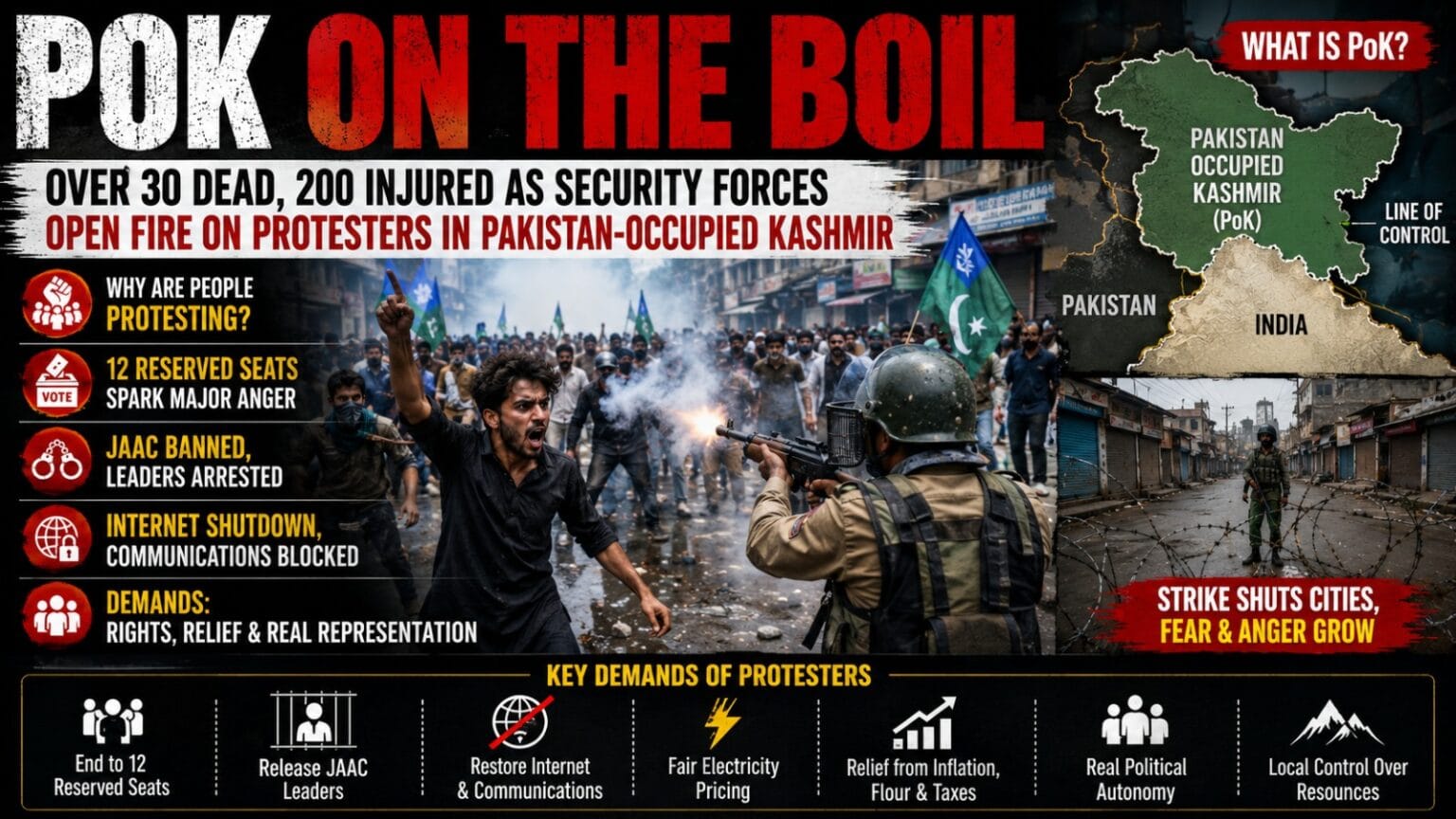
Pakistan-occupied Kashmir, commonly referred to as PoK in India and Pakistan-administered Kashmir internationally, is witnessing one of its most serious waves of unrest in recent years. Reports say security forces opened fire during clashes with protesters, leading to multiple deaths, hundreds of injuries, internet restrictions, arrests, and a region-wide shutdown.
At the centre of the unrest is the Joint Awami Action Committee, or JAAC, a civil society and traders’ alliance that has been leading protests over political representation, inflation, electricity prices, flour costs, unemployment, resource control and what many locals describe as political marginalisation.
The latest violence has brought global attention back to PoK, not just as a territorial dispute between India and Pakistan, but as a region facing deep internal anger over governance, economic stress and civil rights.
The current crisis is not a sudden outburst. It is the result of years of unresolved grievances, rising living costs, limited political autonomy and anger over how power is controlled in the region.
What Triggered the Latest PoK Protests?
The immediate trigger was the decision to reserve 12 out of 45 seats in the upcoming legislative elections for refugees from Indian-administered Jammu and Kashmir who now live in different parts of Pakistan. The election is scheduled for July 27.
JAAC opposed this arrangement, arguing that people who do not live in the region should not have political control over seats in the local assembly. According to the protesters, all seats should represent residents who actually live in Pakistan-occupied Kashmir.
The situation escalated after authorities banned JAAC under anti-terror legislation, citing public order and security concerns. The ban was followed by arrests, warrants, crackdowns and a call for a region-wide protest.
Tensions became worse in Rawalakot after a trader was allegedly shot during a confrontation with law enforcement. Protesters gathered near a hospital mortuary where his body had been taken. When security forces moved to disperse the crowd, clashes broke out. Officials said some protesters used weapons, while local residents and JAAC supporters accused the authorities of using excessive force.
This is why the current PoK crisis has become so serious: it is not only about one election rule. It is about a larger belief among many locals that their political voice is being controlled from outside.
How Many People Have Died in the PoK Violence?
Casualty figures remain disputed.
Some Indian media reports, including NDTV, have reported that over 30 people were killed and around 200 were injured in the violence. Reuters and Al Jazeera, citing regional officials and police, reported at least 11 deaths and more than 70 injuries from the Rawalakot clashes.
The difference in numbers reflects the difficulty of verifying information from the ground, especially amid internet shutdowns, political tension, competing official and local accounts, and restricted access to affected areas.
What is clear is that the violence has been deadly, the crackdown has been severe, and the anger on the streets has intensified.
Who Is JAAC?
JAAC stands for Joint Awami Action Committee. It is a grassroots umbrella organisation representing traders, civil society groups and local activists in Pakistan-occupied Kashmir.
The group became prominent in 2023 during protests over rising electricity bills, flour prices, taxes and economic hardship. It has repeatedly argued that the people of PoK are not getting fair political representation or economic justice.
JAAC’s supporters say the group is fighting for local rights, not against the people of Pakistan. Its critics and authorities, however, accuse it of creating law-and-order problems and fuelling unrest.
The latest ban on JAAC under anti-terror legislation has become one of the biggest reasons for anger. Rights groups have raised concerns that proscribing a civil society protest movement as a terror-linked group can suppress legitimate dissent and worsen public distrust.
What Are the Main Demands of the Protesters?
The protests in PoK are driven by both immediate and long-term demands. The most important ones include:
- Abolition of the 12 reserved seats for non-resident refugees in the local assembly
- End to the ban on JAAC
- Release of arrested activists
- Action against security forces accused of excessive violence
- Restoration of internet and communication services
- Fair electricity pricing
- Relief from inflation and rising flour prices
- More local control over natural resources
- Greater political autonomy
- End to what protesters call political marginalisation
For many locals, the election issue is only the latest spark. The deeper frustration is about power, identity and economic survival.
Also read – Ethanol 85 Explained: Can it bring change in the fuel consumption in India
Why Are 12 Reserved Seats So Controversial?
The July 27 election to the legislative assembly has 45 seats. Out of these, 12 seats are reserved for refugees from Indian-administered Jammu and Kashmir who migrated to Pakistan and now live outside PoK.
This arrangement has existed in some form for decades and is tied to Pakistan’s political position on Kashmir. Pakistan argues that these refugees remain part of the larger Kashmir question.
JAAC and many local protesters argue the opposite. They say people who do not live in the region should not decide the region’s political future. For them, the 12 reserved seats dilute local representation and allow outside political influence over local governance.
This is why the issue has become emotionally powerful. It touches the core question: who truly represents the people living in PoK?
What Is the Status of PoK?
PoK refers to the part of the former princely state of Jammu and Kashmir that has been under Pakistan’s control since the 1947-48 war. India considers the entire Jammu and Kashmir, including PoK, to be an integral part of India. Pakistan administers the region but does not formally treat it as a normal province in the same way as Punjab, Sindh, Balochistan or Khyber Pakhtunkhwa.
PoK is usually divided into two major parts:
1. Azad Jammu and Kashmir, or AJK
This region has a president, prime minister, legislative assembly, cabinet and Supreme Court. Its capital is Muzaffarabad.
2. Gilgit-Baltistan
This region was earlier known as the Northern Areas and has its own administrative structure. It is strategically important because of its borders, mountains, water resources and the China-Pakistan Economic Corridor.
On paper, AJK has a semi-autonomous system. In practice, many critics argue that real power lies with Islamabad through federal control, the Kashmir Council, security agencies and constitutional restrictions.
Why Do People Say PoK Is Not Truly Autonomous?
The name “Azad Kashmir” means “Free Kashmir,” but critics say the region has limited real freedom.
AJK has its own assembly, courts and local government, but key areas such as defence, foreign affairs, currency and communications remain under Pakistan’s control. Political activity is also restricted by constitutional provisions that require loyalty to the idea of Kashmir’s accession to Pakistan.
This means political parties and candidates cannot openly campaign for complete independence or against accession to Pakistan. Critics say this limits democratic choice and prevents open debate about the region’s future.
Another major issue is representation. AJK does not have regular representation in Pakistan’s national parliament because Pakistan does not officially consider it a province. At the same time, many locals feel that Islamabad controls major decisions affecting their lives.
This contradiction is one of the biggest sources of frustration.
Economic Anger: Electricity, Flour, Taxes and Unemployment
The current PoK unrest cannot be understood only through the lens of politics. Economic anger is equally important.
In recent years, PoK has seen repeated protests over high electricity bills, flour prices, taxes and inflation. Many residents argue that the region produces hydroelectric power but does not receive affordable electricity. They also complain that natural resources are extracted while local communities remain poor.
Flour subsidies and electricity rates have become major political issues because they directly affect everyday survival. For ordinary families, rising food prices and power bills are not abstract policy matters. They are daily household crises.
Unemployment is another major concern. Many young people in PoK feel trapped between limited local opportunities and lack of meaningful political voice. This has turned economic frustration into a broader rights movement.
Internet Shutdowns and Communication Blackouts
Internet restrictions have become a major part of the PoK crisis. During protests, authorities have reportedly imposed communication blackouts and restricted online access.
For governments, internet shutdowns are often justified as a way to stop rumours, mobilisation and violence. But for citizens and rights groups, they raise serious concerns about transparency, freedom of expression and the ability to report abuses.
When internet access is blocked, casualty numbers become harder to verify. Videos and eyewitness accounts become harder to circulate. Journalists and rights monitors face more difficulty documenting what is happening.
This is why communication blackouts often deepen public suspicion instead of calming the situation.
Human Rights Concerns in PoK
Rights groups have expressed concern over the use of force, arrests, internet restrictions and the banning of JAAC under anti-terror laws.
The central human rights question is whether the authorities are dealing with protests as a political problem or treating them mainly as a security threat. If protesters are peaceful, their right to assemble and demand accountability must be protected. If violence occurs, the state still has a duty to respond proportionately and lawfully.
The Human Rights Commission of Pakistan has called for dialogue, restraint and respect for fundamental rights. Amnesty International has also criticised the crackdown and warned of deteriorating human rights conditions in the region.
The concern is that heavy-handed action may not solve the crisis. It may make people feel even more alienated.
India’s Position on PoK
India’s position has remained consistent: Jammu and Kashmir, including areas under Pakistan’s control, is an integral part of India.
India has repeatedly referred to PoK as illegally occupied territory. In 1994, both houses of the Indian Parliament passed a unanimous resolution stating that Jammu and Kashmir is an integral part of India and that Pakistan must vacate the areas under its occupation.
Whenever unrest erupts in PoK, India usually highlights it as evidence of Pakistan’s failure to protect rights and provide democratic representation in the region.
The current violence has once again given India an opportunity to raise the issue of human rights violations, police brutality and political repression in PoK at the international level.
Pakistan’s Position on PoK
Pakistan refers to the region as Azad Jammu and Kashmir and presents it as a self-governing territory. Islamabad argues that Kashmir is an unresolved international dispute and that the final status of the region should be determined according to the wishes of the Kashmiri people.
However, the current protests challenge Pakistan’s own narrative. If the region is genuinely self-governing, protesters ask why major decisions are influenced by Islamabad, why local political choices are restricted, and why demands for economic rights are met with crackdowns.
Pakistan’s challenge is therefore not just external. It is internal. It must convince the people living in the region that they have real political voice and economic dignity.
Why PoK Matters Strategically
PoK is not just a local political issue. It is strategically important for several reasons.
First, it is part of the larger India-Pakistan Kashmir dispute. Any instability in the region can affect bilateral tensions.
Second, Gilgit-Baltistan connects Pakistan with China through the China-Pakistan Economic Corridor. This makes the region important for trade, infrastructure and military geography.
Third, PoK has water and hydropower importance. Rivers and hydroelectric projects are closely linked to regional economy and resource politics.
Fourth, the region sits near the Line of Control, one of the world’s most sensitive military borders.
This is why protests in PoK are watched closely not only by India and Pakistan, but also by China, international rights groups and geopolitical observers.
Is This the First Time PoK Has Seen Protests?
No. PoK has seen several waves of protests in recent years.
JAAC-led demonstrations over electricity, flour prices and taxes have already turned deadly in the past. What makes the current moment different is the combination of election-related anger, the ban on JAAC, alleged firing by security forces, internet restrictions and large casualty claims.
The protests have moved from economic demands to a wider political rights movement. That makes the current unrest more serious and harder to control through short-term concessions.
What Is Happening in Muzaffarabad, Rawalakot and Other Cities?
Muzaffarabad, the capital of AJK, has reportedly witnessed deserted streets, shutter-down strikes and heavy security presence. Rawalakot has become the centre of the latest violence after clashes near the hospital mortuary.
Across several towns, shops, markets and transport networks have been affected by the strike. Police and security vehicles have been visible on the streets, while many residents have stayed indoors due to fear of further clashes.
The shutdown reflects the scale of anger and uncertainty. It also shows that the protests are not limited to one isolated town. They have spread across the region as a broader expression of public frustration.
What Could Happen Next?
There are three possible scenarios.
1. Dialogue and De-escalation
The government could open talks with JAAC, restore communication services, release non-violent detainees, and address demands around representation, electricity pricing and economic relief. This would be the least damaging path.
2. Continued Crackdown
If the authorities continue arrests, internet restrictions and forceful policing, the protests may become more intense. This could deepen public anger and increase international criticism.
3. Political Compromise Before Elections
Since the July 27 election is central to the crisis, the government may try to negotiate a limited compromise on reserved seats, candidate rules or local representation. Whether this satisfies protesters remains uncertain.
The most important factor will be whether the authorities treat the unrest as a governance crisis or purely as a security problem.
Why the PoK Protests Matter for Ordinary People
For people outside the region, PoK is often discussed only as a territorial dispute. But for residents, the crisis is about everyday life.
It is about electricity bills.
It is about flour prices.
It is about jobs.
It is about political dignity.
It is about whether local voices matter.
It is about whether protest can happen without fear.
That is why the current unrest has struck a deeper chord. People are not only reacting to one policy. They are reacting to years of accumulated frustration.
Conclusion: PoK Is Facing a Political and Human Rights Crisis
The latest PoK protests show that Pakistan-occupied Kashmir is facing a serious political, economic and human rights crisis. The immediate trigger may be the controversy over 12 reserved seats and the ban on JAAC, but the deeper causes are much older.
People are angry over rising prices, lack of jobs, electricity costs, limited political representation, resource control and the feeling that real power lies outside the region.
The disputed casualty figures, internet restrictions, arrests and allegations of excessive force have made the situation even more sensitive. For India, the unrest strengthens its argument that Pakistan has failed to protect democratic rights in PoK. For Pakistan, it exposes a major governance challenge in a region it calls self-governing. For the people of PoK, the issue is more immediate: dignity, survival, voice and justice.
The coming days will be crucial. If the government chooses dialogue, the crisis may de-escalate. If it chooses force, PoK could see deeper unrest and more international attention.
The PoK protests are not just about one election. They are about who gets to decide the future of a region that has been disputed for nearly eight decades.
Subscribe to our YouTube Channel The Logic Stick for more video insights