







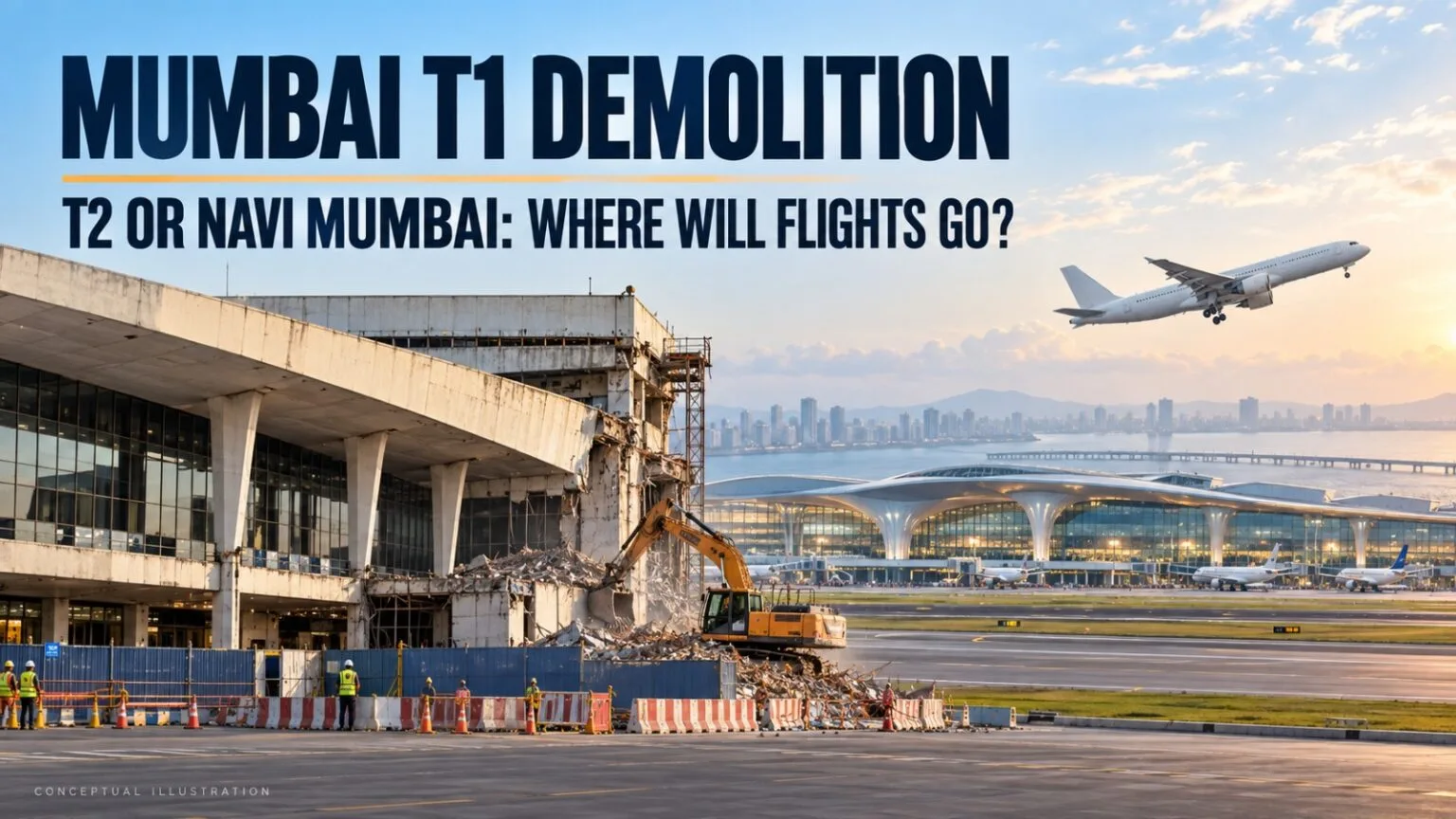
Mumbai T1 Demolition: T2 or Navi Mumbai Flight Shift?
Mumbai’s Terminal 1 redevelopment has become a dispute over where flights should operate, how much capacity the city can temporarily lose, and who should bear the additional costs.
The answer to whether flights will move to Terminal 2 or Navi Mumbai International Airport is both are part of the proposed reshuffle. However, the allocation remains contested. A proposal to withdraw slots at Mumbai should not be mistaken for a confirmed flight-by-flight transfer to Navi Mumbai.
The crucial distinction concerns scale. Adani Airports’ latest announcement describes demolition of the north section of T1B in the first phase, affecting around 5 million annual passengers. Earlier reporting described a broader closure scenario involving approximately 10 million passengers shifting to Navi Mumbai. These figures refer to different descriptions of the transition and should not be used interchangeably. adani.com
Why is Mumbai airport Terminal 1 being demolished?
The operator says redevelopment is necessary because of the condition of the ageing infrastructure. T1 comprises buildings constructed at different times: T1B dates to the 1960s, T1A to the 1990s, and T1C to 2010.
Earlier structural assessments identified corrosion, damaged concrete, exposed reinforcement and cracks in T1B. Reconstruction was deferred during the pandemic. These concerns explain why the airport operator considers further postponement difficult, although they do not establish that every section of T1 has the same structural condition. The Times of India
Redevelopment is scheduled to begin in January 2027, with reporting identifying 15 January as the planned start of first-phase demolition. The rebuilt T1 is intended to handle 20 million passengers annually, compared with its existing capacity of 15 million. The Financial Express
For travellers, the immediate challenge is the period between removing old facilities and opening their replacement.
Will T1 flights move to T2 or Navi Mumbai?
The proposed arrangement redistributes traffic across Mumbai’s existing airport and Navi Mumbai International Airport, commonly called NMIA.
T1 serves domestic operations. T2 handles international services alongside domestic flights. Moving additional domestic operations into T2 therefore requires space within a terminal already serving both markets.
Earlier reporting outlined a broader scenario in which approximately 5 million T1 passengers would be accommodated at T2, while services carrying roughly 10 million passengers could shift to NMIA. It also reported a proposed increase in T2 capacity from 40 million to 45 million passengers annually. These describe that reported planning scenario, rather than a final allocation confirmed for the latest partial demolition. The Times of India
The current controversy centres on a proposal to withdraw 265 of Mumbai’s 770 weekly international departure slots from 25 October, affecting 46 airlines. This would release capacity at T2 for displaced domestic traffic. Affected international services could move to Navi Mumbai, but withdrawing a Mumbai slot does not guarantee that an equivalent flight will operate there. indianexpress.com
Passengers should therefore check their airline’s revised schedule rather than assume every T1 flight is moving to the same airport.
How much will Mumbai’s terminal capacity fall?
Three different measurements are being discussed: annual terminal capacity, passengers affected by construction, and weekly international departure slots.
| Measure | Figure | What it means |
|---|---|---|
| Existing CSMIA terminal capacity | 55 million passengers annually | T1: 15 million; T2: 40 million |
| Initial affected capacity/traffic | Around 5 million annually | Operator’s first-phase estimate |
| Share initially affected | About 9% | Approximately 5 million out of 55 million |
| Proposed international departure withdrawal | 265 of 770 weekly slots | Approximately 34.4% of international departure slots |
| Rebuilt T1 capacity | 20 million annually | Five million above existing T1 capacity |
The existing terminal capacity split appears in MIAL’s submissions published by the Airports Economic Regulatory Authority. The first-phase impact and rebuilt T1 figures come from the operator’s latest announcement. Once constructed
Also read- Ujjain Shahi Masjid Road Widening Dispute
Using the first-phase estimate, simple subtraction gives approximately 50 million passengers of remaining annual capacity before mitigation or redistribution. This is an arithmetic illustration, not a separately announced revised operating limit.
Actual operating capacity also depends on peak-hour congestion, aircraft stands and passenger-processing facilities. An annual capacity number cannot show whether sufficient space exists during the busiest departure periods.
A complete T1 closure would remove a larger 15 million annual capacity block before compensating measures. That should not be presented as the immediate first-phase loss.
Similarly, withdrawing roughly one-third of international departure slots does not mean Mumbai loses one-third of its total passenger capacity. Aircraft sizes, passenger loads and domestic operations make these different measurements.
Why are airlines resisting the Navi Mumbai move?
Splitting operations increases work and expense
Airlines have established ground teams, handling arrangements and support systems at CSMIA. Operating across two airports can require additional staffing, training, equipment and coordination.
Air France-KLM has specifically objected to splitting its ground teams between the airports. Its concern illustrates why relocating only some weekly flights can be commercially awkward, even when the receiving airport has available terminal space. The Times of India
Winter schedules are already committed
Airlines say their winter schedules, aircraft deployment and ticket sales were arranged before the proposed restrictions. The dispute consequently involves changing services that passengers may already have booked.
The Airline Operators Committee has sought the capacity calculations supporting the proposed cuts. Airlines also distinguish consultation about redevelopment from agreement to a particular reduction in international operations. Mint
Connecting flights become harder to preserve
A domestic passenger arriving at CSMIA may be connecting to an international departure. If that international flight shifts to NMI, the itinerary could require a road transfer between airports.
As an operational implication, airlines would need to reassess connection times, baggage arrangements and missed-connection handling. A seat available at another airport is not automatically an equivalent replacement for an existing connection.
Financial Express, citing Jefferies, identifies network connectivity, aircraft availability and potentially higher operating costs as obstacles that landing-fee incentives may not fully resolve. The Financial Express
Readiness extends beyond the terminal building
Airlines’ operational requirements include catering, maintenance support and arrangements for crews and ground staff.
Supporting infrastructure is being added. On 6 October, NMIA announced a TajSATS flight kitchen serving more than 40 daily departures, with capacity for 7,500 meals a day, expandable to 15,000. This addresses catering needs, although it does not independently settle every airline’s readiness concerns. adani.com
How will the CSMIA-to-NMI shift take place?
The reported plan brings schedule changes forward to late October, before demolition begins in January. The airport operator has described advance notice and transition assistance, with airlines considering T2 where capacity is available, NMIA or other options. The Financial Express
In practical terms, an orderly transfer would require several coordinated steps:
- Identify which flights remain at CSMIA and which receive revised slots.
- Match proposed NMI services with aircraft rotations and destination-airport timings.
- Complete staffing, ground handling, catering and technical arrangements.
- Update booking systems and inform affected passengers.
- Rework connections, transfers and contingency plans.
These are operational requirements inferred from the nature of the move, rather than a published final implementation checklist.
The Civil Aviation Ministry scheduled a meeting with airlines and MIAL for 6 October to address the disagreement. The reporting reviewed for this article does not establish a final outcome of that meeting. The Times of India
Is it a complicated reshuffle?
Yes. Moving from T1 to T2 changes the terminal within CSMIA. Moving from CSMIA, airport code BOM, to Navi Mumbai, code NMI, changes the airport itself. adani.com
Consider a hypothetical passenger travelling from a domestic city through Mumbai to an overseas destination. If both flights remain at CSMIA, the airline can plan the connection around one airport. If one leg moves to NMI, the journey must accommodate surface travel and potentially another check-in process.
Airlines must also consider what each aircraft does after arriving. Changing one Mumbai service can affect subsequent flights elsewhere in the network.
The challenge is therefore to rebuild workable schedules and connections while keeping passenger disruption manageable.
Will travel costs increase, and by how much?
International departure fees: a reported ₹610 difference
Mint reports an international departing passenger User Development Fee of ₹1,225 at Navi Mumbai, compared with ₹615 at Mumbai.
That represents a ₹610 difference per passenger, or ₹2,440 for four departing international passengers, using those reported rates. This comparison concerns UDF alone; it is not a prediction of the total airfare increase.
Adani has proposed cash vouchers to offset the fee difference. Travellers should verify eligibility and implementation rather than assume compensation is automatic. Mint
Road travel: the increase depends on the starting point
Passengers travelling from some Mumbai neighbourhoods may face longer journeys and higher taxi costs. Travellers closer to Navi Mumbai could find the new airport more convenient.
There is no defensible single additional taxi charge applicable to everyone.
Lower-cost transport options are expanding. NMIA’s 5 October announcement lists MSRTC bus fares of ₹170 to Dadar East, ₹210 to Borivali and ₹450 to Pune, with services scheduled to begin on 7 October. It also announces a complimentary hourly inter-airport shuttle. Passengers should check operating times before relying on these services. adani.com
Airline expenses and airfares: no confirmed uniform increase
NMIA offers a 100% first-year landing-charge waiver for eligible new international routes, with subsequent concessions under the revised incentive framework. This reduces one airline expense, rather than all relocation costs. The Financial Express
Airfares could rise on particular routes if departures disappear without equivalent replacement capacity. Additional competition at NMIA could also influence pricing in the opposite direction. These are possible market effects, not confirmed forecasts.
For passengers, the useful comparison is the complete journey cost: ticket price, airport fees, ground transport and additional connection time. For airlines, the unresolved issue is whether incentives compensate for the expense and complexity of operating across two airports.
Mumbai T1 redevelopment promises additional terminal capacity eventually. Its immediate success depends on coordinating flight schedules, ground infrastructure and passenger connections throughout construction.
For freshly brewed Business ideas follow JC Based on Instagram