






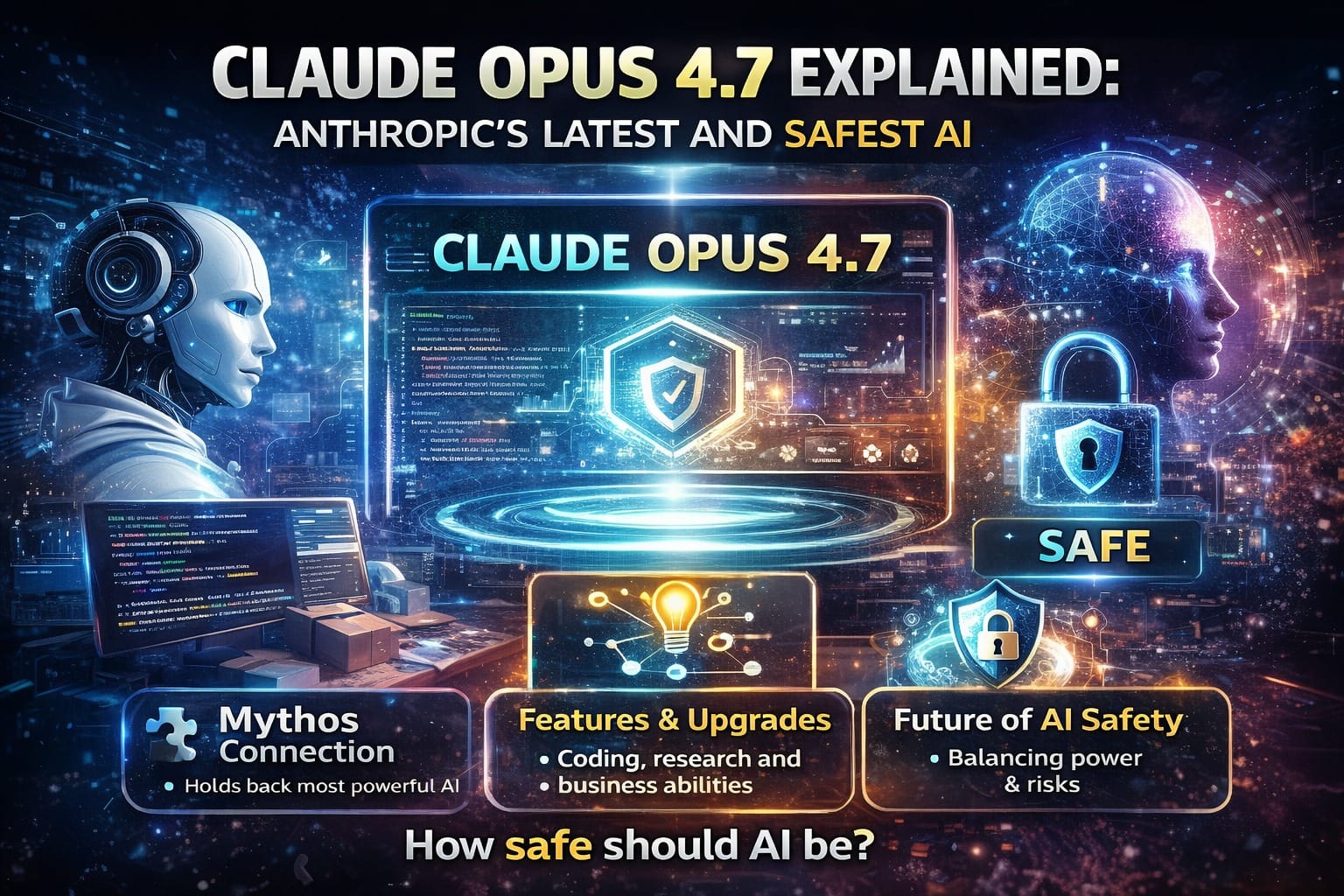
Introduction: Why Claude Opus 4.7 Is Making Global Headlines
In April 2026, Anthropic released its latest flagship AI model—Claude Opus 4.7.
At first glance, it looks like just another upgrade in the AI race.
But if you look deeper, this release signals something much bigger:
A shift toward controlled intelligence, where capability is no longer the only priority—safety is.
Claude Opus 4.7 is not just about better performance.
It is about balancing power, accessibility, and risk—especially in a world where AI is becoming dangerously capable.
What Is Claude Opus 4.7? (Simple Explanation)
Claude Opus 4.7 is:
- The latest version of Anthropic’s most powerful public AI model
- Positioned between:
- Everyday AI tools
- And a highly restricted model called Mythos
It is designed to:
- Solve complex problems
- Assist in coding and research
- Generate content and insights
- Operate in enterprise environments
But with one key difference:
It is intentionally not the most powerful model Anthropic has built.
The Mythos Factor: Why Opus 4.7 Is Not the Most Powerful AI
To understand Claude Opus 4.7, you must understand Claude Mythos.
Mythos is:
- A next-generation AI model
- Far more powerful than Opus 4.7
- Currently not publicly released
Why?
Because of its capabilities.
Reports suggest Mythos can:
- Detect thousands of critical software vulnerabilities
- Generate exploit-level insights
- Analyze complex systems at unprecedented depth
This level of intelligence raises serious concerns:
- Cybersecurity threats
- Misuse by bad actors
- Global digital risk
So Where Does Opus 4.7 Fit?
Claude Opus 4.7 is essentially:
A controlled version of next-gen AI, made safe for public and enterprise use.
It acts as a bridge between:
- Safe AI (today)
- And ultra-powerful AI (future)
Key Features of Claude Opus 4.7
While full technical details are still emerging, early insights highlight major upgrades:
1. Enhanced Coding & Engineering Capabilities
Claude Opus 4.7 significantly improves:
- Code generation
- Debugging
- Software architecture understanding
It builds upon earlier versions like Opus 4.6, which already:
- Supported agent-based workflows
- Could plan and execute complex tasks autonomously
2. Advanced Image & Multimodal Understanding
The model now better handles:
- Visual inputs
- Document analysis
- Slide creation and structured outputs
This makes it useful for:
- Business reports
- Presentations
- Design workflows
3. Improved Instruction Following
One of the biggest upgrades is:
Better understanding of user intent.
This means:
- Fewer hallucinations
- More accurate outputs
- Higher reliability for professional use
4. Cybersecurity Awareness (A Major Focus)
Unlike previous models, Opus 4.7 includes:
- Built-in safeguards against misuse
- Detection of risky prompts
- Restrictions on harmful outputs
This is directly inspired by learnings from the Mythos model.
5. Enterprise-Ready AI
Claude Opus 4.7 is already being tested by:
- Notion
- Shopify
- Intuit
This shows its positioning as:
A serious business AI tool, not just a chatbot.
Claude Opus 4.7 vs Opus 4.6: What Has Changed?
To understand the upgrade, let’s look at what Opus 4.6 already offered:
- 1 million token context window
- Adaptive thinking
- Agent-based execution
- Context compaction for long tasks
What 4.7 Improves
- Better reasoning consistency
- Improved multimodal capabilities
- Stronger safety layers
- More refined enterprise performance
Key Insight
Opus 4.7 is not a radical leap.
It is a refinement + control upgrade.
Why Anthropic Is Holding Back Mythos (And Why It Matters)
This is the most important part of the story.
Anthropic is not releasing its most powerful AI.
Instead, it is:
- Testing it privately
- Limiting access to select organizations
- Studying its risks
What This Means for the AI Industry
We are entering a new phase:
Not all AI will be publicly available anymore.
AI companies are now deciding:
- What level of intelligence is “safe enough”
- Who should access powerful models
- And when to release them
The Bigger Debate: Safety vs Innovation
Claude Opus 4.7 represents a larger philosophical shift.
Old Approach
- Build the most powerful AI
- Release it widely
New Approach
- Build powerful AI
- Restrict access
- Release safer versions
Why This Matters
Because AI is now capable of:
- Writing code
- Breaking systems
- Influencing decisions
And that comes with risk.
Criticism and Controversy Around Opus 4.7
Not everyone is impressed.
Some users have raised concerns that:
- AI models are becoming less powerful over time
- Companies are prioritizing premium models
- Public versions are being “limited”
The Real Concern
Are we entering an era where only big companies get the best AI?
This raises questions about:
- Accessibility
- Innovation
- Digital inequality
Is Claude Opus 4.7 Better Than ChatGPT and Gemini?
This is a common question.
Claude Opus 4.7 Strengths
- Deep reasoning
- Long context understanding
- Safer outputs
Competitor Strengths
- OpenAI → broader ecosystem
- Google Gemini → strong multimodal integration
Reality Check
No single model is “best.”
Each is optimized differently.
Real-World Use Cases of Claude Opus 4.7
Claude Opus 4.7 is designed for:
1. Developers
- Code generation
- Debugging
- System design
2. Businesses
- Report generation
- Data analysis
- Workflow automation
3. Content Creators
- Blogs
- Scripts
- Marketing content
4. Cybersecurity Professionals
- Risk detection
- System analysis
- Threat modeling
Future of Claude and AI Models
Claude Opus 4.7 is just a step.
The real future lies in:
- Mythos-level intelligence
- Controlled deployment
- AI governance
What We Can Expect
- Tiered AI access (basic vs advanced)
- Stronger regulations
- Limited public releases of powerful models
Final Verdict: Is Claude Opus 4.7 a Breakthrough or a Controlled Evolution?
Claude Opus 4.7 is not about:
- Breaking records
- Showing off power
It is about:
Responsible progress.
Final Insight
The future of AI will not be defined by how powerful it is…
but by how responsibly it is controlled.
Subscribe to our YouTube Channel The Logic Stick for more video insights