







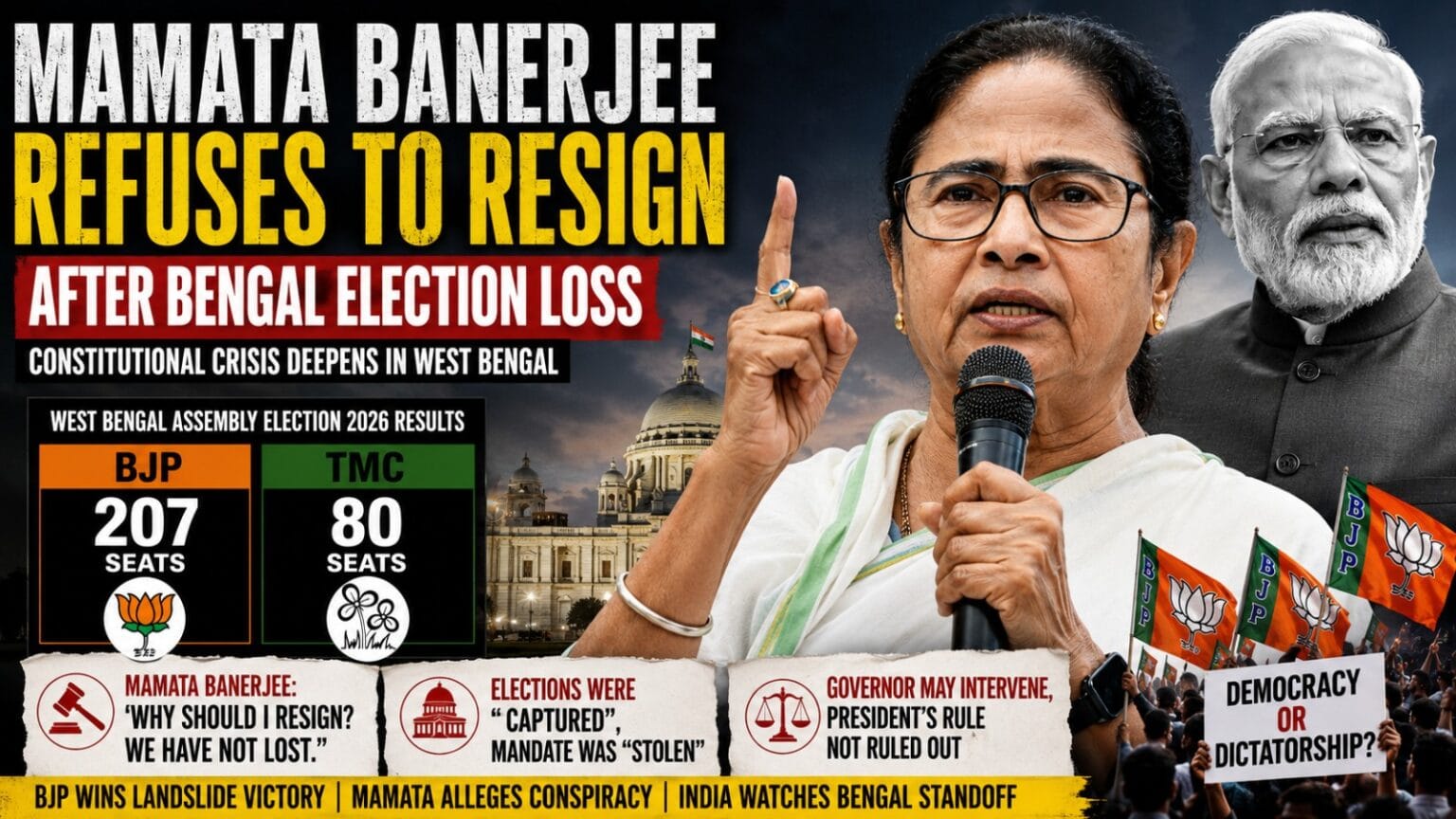
West Bengal politics has entered uncharted territory after Chief Minister Mamata Banerjee refused to resign despite her party’s crushing defeat in the 2026 West Bengal Assembly elections. The dramatic political standoff has triggered intense debate over constitutional norms, democratic ethics, and the growing dominance of Prime Minister Narendra Modi and the BJP across India.
The unprecedented development comes after the Bharatiya Janata Party (BJP) secured a historic landslide victory in West Bengal, winning 207 out of 294 seats and ending the 15-year rule of Banerjee’s Trinamool Congress (TMC). Despite the defeat, Banerjee has publicly declared that she will not step down, alleging that the election mandate was “stolen” and manipulated through conspiracy and institutional interference.
BJP’s Historic Victory In West Bengal 2026
The 2026 West Bengal Assembly election is being described as one of the biggest political shifts in modern Indian politics. For decades, Bengal had remained one of the few major states resistant to BJP dominance. However, the 2026 results completely transformed the political map of the state.
According to election data, the BJP won 207 seats, while the TMC was reduced to just 80 seats — a dramatic fall from its dominant position in previous elections.
The defeat was particularly symbolic because Mamata Banerjee herself reportedly lost her constituency, marking one of the biggest personal setbacks of her political career.
Political analysts say the BJP’s victory reflects a combination of anti-incumbency, organisational expansion, aggressive campaigning, and Prime Minister Narendra Modi’s continued national influence.
Why Mamata Banerjee Refused To Resign
Following the election results, Mamata Banerjee stunned political observers by refusing to submit her resignation as Chief Minister.
Addressing party leaders and supporters, Banerjee alleged that the elections were “captured,” claiming that democratic institutions and the Election Commission had failed Bengal. She argued that the BJP’s mandate did not represent the true will of the people.
Banerjee reportedly stated:
“Why should I resign? We have not lost.”
She also described the election outcome as an “atrocity” and instructed newly elected TMC MLAs to wear black in protest against what she called electoral injustice.
Her refusal has now sparked discussions about whether India is witnessing one of the most serious constitutional confrontations in state politics in decades.
Also read – Manipur Violence Explained
What Does The Constitution Say?
The Indian Constitution does not explicitly mention what happens if a Chief Minister refuses to resign after losing an election. However, constitutional experts say the legitimacy of a government depends on majority support in the Legislative Assembly.
Legal experts quoted in multiple reports suggest that once the Assembly term expires and a new majority is established, the outgoing Chief Minister cannot continue indefinitely.
Former Chief Election Commissioner S.Y. Quraishi reportedly stated that the Governor has the authority to seek the Chief Minister’s resignation and, in extreme circumstances, recommend President’s Rule under Article 356 if constitutional machinery breaks down.
NDTV also reported that the matter could eventually reach the Supreme Court if the standoff escalates further.
Governor’s Role In The Crisis
West Bengal Governor RN Ravi is expected to play a critical role in resolving the situation.
Under constitutional procedure, the Governor invites the leader of the majority party to form the government. If the outgoing Chief Minister refuses to resign despite lacking majority support, the Governor may intervene directly.
Reports indicate that constitutional experts believe the Governor could formally ask Mamata Banerjee to vacate office once the Assembly’s term ends.
This has raised fears of a direct confrontation between Raj Bhavan and the TMC leadership.
Mamata Banerjee’s Allegations Against Election Commission
Mamata Banerjee has repeatedly accused the Election Commission of bias and misconduct during the election process.
She alleged that votes were manipulated and claimed that around 100 seats were “forcibly taken.” However, no public evidence has yet been produced to support these allegations.
The Election Commission has denied allegations of irregularities and maintained that the elections were conducted according to established rules and procedures.
The controversy has further intensified debates around electoral transparency and institutional trust in India.
Rising Concerns Over One-Party Dominance In India
The Bengal election outcome has reignited discussions about the growing dominance of the BJP under Narendra Modi.
International media outlets, including The Guardian and The Wall Street Journal, described the BJP’s Bengal victory as a major milestone in the party’s expansion across India.
Political commentators argue that regional parties are increasingly struggling against the BJP’s massive organisational machinery, financial resources, and national appeal.
Supporters of Mamata Banerjee claim the Bengal defeat reflects a larger threat to federal politics and regional autonomy. Meanwhile, BJP supporters view the victory as proof of public dissatisfaction with TMC governance and corruption allegations.
Political Reactions Across India
The crisis has triggered sharp reactions from political leaders across the country.
Senior BJP leaders accused Mamata Banerjee of insulting democracy by refusing to accept the election verdict. Union Minister Dharmendra Pradhan described the situation as “democracy being held at gunpoint.”
On the other hand, opposition leaders sympathetic to Banerjee questioned the Election Commission’s neutrality and warned against excessive centralisation of political power.
The issue is now likely to dominate national political discourse in the coming weeks.
TMC Faces Its Biggest Crisis In 15 Years
The election defeat marks the biggest crisis for the Trinamool Congress since it came to power in 2011 by ending the Left Front’s 34-year rule in Bengal.
Mamata Banerjee had built her political image as Bengal’s most powerful regional leader and one of the strongest anti-BJP faces in India. The 2026 election results have dramatically weakened that position.
Reports also suggest that security barricades outside Banerjee’s residence have already been removed following the electoral defeat, symbolising the end of an era in Bengal politics.
Meanwhile, several administrative changes are reportedly taking place in state offices ahead of the BJP’s expected takeover.
Could President’s Rule Be Imposed?
One of the biggest questions now is whether West Bengal could briefly come under President’s Rule.
Constitutional experts cited by The Telegraph suggested that if the transition of power becomes impossible due to refusal to resign, Article 356 could theoretically be invoked for a short duration until a new government is sworn in.
However, such a move would be politically explosive and could trigger nationwide protests and legal challenges.
BJP’s Next Chief Minister Face
After the landslide victory, attention has shifted toward who will become the BJP’s first Chief Minister in West Bengal.
Names like Suvendu Adhikari, Dilip Ghosh, Samik Bhattacharya, and Agnimitra Paul are being discussed within political circles.
Suvendu Adhikari, who previously defeated Mamata Banerjee in Nandigram in 2021, is currently seen as one of the strongest contenders due to his aggressive anti-TMC positioning and organisational influence.
Why This Political Crisis Matters Nationally
The Bengal political crisis is not just a regional issue. It has national implications for Indian democracy, federalism, constitutional governance, and opposition politics.
West Bengal had long been considered one of the BJP’s toughest political frontiers. The party’s massive victory now signals a dramatic expansion of its influence into eastern India.
At the same time, Mamata Banerjee’s refusal to resign raises difficult constitutional questions that India has rarely faced before.
The coming days will determine whether the transition of power in Bengal remains peaceful or turns into one of the most contentious political confrontations in recent Indian history.
Conclusion
Mamata Banerjee’s refusal to resign after the TMC’s crushing defeat in the 2026 West Bengal elections has created an unprecedented constitutional and political crisis. While Banerjee claims the election was manipulated, the BJP insists the people of Bengal have delivered a clear democratic mandate.
As legal experts, constitutional authorities, and political parties prepare for the next phase of confrontation, West Bengal has become the centre of India’s biggest political drama of 2026.
Whether this crisis ends through constitutional negotiation, judicial intervention, or political compromise, its impact on Indian politics is likely to be felt for years to come.
Subscribe to our YouTube Channel The Logic Stick for more video insights