







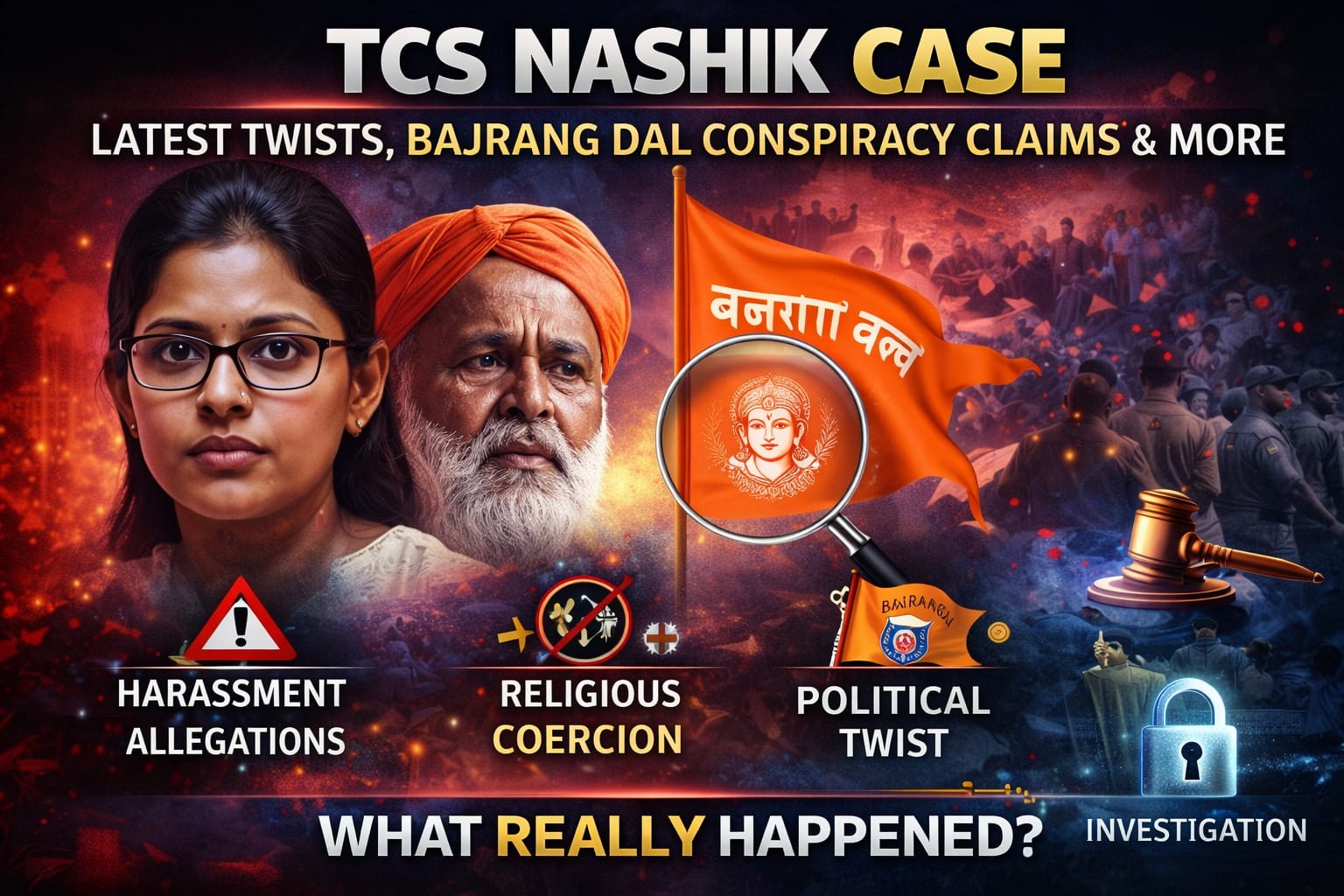
The TCS Nashik case has rapidly evolved from a single workplace complaint into one of the most serious corporate controversies in India’s IT sector in recent years. What initially appeared to be an isolated allegation has now expanded into multiple FIRs, arrests, protests, political involvement, and even legal discussions at the national level.
At its core, this case is not just about one incident of harassment. It is about systemic failure, alleged HR negligence, multiple accused individuals, and a deeply polarising narrative involving religion, workplace safety, and corporate accountability.
To understand the full picture, it is important to go step by step—how it started, who is involved, what the allegations are, and what lies ahead.
How the TCS Nashik Case Started
The controversy traces back to early 2026, when a complaint was filed by a woman employee at the TCS Nashik BPO unit. According to initial reports, her behaviour had changed significantly, which triggered concern among colleagues and eventually led to a formal complaint being registered.
This first complaint became the turning point.
What began as a personal grievance soon opened what investigators later described as a “larger pattern” of misconduct inside the office.
As police began investigating, more women started coming forward, and the case expanded far beyond its original scope.
From One Complaint to Multiple FIRs
Within weeks, the situation escalated dramatically.
Authorities registered multiple FIRs—eventually reaching around 9 separate cases, all linked to allegations of:
- Sexual harassment
- Emotional manipulation
- Coercion in relationships
- Alleged religious pressure or conversion attempts
These cases were not limited to a single individual but pointed towards multiple employees allegedly involved across different levels of the organisation.
This is where the case shifted from an individual misconduct issue to what many began calling a possible organised pattern inside the workplace.
Also read – Delimitation Bill India Explained
Who Are the Accused?
The investigation has named several individuals, including team leaders and senior employees.
One of the most significant names to emerge is Ashwini Chainani, reportedly an HR or senior managerial figure, whose role has drawn intense scrutiny.
According to reports:
- She has been arrested and remanded to judicial custody
- She is accused of failing to act on complaints
- Allegations suggest she may have discouraged victims from reporting harassment
This aspect of the case is critical because it shifts the narrative from crime to cover-up.
Internal communication reportedly included dismissive responses such as asking victims to “let it go,” raising serious questions about HR accountability and workplace ethics.
The Role of HR: The Most Controversial Angle
The most disturbing part of the TCS Nashik case is not just the alleged harassment—it is the claim that complaints were ignored or suppressed.
If proven true, this represents:
- Failure of POSH (Prevention of Sexual Harassment) mechanisms
- Breakdown of corporate governance
- Lack of safe reporting systems
The involvement of HR, especially someone in a leadership role like Ashwini Chainani, has led to a critical question:
Was this just negligence—or was it active suppression?
Police Investigation and Arrests
The Nashik police launched a full-scale investigation after the complaints surfaced.
So far:
- Multiple individuals have been arrested
- Some accused are linked to multiple cases simultaneously
- Police are actively searching for digital evidence, including phones
- More victims are expected to come forward
Authorities have even indicated that this may not be a closed case yet, and the scope could expand further as new testimonies emerge.
The Religious Angle: Facts vs Narrative
One of the most sensitive aspects of the TCS Nashik case is the alleged religious conversion angle.
Some complaints have claimed that:
- Women were pressured or influenced regarding religion
- Relationships were allegedly used as a means of coercion
This has triggered:
- Public outrage
- Political involvement
- Protests and rallies
However, it is important to understand that:
- These claims are still under investigation
- There are conflicting narratives, with some calling it a conspiracy
- The truth will depend on evidence presented in court
The religious angle has amplified the case nationally, making it more than just a corporate issue—it has become a social and political flashpoint.
Public Reaction and Protests
The case has led to widespread public outrage in Nashik and beyond.
- Women-led protests and rallies have been organised
- Political leaders have joined demonstrations
- There are demands for strict punishment
One such protest, a large bike rally, highlighted concerns over:
- Workplace safety
- Women’s dignity
- Accountability of corporations
The case has now become symbolic of a larger issue:
Are workplaces truly safe for women in India?
TCS Response and Internal Action
Tata Consultancy Services has responded by:
- Launching an internal investigation led by senior leadership
- Suspending accused employees
- Cooperating with police authorities
Additionally, the company has taken a significant operational step:
- Employees at the Nashik office were asked to work from home temporarily
This decision was taken due to safety concerns and rising tensions around the office premises.
Why This Case Is Bigger Than It Looks
The TCS Nashik case is not just about one company. It highlights deeper systemic issues:
1. Corporate Silence
When multiple complaints exist but no action is taken, it indicates institutional failure.
2. Fear Among Employees
Victims may hesitate to speak due to:
- Job insecurity
- Social pressure
- Lack of trust in HR
3. Power Dynamics
Many accused were reportedly in positions of authority, which may have:
- Enabled misconduct
- Prevented early reporting
4. Delayed Justice
The biggest question remains:
Why did it take years for this to surface?
Can Victims Still Get Justice?
Yes, legally, victims can still seek justice.
The case is currently progressing through:
- Criminal investigation
- Judicial custody and court proceedings
- Potential expansion of FIRs
If evidence is strong:
- Accused can face serious criminal charges
- Corporate penalties may also follow
- Compensation mechanisms may be activated
However, justice in such cases depends heavily on:
- Witness testimonies
- Digital evidence
- Institutional cooperation
What Happens Next?
The future of this case depends on three parallel tracks:
1. Police Investigation
This will determine the criminal liability of the accused.
2. Internal Corporate Audit
TCS must identify:
- Process failures
- HR accountability
- Systemic gaps
3. Judicial Outcome
Courts will ultimately decide:
- Whether allegations are proven
- The extent of punishment
Additionally, there is increasing pressure for:
- Stronger workplace laws
- Better POSH implementation
- Independent complaint systems
NEW TWIST: “Scripted Conspiracy” Claim by Accused’s Family
The biggest recent development has completely shifted the narrative.
A relative (uncle) of one of the accused has publicly claimed that:
- The case is “not a major scandal”
- It is a “scripted conspiracy”
- Bajrang Dal is allegedly involved in amplifying or framing the issue
These claims stand in direct contradiction to the seriousness of the allegations and ongoing investigation.
This has now created two opposing narratives:
Narrative 1 (Investigation Side)
- Multiple victims
- Organized misconduct
- Serious criminal charges
Narrative 2 (Defense Side)
- Exaggeration of facts
- Political or ideological influence
- Alleged targeting by external groups
This clash of narratives is now at the heart of the controversy.
Another Twist: Accused Claims Assault in Custody
Adding further complexity, one of the accused has alleged:
- Physical assault while in police custody
This raises new concerns about:
- Investigation fairness
- Police conduct
- Legal integrity of the case
Investigation Status: What We Know So Far
The case is still evolving, with several developments:
- SIT actively investigating
- Digital evidence (phones, chats) being tracked
- More victims expected to come forward
- Several accused already arrested
- Corporate internal probe ongoing
TCS has also:
- Suspended accused employees
- Initiated internal inquiry
- Reiterated zero tolerance policy
Why This Case Is So Complex
The TCS Nashik case is no longer just a legal matter. It sits at the intersection of:
1. Workplace Safety
Are corporate systems truly protecting employees?
2. Power and Silence
Did authority figures suppress complaints?
3. Religion and Politics
Is the religious angle real, exaggerated, or misused?
4. Media Amplification
Is public perception being shaped faster than facts?
The Core Question: Truth vs Narrative
At this stage, the biggest challenge is separating:
- Verified facts
- Ongoing allegations
- Public narratives
- Political interpretations
Because right now, the case is not just being fought in court—
it is being fought in media, public opinion, and ideological space.
What Happens Next?
The future of the TCS Nashik case will depend on:
1. Evidence
Digital proof, testimonies, and forensic analysis
2. Court Proceedings
Legal scrutiny of all allegations and counterclaims
3. Corporate Accountability
Internal audits and HR responsibility
4. Public Pressure
Protests and media coverage influencing pace of action
Final Analysis: A Case That Changed the Conversation
The TCS Nashik controversy is now bigger than a workplace issue.
It has become a national debate on:
- Corporate ethics
- Women’s safety
- Religious narratives
- Institutional accountability
And now, with conspiracy claims entering the picture, one thing is clear:
This case is no longer just about what happened—
it is about what people believe happened.
Subscribe to our YouTube Channel The Logic Stick for more video insights