






Introduction: Why the Delimitation Bill Has Become India’s Biggest Political Flashpoint
In April 2026, India witnessed one of the most intense political debates in recent years—the Delimitation Bill controversy.
What was expected to be a technical and constitutional process suddenly turned into:
- A North vs South political battle
- A debate over fair representation
- A controversy linked with the Women’s Reservation Bill
- And a larger question about the future of Indian democracy
At the heart of this issue lies a simple but powerful question:
Who gets more political power in India—and how is that decided?
To understand this, we need to start from the basics.
What is Delimitation? (Explained in the Simplest Way)
Delimitation means:
Redrawing the boundaries of electoral constituencies based on population.
In India, this is done by the Delimitation Commission, an independent body whose decisions cannot be challenged in court.
The purpose is to ensure:
- Equal representation
- Fair distribution of voters
- Balanced political power
For example:
If one area has 10 lakh people and another has 2 lakh people, both cannot have equal representation. Delimitation corrects this imbalance.
Why is Delimitation Happening Now in 2026?
Here’s where things get interesting.
India has not done a full delimitation exercise based on population changes for decades.
Why?
Because in 1976, the government decided to freeze seat distribution to encourage population control.
That freeze was extended multiple times.
Now, the Constitution mandates:
The next delimitation must happen after the first census conducted after 2026.
But in 2026, the government is pushing for:
- A new delimitation framework
- Possibly using 2011 census data
- Along with a major increase in Lok Sabha seats
The Big Change: Lok Sabha May Increase From 543 to 850 Seats
One of the most controversial aspects of the Delimitation Bill is this:
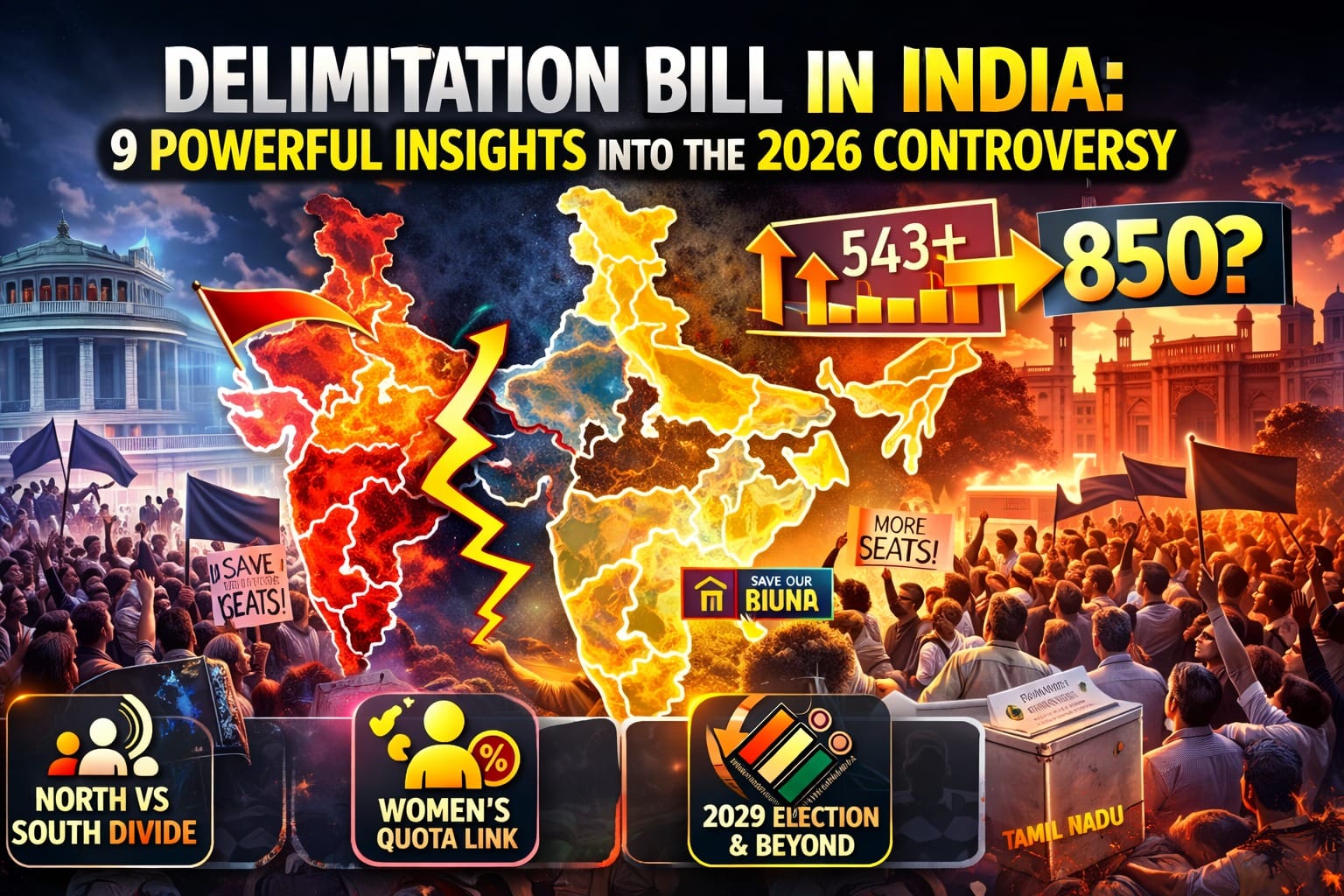
The Lok Sabha strength may increase from 543 to around 850 seats.
This is a massive jump.
Why is this being proposed?
Reason 1: Population Growth
India’s population has grown significantly since the last delimitation.
Reason 2: Women’s Reservation Bill
The 33% reservation for women needs:
- More seats
- New constituency structures
Reason 3: Political Expansion
More seats = more representation
But also = shift in political power
The Women’s Reservation Link: Why Delimitation Matters More Now
In 2023, India passed the Women’s Reservation Bill, which guarantees:
- 33% seats for women in Lok Sabha and state assemblies
But there’s a catch.
The bill will only be implemented:
After delimitation is completed.
This is why both issues are now connected.
The government plans to:
- Increase seats
- Redraw constituencies
- Then apply reservation
This has created suspicion among opposition parties.
The Core Controversy: Population-Based Representation
Now comes the most sensitive part.
If delimitation is done based on population:
- States with higher population growth will get more seats
- States with controlled population growth may lose relative power
And this is exactly where the controversy begins.
North vs South Divide: The Biggest Political Fault Line
Southern states like:
- Tamil Nadu
- Telangana
- Karnataka
- Andhra Pradesh
are strongly opposing the proposed delimitation.
Why?
Because they believe:
They are being punished for controlling population.
What Southern Leaders Are Saying
Tamil Nadu Chief Minister MK Stalin has openly protested, calling it:
- A threat to political rights
- A move that could reduce southern influence
He even called for a statewide black flag protest, asking citizens to oppose the move.
Telangana CM Revanth Reddy also warned:
- Increasing seats to 850 based on population could damage democracy
Why South India is Worried
Southern states have:
- Lower population growth
- Better implementation of family planning
But if seats are allocated purely based on population:
- Northern states may gain more seats
- Southern states may lose influence
Centre’s Argument: Why the Government Supports Delimitation
The central government has a different perspective.
It argues:
- No state will lose its existing seats
- All states will benefit from seat expansion
- Delimitation ensures fair representation
Some sources even claim:
Southern states will also see a 50% increase in seats
So the government says:
This is not about reducing power.
It’s about expanding representation.
But Why Is There So Much Distrust?
Because this is not just mathematics.
This is politics.
Critics argue:
- Even if seats increase, relative influence matters
- More seats in the north = more political dominance
This could:
- Change election outcomes
- Reduce the importance of southern states in forming governments
Is This “Power Reengineering”? The Big Allegation
Opposition leaders are calling this:
A move to “reengineer political power”
The argument is:
- Population-based delimitation favors states where BJP is stronger
- It could shift the balance in Parliament
This is why the issue has become so politically charged.
The Census Factor: Why 2011 Data is Controversial
Another key issue is:
Which census data should be used?
- 1971 Census → Old system
- 2011 Census → Proposed
- New Census → Not yet conducted
Some leaders argue:
- Using 2011 data is outdated
- It creates unfair advantages
Others say:
- Waiting for a new census will delay reforms
The Real Fear: Losing Political Voice
At its core, the delimitation controversy is about:
Representation = Power
If a state loses relative seats:
- Its voice weakens in Parliament
- Its influence in national decisions reduces
This is why the issue has triggered such strong reactions.
Why This Issue Matters for Every Indian
This is not just about politicians.
It affects:
- Policy decisions
- Budget allocation
- National priorities
Because representation directly impacts:
- Infrastructure
- Welfare schemes
- Economic focus
How Seat Distribution Could Change: The Real Numbers Game
Let’s simplify what could happen if delimitation is implemented based on population.
States Likely to Gain More Seats
- Uttar Pradesh
- Bihar
- Madhya Pradesh
- Rajasthan
These states have:
- Higher population growth
- Larger voter base
States That May Lose Relative Influence
- Tamil Nadu
- Kerala
- Karnataka
- Andhra Pradesh
Important clarification:
They may not lose absolute seats,
but they could lose relative power.
Why Relative Power Matters
In Parliament:
- Laws are passed by majority
- Governments are formed by numbers
So even if southern states gain seats—
If northern states gain much more,
they will dominate decision-making.
2029 Elections: A Completely Different Political Map?
If delimitation is completed before the 2029 general elections, India could see:
- A new electoral map
- Different coalition strategies
- Shift in political strongholds
What Could Change?
- National parties may focus more on Hindi belt states
- Regional parties may lose bargaining power
- Coalition politics may become more centralized
Key Insight
Delimitation is not just about seats.
It is about who decides the future of India.
The Women’s Reservation Factor: Opportunity or Political Tool?
The Women’s Reservation Bill promises:
- 33% seats for women
But because it is linked with delimitation:
- It cannot be implemented immediately
Two Perspectives
Supporters Say:
- Delimitation is necessary to ensure proper implementation
- It creates space for new reserved constituencies
Critics Say:
- Linking both delays women’s representation
- It is being used as a political timing strategy
Hidden Layer
If seats increase significantly:
- Women’s quota becomes easier to implement
- But also allows reshaping of constituencies
This dual effect is why the debate is intense.
The Caste and Reservation Angle (Often Ignored)
Another layer that is not openly discussed is:
How delimitation may impact caste-based politics.
In India:
- Electoral outcomes are deeply influenced by caste demographics
If constituency boundaries change:
- Caste dominance in certain seats may shift
- Reservation patterns may be recalibrated
Why This Matters
- Political parties rely on caste equations
- Delimitation can disrupt these equations
This makes it not just a population issue—
but a social power shift.
Urban vs Rural Power Shift
Delimitation may also impact:
- Urban constituencies
- Rural representation
With population growth:
- Urban areas may gain more seats
- Rural dominance may reduce in some regions
Impact
- More focus on urban issues
- Shift in development priorities
- Changing political narratives
The Federalism Debate: Is India’s Balance at Risk?
India is a federal country, meaning:
- Power is shared between Centre and States
But critics argue:
If delimitation shifts power heavily towards certain regions:
- Federal balance could weaken
- Regional voices may get diluted
Southern States’ Concern
Their argument is simple:
“We followed national policies like population control.
Now we are being penalized for it.”
Why This Issue Is Emotionally Charged
Unlike economic policies, delimitation touches:
- Identity
- Representation
- Regional pride
That’s why we are seeing:
- Black flag protests
- Political rallies
- Strong public reactions
This is not just policy.
This is perception of fairness.
Global Comparison: How Other Countries Handle This
Many democracies face similar issues.
United States
- Seats in Congress are adjusted after every census
- States gain or lose representation
Key Difference
In India:
- Population differences are far more extreme
- Regional imbalance is more sensitive
Possible Solutions: Can This Be Fixed?
To resolve the Delimitation Bill controversy, India may need a balanced approach.
1. Hybrid Formula (Population + Performance)
Instead of pure population:
- Combine population with:
- Development indicators
- Population control efforts
This ensures fairness.
2. Guaranteed Minimum Representation
Ensure:
- No state loses political relevance
- Maintain a minimum influence level
3. Phased Implementation
Instead of sudden changes:
- Introduce delimitation gradually
- Allow political systems to adapt
4. Transparent Communication
One of the biggest issues is:
- Lack of clarity
People fear what they don’t understand.
5. Independent Oversight
Although the Delimitation Commission is independent—
- More transparency can build trust
What Happens If This Is Not Resolved Properly?
If mishandled, the consequences could be serious:
- Increased regional divide
- Political instability
- Loss of trust in institutions
Worst Case Scenario
A perception that:
“Some states matter more than others”
This can damage the idea of national unity.
What Happens If It Is Done Right?
If implemented carefully:
- More accurate representation
- Stronger democracy
- Better policy alignment
Best Case Scenario
A system where:
- Every vote has equal value
- Every region feels represented
The Bigger Picture: India’s Democratic Evolution
India is at a turning point.
Delimitation is not just a process—
It is part of:
- Political modernization
- Demographic correction
- Institutional reform
Final Conclusion: The Real Question India Must Answer
The Delimitation Bill is forcing India to confront a difficult question:
Should representation be based purely on numbers…
or should it also consider fairness and effort?
Because:
- Population reflects reality
- But policies reflect intention
Final Insight
A democracy is not just about counting people.
It is about valuing every voice equally.
Subscribe to our YouTube Channel The Logic Stick for more video insights