







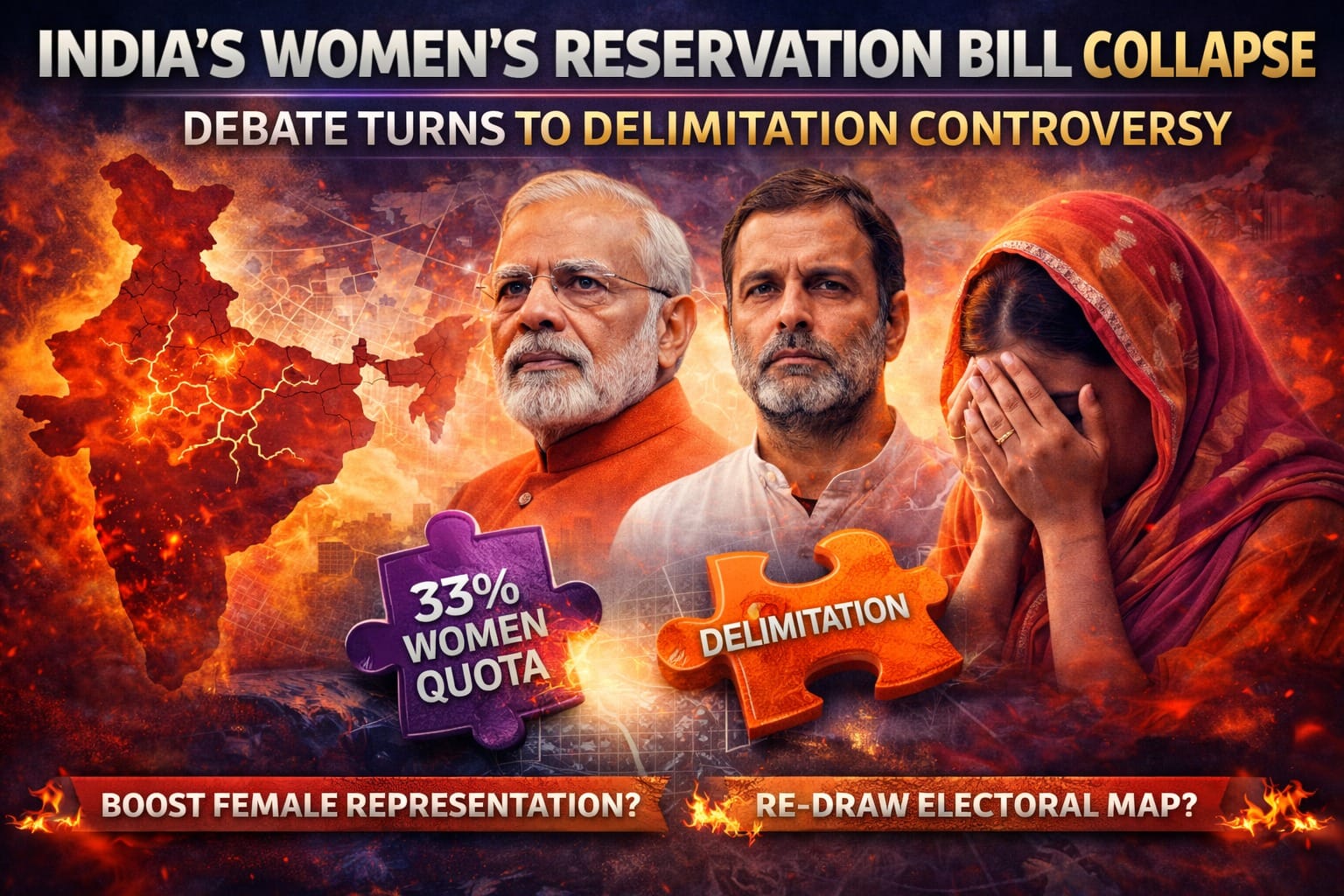
India’s Women’s Reservation Bill Collapse
India’s attempt to pass a landmark bill aimed at increasing female representation in Parliament has ended in a dramatic political setback. What could have been one of the most significant reforms in Indian democracy—reserving 33% seats for women—instead turned into a heated national controversy.
At the heart of this failure lies a deeper issue: delimitation, or the redrawing of electoral boundaries. Critics have accused the government of using women’s empowerment as a political cover to reshape India’s electoral map, leading to one of the most intense parliamentary confrontations in recent years.
This is not just a story about a failed bill. It is a story about power, representation, federal balance, and trust in democratic processes.
The Women’s Reservation Bill That Could Have Changed Indian Politics
The proposed legislation was part of a broader reform package introduced by the government to:
- Reserve one-third (33%) of seats for women in Lok Sabha and state assemblies
- Expand the number of parliamentary seats significantly
- Link implementation to a new delimitation exercise
The idea of women’s reservation is not new. In fact, India had already passed a version of this reform in 2023 under the Nari Shakti Vandan Adhiniyam, which promised 33% reservation but delayed implementation until after the next census and delimitation exercise.
The 2026 women’s reservation bill aimed to fast-track this process, bringing women’s reservation into effect sooner. But the way it was structured became its biggest weakness.
The Core Problem: Linking Women’s Reservation to Delimitation
The government chose to tie women’s reservation to delimitation, a process that redraws electoral boundaries based on population data.
This linkage immediately raised alarm.
Delimitation in India is one of the most sensitive political issues because it directly affects:
- Number of seats each state gets
- Political representation across regions
- Electoral power balance
The proposed plan suggested:
- Increasing Lok Sabha seats from 543 to around 850
- Redrawing constituencies based on the 2011 census
At first glance, this might seem like a technical reform. But politically, it carries massive consequences.
Why Delimitation Became So Controversial
The biggest concern came from southern states like Tamil Nadu and Kerala, which have successfully controlled population growth over the decades.
Under a population-based delimitation system:
- States with higher population growth (mostly northern states) gain more seats
- States with lower population growth (mostly southern states) lose relative influence
This creates a perception of punishment for development success.
Critics argued that the new delimitation exercise would:
- Shift power toward northern states
- Strengthen the ruling party’s electoral advantage
- Disrupt India’s federal balance
This fear became the central reason why opposition parties united against the bill.
The Political Accusation: “Using Women as a Cover”
The opposition did not oppose women’s reservation itself. In fact, most parties supported it.
Their objection was clear:
Why link women’s representation to delimitation at all?
Opposition leaders accused the government of:
- “Hiding behind women” to push electoral restructuring
- Using the bill as a “guise to redraw India’s electoral map”
- Attempting to “bulldoze delimitation through the backdoor”
This framing changed the narrative completely.
What began as a gender equality reform was now seen as a political strategy.
Also read – SIR Row in India Explained
The Parliamentary Showdown: Why the Bill Failed
As a constitutional amendment, the bill required a two-thirds majority in Parliament.
Despite government backing, the numbers fell short.
- Votes in favor: 298
- Votes against: 230
This marked a rare political defeat for the government, especially considering its long-standing dominance.
More importantly, it showed something unusual in Indian politics:
Opposition unity.
Different political parties, often divided on multiple issues, came together to oppose the bill because of the delimitation linkage.
The Southern States vs Northern States Divide
The controversy exposed a deeper structural divide within India.
Southern States’ Concerns:
- Fear of losing parliamentary representation
- Concern over reduced political voice
- Resistance to population-based redistribution
Northern States’ Position:
- Larger populations justify more representation
- Demand for proportional seat allocation
This is not just a political issue—it is a demographic conflict.
And delimitation sits right at the center of it.
Government’s Defense: Why It Linked the Two
The government defended its decision by arguing that:
- Women’s reservation requires seat restructuring
- Delimitation is necessary to implement quotas effectively
- Population-based representation is constitutionally fair
Officials also claimed that:
- No state would lose absolute seats
- Representation would increase for all
However, critics remained unconvinced, arguing that relative power matters more than absolute numbers.
Why This Failure Matters for Women
India currently has:
- Around 14% women in Lok Sabha
- Around 17% in Rajya Sabha
This is significantly lower than global averages.
The failure of this bill means:
- Continued delay in women’s political representation
- Missed opportunity for structural reform
- Another chapter in a decades-long struggle
Many leaders called it a “lost moment for gender equality”.
The Bigger Question: Reform or Political Strategy?
This entire episode raises a critical question:
Was the bill genuinely about women’s empowerment—or was it politically engineered?
The answer may lie somewhere in between.
On one hand:
- Women’s reservation is widely supported
- It is a long-pending reform
On the other:
- Linking it to delimitation made it controversial
- Timing and structure raised suspicion
This duality is what ultimately led to the bill’s failure.
Historical Context: Why This Debate Keeps Returning
The idea of reserving seats for women has existed for decades.
- First major attempt: 1990s
- Bill passed in Rajya Sabha: 2010 (but lapsed)
- Major breakthrough: 2023 Act
Yet, implementation has always been delayed due to:
- Political disagreements
- Structural complexities
- Electoral implications
The 2026 attempt was supposed to break this cycle—but instead reinforced it.
What Happens Next?
The government has indicated that it will:
- Continue pushing for women’s reservation
- Possibly reintroduce a revised bill
Opposition leaders have suggested a clear alternative:
Decouple women’s reservation from delimitation.
This could:
- Reduce political resistance
- Enable faster implementation
- Build broader consensus
The Future of Delimitation in India
Regardless of the bill’s failure, delimitation itself remains inevitable.
According to constitutional provisions:
- It will occur after the next census
- It will redefine India’s electoral structure
The real question is not whether delimitation will happen—but:
How it will be implemented, and who benefits from it.
Final Analysis: A Reform That Collapsed Under Its Own Weight
The failure of the Women’s Reservation Bill in 2026 is a classic example of how good intentions can be derailed by political strategy.
By linking two powerful but controversial ideas—
gender representation and electoral restructuring—
the government created a bill that became too complex, too sensitive, and too contested to pass.
In the end:
- Women lost a historic opportunity
- Parliament witnessed rare political unity
- India was forced to confront deeper questions about democracy and representation
And perhaps the biggest takeaway is this:
In politics, how you design a reform can be just as important as the reform itself.
Subscribe to our YouTube Channel The Logic Stick for more video insights