







Introduction
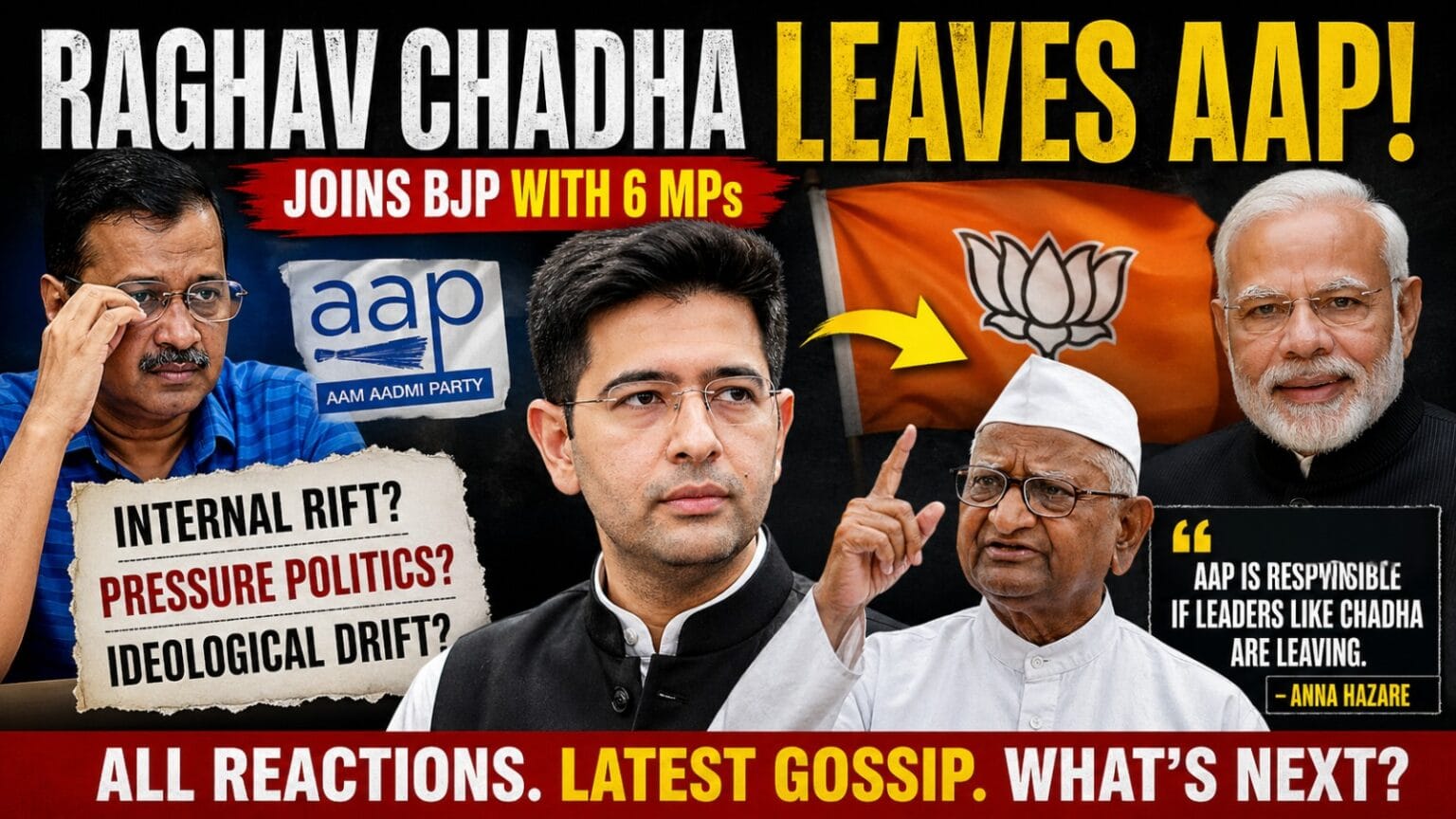
In a dramatic political development that has shaken India’s opposition landscape, Rajya Sabha MP Raghav Chadha has officially exited the Aam Aadmi Party and joined the Bharatiya Janata Party (BJP), along with six other AAP MPs. Effective from late April 2026, this mass exit has triggered intense political debate, raising questions about internal rifts within AAP, ideological shifts, and the future of opposition politics in India.
The development has drawn strong reactions from political leaders across party lines, including a significant statement from social activist Anna Hazare, whose anti-corruption movement originally gave birth to AAP.
What Happened: Raghav Chadha’s Exit from AAP
On April 24, 2026, Raghav Chadha, once considered a close aide of AAP chief Arvind Kejriwal, resigned from the party and joined the BJP along with six other Rajya Sabha MPs. This move effectively met the two-thirds requirement under India’s anti-defection law, allowing them to avoid disqualification by merging with another party.
The exit followed:
- Chadha’s removal as Deputy Leader in Rajya Sabha
- Growing internal tensions within AAP
- Allegations of being sidelined and “silenced” within the party
Chadha reportedly described his exit as not a defeat, but a consequence of internal suppression, signaling deep cracks within AAP’s leadership structure.
Anna Hazare’s Reaction: “AAP Lost Its Path”
One of the most impactful reactions came from Anna Hazare, who played a foundational role in the anti-corruption movement that led to AAP’s creation.
Key Statements by Anna Hazare
- If AAP had followed the “right path,” leaders like Chadha would not have left
- The exit indicates internal problems and ideological drift within the party
- Leaders may have faced difficulties or dissatisfaction within AAP
In a sharper remark, Hazare also criticized party-switching for personal reasons, calling it “not right” in a democracy.
Interpretation
Hazare’s comments highlight:
- Disappointment with AAP’s current direction
- Concerns over deviation from its original anti-corruption ideals
- A broader critique of political opportunism
Political Reactions: War of Narratives Begins
The exit has triggered a full-scale political reaction across parties.
AAP’s Response: “Betrayal and Pressure Politics”
Leaders from AAP strongly criticized the move:
- Arvind Kejriwal alleged BJP used central agencies like ED and CBI to pressure MPs
- Party leaders called the move a betrayal of Punjab voters
- AAP hinted at legal action and disqualification attempts
AAP’s narrative:
“This is not defection, this is forced political engineering.”
Also read – Manipur Violence Explained
BJP’s Response: “AAP in Disarray”
From the BJP side:
- Leaders claimed AAP is facing internal collapse
- They projected Chadha’s entry as proof of AAP’s weakening structure
BJP’s narrative:
“Leaders are leaving because AAP is failing internally.”
Opposition Voices: “Fear or Greed?”
Other opposition leaders also weighed in:
- Tejashwi Yadav suggested such moves happen due to “fear or greed”
- Some leaders accused BJP of running an “Operation Lotus-style strategy” to break opposition parties
AAP Leaders’ Counterattack
AAP spokespersons and leaders:
- Accused BJP of poaching MPs through pressure tactics
- Claimed Chadha had been aligned with BJP interests for a while
Inside the Fallout: What Led to the Exit?
Multiple factors appear to have contributed:
1. Internal Power Struggle
- Chadha’s removal from key positions
- Growing differences with top leadership
2. Ideological Drift
- Claims that AAP has moved away from its founding principles
- Echoed by Anna Hazare and former insiders
3. Political Strategy and Pressure
- Allegations of central agencies influencing decisions
- Strategic realignment before upcoming elections
4. Punjab Factor
- Several defecting MPs were linked to Punjab politics
- AAP’s stronghold state now under scrutiny
Why This Exit Matters for Indian Politics
This is not just an individual exit — it signals a major shift in political equations.
Impact on AAP
- Loss of key leadership figures
- Questions over internal unity
- Potential weakening in Parliament
Impact on BJP
- Strengthens numbers and influence
- Signals success in attracting opposition leaders
Impact on Opposition Politics
- Raises concerns about fragmentation
- Could affect future coalition dynamics
The Bigger Question: Is AAP Facing an Identity Crisis?
Since its formation in 2012, AAP has seen several high-profile exits. Chadha’s departure adds to a pattern of leaders leaving due to:
- Leadership disagreements
- Ideological differences
- Organizational challenges
Anna Hazare’s remarks reinforce the idea that:
AAP may be drifting from its original anti-corruption and reform-driven identity.
Conclusion
The exit of Raghav Chadha from the Aam Aadmi Party and his move to the Bharatiya Janata Party marks a defining moment in Indian politics.
With:
- Strong criticism from Anna Hazare
- Allegations and counter-allegations from all sides
- Legal and ideological implications
This political episode is far from over.
The real question now is:
Is this a one-off rebellion, or the beginning of a larger shift in India’s opposition landscape?
Subscribe to our YouTube Channel The Logic Stick for more video insights