







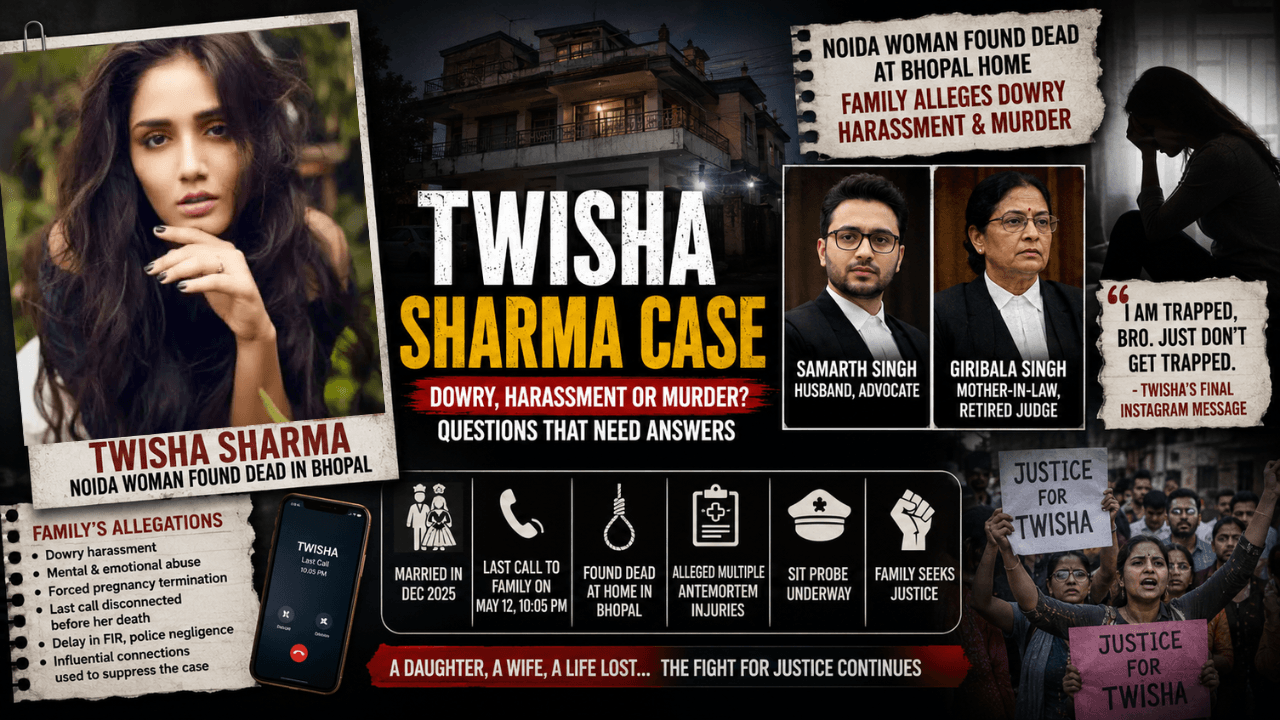
Twisha Sharma Case Explained
The death of Twisha Sharma, a Noida-based woman who was found dead at her matrimonial home in Bhopal just months after her marriage, has sparked nationwide outrage and raised serious questions about dowry harassment, domestic violence, influence in the justice system, and women’s safety in India.
The case has become one of the most discussed crime stories of 2026 after Twisha Sharma’s family accused her husband and in-laws of sustained mental harassment, abuse, dowry-related pressure, and obstruction of justice. Multiple media reports suggest the case has now intensified due to allegations involving influential judicial connections, delayed FIR registration, suspicious injuries, and emotional messages reportedly sent by Twisha before her death.
The Madhya Pradesh Police has formed a Special Investigation Team (SIT) to investigate the matter, while protests by Twisha Sharma’s family continue in Bhopal.
Who Was Twisha Sharma?
Twisha Sharma was a woman originally from Noida, Uttar Pradesh. According to reports, she married Bhopal-based advocate Samarth Singh in December 2025 after the two reportedly met through a dating app in 2024.
Some reports described Twisha Sharma as a former “Miss Pune,” while others noted that she had left her professional life after marriage and moved to Bhopal to live with her husband and his family.
Her husband belongs to a family with strong judicial backgrounds:
- Her mother-in-law, Giribala Singh, is a retired district judge
- Her husband Samarth Singh is an advocate practicing in Bhopal
What Happened to Twisha Sharma?
Twisha Sharma was found dead at her matrimonial home in the Katara Hills area of Bhopal on May 12, 2026.
According to police:
- She was allegedly found hanging inside the house
- She was taken to a hospital where doctors declared her dead
- No suicide note was initially recovered from the scene
However, her family has strongly rejected the suicide narrative and alleged that she was murdered after months of mental harassment and abuse.
The case escalated after:
- Allegations of dowry harassment emerged
- Claims of forced pregnancy termination surfaced
- Reports of “multiple antemortem injuries” appeared in media coverage
Twisha Sharma’s Last Phone Call
One of the most disturbing aspects of the case involves Twisha Sharma’s final phone call.
According to her family:
- Twisha called her mother and brother around 10:05 pm on the night of her death
- She allegedly spoke about the distress she was facing
- The call abruptly disconnected after her husband reportedly entered the room
Her brother, Major Harshit Sharma, who serves in the Indian Army, said repeated attempts to contact her afterward failed.
According to the family:
- Her mother-in-law later answered the phone
- Around 10:20 pm, the family was informed Twisha was “not breathing”
The timeline has become a major focus of the investigation.
“I Am Trapped”: The Instagram Message That Shocked Social Media
The case gained massive traction after reports emerged about Twisha Sharma’s final Instagram message.
According to reports:
“I am trapped, bro. Just don’t get trapped.”
The alleged message reportedly suggested:
- Emotional distress
- Feelings of helplessness
- Fear about her situation
Social media users widely circulated the message, turning the case into a national discussion about:
- Toxic marriages
- Emotional abuse
- Domestic violence
- Mental harassment faced by women
Allegations Made by Twisha Sharma’s Family
Twisha Sharma’s father Navnidhi Sharma and other relatives have made several serious allegations publicly.
According to NDTV interviews:
- Twisha had repeatedly expressed unhappiness
- She wanted to leave Bhopal and return home
- Her train tickets to leave were allegedly cancelled forcibly
- The family had planned to bring her back to Noida
Her father alleged:
“This was an outright brutal murder.”
The family also claimed:
- Police delayed registering the FIR
- They were forced to “run from pillar to post”
- Influential people were allegedly trying to suppress the case
Dowry Harassment Allegations
One of the central aspects of the investigation is the allegation of dowry-related harassment.
Police have reportedly booked:
- Husband Samarth Singh
- Mother-in-law Giribala Singh
under provisions related to:
- Dowry death
- Mental harassment
- Cruelty against a married woman
According to media reports:
- Twisha allegedly faced sustained mental pressure
- She was allegedly subjected to emotional abuse
- Disputes over work and family expectations intensified stress
The case has reignited conversations around:
- Dowry culture
- Abuse within influential families
- Failures in women’s protection systems
Was Twisha Sharma Pregnant?
Several reports suggest Twisha Sharma was pregnant at the time of her death.
According to family allegations:
- She was around two months pregnant
- She was allegedly pressured regarding the pregnancy
- Some reports claim she was forced to terminate a pregnancy earlier
These allegations are now being examined as part of the broader investigation.
Postmortem Report and Injury Allegations
The case intensified further after reports mentioning “multiple antemortem injuries” surfaced.
“Antemortem injuries” means injuries sustained before death.
The family has demanded:
- A second postmortem
- Independent forensic examination
- Greater transparency in the investigation
Some relatives even protested outside the Madhya Pradesh Chief Minister’s residence demanding:
- A fair investigation
- AIIMS Delhi re-postmortem examination
- Arrest of the accused
Also read- WHO warns of the Dangerous Ebola Outbreak2026: Explained SIT Investigation Ordered
Following public outrage, police formed a six-member Special Investigation Team (SIT).
According to officials:
- ACP Rajnish Kashyap is heading the SIT
- Multiple teams are tracing the accused husband
- Digital evidence and forensic details are being examined
Authorities say:
- The investigation is ongoing
- Statements are being recorded
- Evidence is being reviewed carefully
Why the Twisha Sharma Case Is Creating Nationwide Attention
The case has become nationally significant for several reasons:
1. Judicial Influence Allegations
The family alleged that powerful judicial connections were influencing the investigation.
These allegations sparked debate over:
- Equality before law
- Judicial accountability
- Influence in criminal investigations
2. Delayed FIR Allegations
The family claimed:
- Police initially resisted filing an FIR
- Legal proceedings were delayed
- They faced procedural hurdles repeatedly
This has raised concerns about:
- How domestic violence complaints are handled
- Institutional response to influential accused persons
3. Women’s Safety and Mental Harassment
The case has also reopened broader discussions around:
- Emotional abuse in marriages
- Mental health
- Pressure on married women
- Domestic violence hidden behind “respectable” families
Social Media Reaction to the Twisha Sharma Case
The case has gone viral across:
- X (Twitter)
- YouTube news discussions
Many users are demanding:
- Immediate arrests
- Independent investigation
- Stronger dowry laws enforcement
- Better protection systems for women
Hashtags related to Twisha Sharma and women’s justice have been trending across social platforms.
Dowry Death Cases in India: A Larger Problem
The Twisha Sharma case has once again highlighted the ongoing issue of dowry-related violence in India.
According to NCRB data:
- Thousands of dowry death cases are reported annually
- Many incidents involve educated and financially stable families
- Emotional and psychological abuse often goes unnoticed
Experts say:
- Modern dowry pressure may not always involve direct cash demands
- Emotional coercion and family pressure have become common
- Social reputation often prevents women from seeking help early
Legal Sections Likely Involved in the Case
The investigation reportedly includes sections related to:
- Dowry death
- Cruelty by husband/in-laws
- Mental harassment
- Abetment-related provisions under Bharatiya Nyaya Sanhita (BNS)
If evidence supports murder allegations, additional serious criminal charges could potentially be added.
Questions Still Unanswered
Several major questions remain unresolved:
- What exactly caused Twisha Sharma’s death?
- Why were injuries reportedly found?
- Why was there alleged delay in hospital treatment?
- Why did she allegedly want to leave Bhopal?
- Were her complaints ignored?
- Was there an attempt to influence the investigation?
- What digital evidence exists?
- What do forensic reports conclusively show?
These questions are likely to determine the future direction of the case.
Why This Case Has Resonated Across India
The Twisha Sharma case resonates emotionally because it reflects fears many women silently face:
- Emotional isolation after marriage
- Pressure to “adjust”
- Family image overriding personal safety
- Lack of institutional support
- Mental abuse hidden behind social respectability
The case has also intensified debate around:
- Fast-track justice
- Domestic abuse awareness
- Mental health support systems
- Accountability for influential families
Conclusion
The death of Twisha Sharma in Bhopal has become far more than a local criminal investigation. It has evolved into a national conversation around women’s safety, dowry harassment, emotional abuse, institutional accountability, and justice.
While police continue investigating through the SIT, the case has already triggered widespread public anger because of the serious allegations made by the family and the disturbing details emerging through media reports.
At the center of the controversy remains one unanswered question:
Was Twisha Sharma failed by the systems that were supposed to protect her?
As the investigation progresses, the country will closely watch whether the case results in accountability, transparency, and justice — or becomes another tragic story lost in India’s long history of unresolved domestic violence cases.
Subscribe to our YouTube Channel The Logic Stick for more video insights