







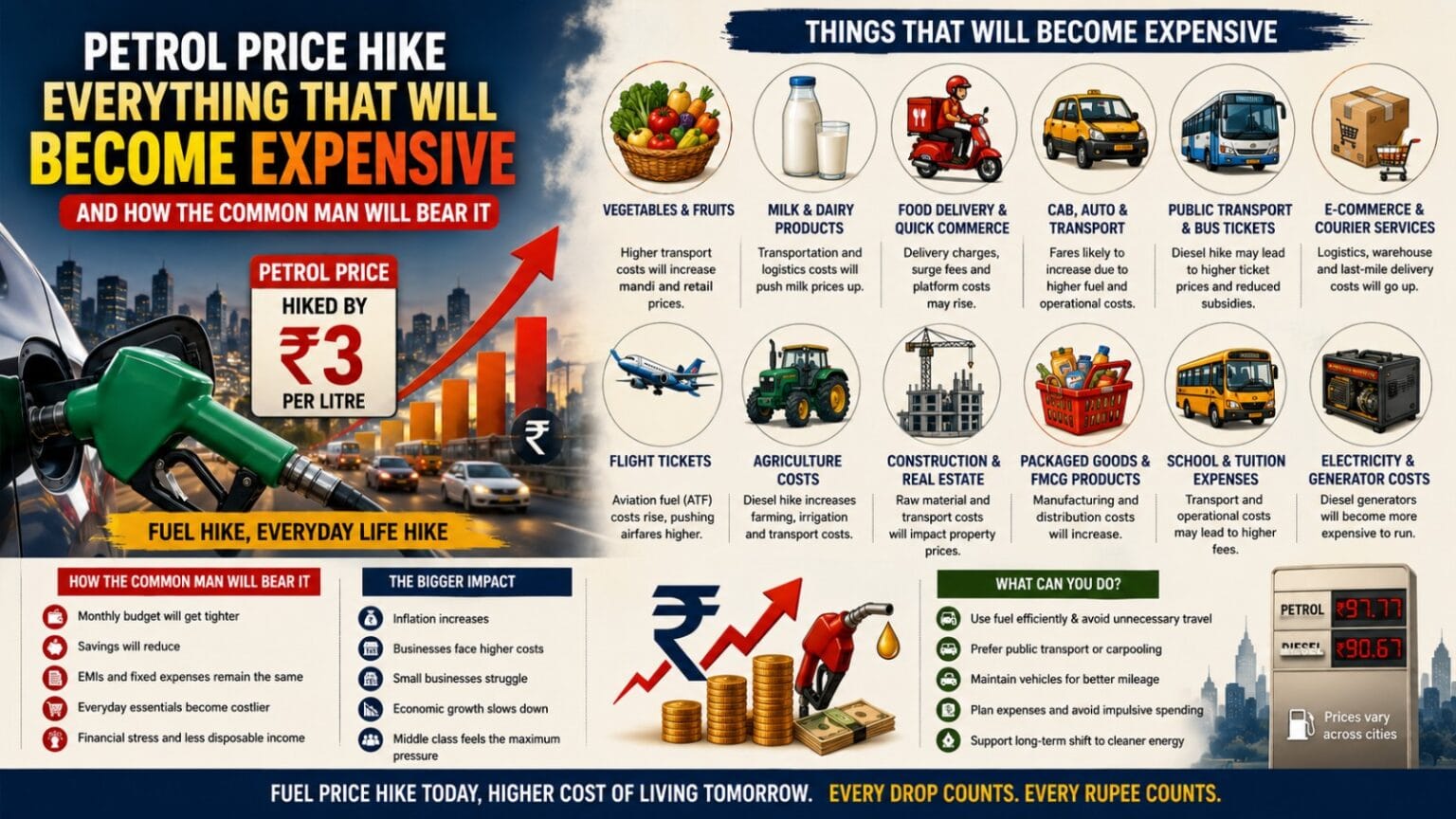
Petrol Price Hike – Here’s Everything That’s About to Get More Expensive
India’s recent petrol and diesel price hike may look like “just ₹3 per litre” on paper — but for the common citizen, it could trigger a chain reaction that slowly makes almost every part of daily life more expensive.
Fuel prices are not isolated economic numbers.
They are connected to:
- transportation,
- food supply,
- logistics,
- delivery services,
- manufacturing,
- agriculture,
- and inflation itself.
After the latest fuel hike announced by oil marketing companies amid rising crude oil prices and Middle East tensions, economists are warning that the real impact will now begin spreading across the Indian economy.
For middle-class families already struggling with:
- EMIs,
- school fees,
- rent,
- medical costs,
- grocery inflation,
- and stagnant salaries,
the fuel hike could quietly become another major pressure point in 2026.
Why Petrol Prices Were Increased
India raised petrol and diesel prices by ₹3 per litre after global crude oil prices surged sharply due to the ongoing West Asia conflict and disruptions linked to the Strait of Hormuz.
India imports nearly 85% of its crude oil requirements, making the country highly vulnerable to global oil shocks.
Reports suggest:
- Oil companies were facing huge losses
- Global crude crossed $120 per barrel in some sessions
- The government could no longer absorb all the costs
But while the increase directly affects fuel buyers first, its indirect effects are much larger.
1. Vegetables and Fruits Will Become More Expensive
One of the first sectors affected by fuel inflation is food transportation.
Most vegetables and fruits in India travel through:
- trucks,
- mini tempos,
- cold chain logistics,
- diesel-powered transportation networks.
When diesel prices rise:
- transporters increase freight charges,
- mandi costs rise,
- retail vendors pass costs to consumers.
Economists already expect:
- onions,
- tomatoes,
- potatoes,
- leafy vegetables,
- fruits,
- and milk prices
to rise in the coming weeks.
For a middle-class family, this means:
- grocery bills slowly increasing every week,
- even without “major inflation headlines.”
2. Milk Prices Could Rise Again
Milk distribution depends heavily on:
- refrigerated transportation,
- local delivery vans,
- diesel logistics.
India Today and Economic Times reports suggest milk prices may soon rise due to increased transportation costs.
For millions of Indian households:
- milk is not optional,
- especially for children and elderly family members.
Even a ₹2–₹4 increase per litre adds up significantly over months.
3. Online Food Delivery Will Become Costlier
Platforms like:
- Swiggy,
- Zomato,
- Blinkit,
- Zepto,
- Instamart
depend on fuel-based delivery networks.
Higher petrol prices mean:
- delivery partners spend more,
- logistics costs rise,
- platforms may increase delivery charges,
- surge pricing may become more frequent.
Economic Times reported that quick-commerce and food delivery services are among the sectors expected to be impacted immediately.
Consumers may soon notice:
- higher platform fees,
- smaller discounts,
- increased delivery charges.
4. Cab Fares and Auto-Rickshaw Rates May Increase
Ola, Uber, Rapido, auto-rickshaws, and local taxi operators are directly affected by petrol and CNG prices.
Once fuel becomes expensive:
- drivers demand fare revisions,
- surge pricing increases,
- minimum fares rise,
- night charges may increase further.
This especially impacts:
- office-goers,
- students,
- women commuters,
- daily wage workers.
A person taking two cab rides daily could end up spending:
- thousands of rupees extra annually.
5. Bus and Public Transport Costs Could Increase
Diesel price hikes directly affect:
- state transport buses,
- private buses,
- school buses,
- tourist transport,
- intercity transport services.
Many state transport corporations already operate under financial stress.
Higher diesel prices may force:
- ticket fare revisions,
- reduced subsidies,
- fewer low-cost routes.
School transportation costs may also rise, increasing pressure on parents.
6. Grocery Delivery and E-Commerce Costs May Rise
Amazon, Flipkart, Blinkit, Dunzo, and courier services rely on transportation networks.
Fuel inflation affects:
- warehouse logistics,
- delivery fleets,
- interstate transportation,
- last-mile delivery.
Consumers may experience:
- higher delivery fees,
- reduced free delivery thresholds,
- increased product prices.
Even if companies do not immediately increase delivery charges, sellers may quietly increase product pricing to compensate.
7. Flight Tickets Could Become More Expensive
Aviation turbine fuel (ATF) is one of the biggest expenses for airlines.
Fuel price increases generally push up:
- domestic airfare,
- international ticket pricing,
- cargo aviation costs.
Economic Times reported that airlines may eventually pass rising fuel costs to passengers.
This affects:
- working professionals,
- migrant workers,
- tourism,
- business travel.
8. Agriculture Costs Could Rise
Fuel inflation affects farmers directly.
Diesel powers:
- tractors,
- irrigation pumps,
- harvesting machinery,
- crop transportation.
Research on Indian food inflation shows fuel inflation significantly impacts agricultural costs.
When farming costs rise:
- food inflation rises,
- production becomes expensive,
- farmers reduce margins,
- consumers pay more eventually.
This creates a dangerous cycle:
fuel inflation → agriculture inflation → food inflation.
Also read – Gold Import Duty Hike
9. Construction and Housing Costs May Rise
Fuel affects:
- cement transport,
- steel movement,
- construction logistics,
- raw material transportation.
Builders may increase:
- property prices,
- rental rates,
- maintenance charges.
For middle-class families planning:
- home purchases,
- renovations,
- construction,
this could mean another rise in costs.
10. Packaged Goods and FMCG Products May Become Expensive
Fuel inflation affects:
- factories,
- transportation,
- warehousing,
- distribution networks.
This impacts:
- biscuits,
- soaps,
- shampoos,
- detergents,
- snacks,
- packaged foods,
- personal care products.
Companies may use:
- smaller quantities at same prices,
- reduced discounts,
- silent price hikes,
- “shrinkflation.”
Experts already warn that inflation pressure is broadening across sectors.
11. School and Tuition Costs May Increase
Parents may soon face:
- higher school transport fees,
- increased operational charges,
- revised tuition transportation costs.
Educational institutions also face:
- higher electricity,
- logistics,
- transportation,
- vendor pricing pressures.
12. Electricity and Generator Costs Could Rise
Diesel generators are widely used in:
- apartments,
- malls,
- offices,
- hospitals,
- factories.
Rising diesel prices increase:
- maintenance charges,
- generator costs,
- operational expenses.
Residential societies may eventually increase maintenance fees.
13. Small Businesses Will Suffer the Most
Fuel inflation hurts small businesses heavily because:
- profit margins are already thin,
- transportation costs rise immediately,
- consumers reduce discretionary spending.
Affected sectors include:
- local retailers,
- delivery businesses,
- transport operators,
- kirana stores,
- food vendors,
- small manufacturers.
Many small businesses may either:
- raise prices,
- reduce staff,
- or absorb losses.
Why the Middle Class Suffers the Most
The rich can absorb inflation.
The poor sometimes receive government support schemes.
But the middle class often faces the biggest squeeze because:
- salaries don’t rise immediately,
- expenses increase slowly everywhere,
- savings shrink,
- EMIs remain fixed,
- taxes continue.
Fuel inflation creates “invisible inflation.”
People may not immediately notice it at once.
But over months:
- household budgets get tighter,
- savings reduce,
- discretionary spending disappears.
The Psychological Impact on Citizens
Fuel inflation also creates emotional stress.
People begin:
- avoiding unnecessary travel,
- cutting family outings,
- postponing purchases,
- worrying about expenses constantly.
For many Indians, it creates the feeling that:
“Everything is becoming expensive together.”
Could Inflation Rise Further?
Experts warn that if:
- crude oil prices remain high,
- Middle East tensions continue,
- the rupee weakens further,
India could face broader inflationary pressure in:
- food,
- transportation,
- services,
- and consumer goods.
Will Electric Vehicles Benefit?
Higher petrol prices may accelerate:
- EV adoption,
- electric scooters,
- hybrid vehicle demand,
- public transport usage.
However, EV affordability still remains difficult for many middle-class households.
Final Thoughts
A petrol hike is never just about petrol.
It quietly spreads into:
- groceries,
- transportation,
- food delivery,
- rent,
- school fees,
- daily expenses,
- and inflation itself.
For India’s common citizen, the biggest challenge is not one large expense —
it is dozens of smaller increases happening everywhere at the same time.
That is how fuel inflation slowly changes the cost of living.
And unless global crude prices stabilise soon, many Indians may have to prepare for a future where:
and middle-class financial pressure becomes even more intense. saving becomes harder,
monthly expenses rise steadily.
Subscribe to our YouTube Channel The Logic Stick for more video insights