







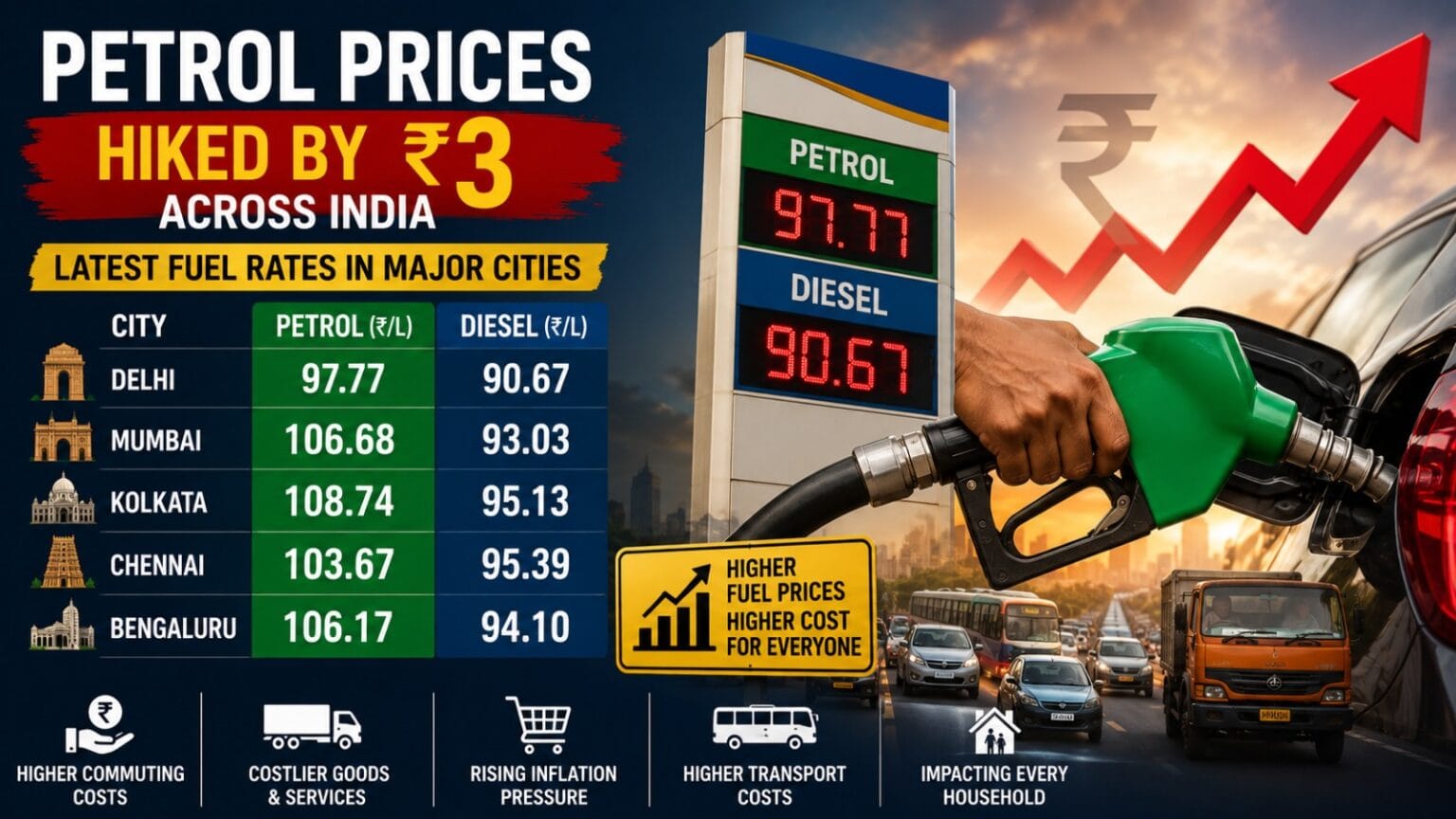
Petrol Prices Surge in India After ₹3 Hike
India has witnessed its first major fuel price hike in nearly four years, with petrol and diesel prices increasing by ₹3 per litre across the country. The sharp rise comes amid soaring global crude oil prices, geopolitical tensions in West Asia, and mounting losses faced by India’s oil marketing companies (OMCs).
The fuel price hike has immediately affected household budgets, transportation costs, logistics businesses, inflation expectations, and daily commuting expenses for millions of Indians.
The latest petrol prices in major Indian cities have once again crossed psychologically important levels, with many metro cities now seeing petrol rates above ₹100 per litre.
This has triggered nationwide concern around:
- Petrol price hike India 2026
- Latest petrol prices in metro cities
- Diesel prices today
- Fuel price impact on common people
- Why petrol prices are rising
- Global crude oil crisis
- Petrol price today in Delhi Mumbai Chennai Kolkata
Why Petrol and Diesel Prices Were Increased
Oil marketing companies such as:
- Indian Oil Corporation
- Bharat Petroleum Corporation Limited
- Hindustan Petroleum Corporation Limited
raised petrol and diesel prices after facing massive financial pressure due to rising global crude oil costs.
The biggest reason behind the hike is the ongoing geopolitical instability in West Asia, especially disruptions around the Strait of Hormuz — one of the world’s most important oil transit routes.
Global crude oil prices recently surged above:
- $120 per barrel in some trading sessions
India imports nearly 85% of its crude oil requirements, making the country highly vulnerable to international oil price shocks.
Latest Petrol Prices in Major Indian Cities
After the ₹3 per litre increase, fuel prices in major cities now stand at:
| City | Petrol Price (Per Litre) | Diesel Price (Per Litre) |
|---|---|---|
| New Delhi | ₹97.77 | ₹90.67 |
| Mumbai | ₹106.68 | ₹93.03 |
| Kolkata | ₹108.74 | ₹95.13 |
| Chennai | ₹103.67 | ₹95.39 |
| Bengaluru | ₹106.17 | ₹94.10 |
| Hyderabad | ₹110+ approx | ₹98+ approx |
| Thiruvananthapuram | ₹110+ approx | ₹99+ approx |
Kolkata and Hyderabad continue to remain among the costliest cities for petrol in India.
Why Petrol Prices Differ Across States
Many Indians wonder why fuel prices vary significantly between states.
Petrol prices are influenced by:
- Global crude oil prices
- Rupee-dollar exchange rate
- Central excise duty
- State VAT taxes
- Transportation costs
- Dealer commissions
Since state governments impose different VAT rates, fuel prices vary from city to city.
That is why petrol in Delhi is cheaper than in Mumbai or Kolkata.
How Petrol Price Hike Affects Common Citizens
The biggest impact of rising petrol prices is not limited to fuel stations.
The effect spreads across the entire economy.
1. Daily Commuting Becomes More Expensive
For middle-class salaried employees:
- Bike commuting costs rise
- Car fuel expenses increase sharply
- Cab fares may increase
- Office travel budgets get affected
A person consuming:
- 50 litres of petrol monthly
will now spend:
- Around ₹150 extra every month directly
- More indirectly through higher transport costs
For families already managing:
- School fees
- EMIs
- Rent
- Grocery inflation
even a ₹3 increase matters significantly.
2. Food Prices May Increase
Fuel prices directly affect:
- Truck transportation
- Delivery logistics
- Cold storage supply chains
- Agricultural transport
This means:
- Vegetables
- Fruits
- Milk
- Packaged goods
- Grocery items
could become more expensive in the coming weeks.
Economists often call fuel inflation “base inflation” because it spreads into multiple sectors.
3. Public Transport Costs Could Rise
Higher diesel prices especially affect:
- Buses
- Trucks
- Auto-rickshaws
- State transport systems
State transport corporations may eventually revise:
- Bus ticket fares
- Freight charges
- Cargo transportation pricing
Private logistics operators are also likely to pass increased costs onto consumers.
4. Delivery and E-Commerce Costs Could Increase
The rise in fuel prices may also affect:
- Food delivery charges
- Courier costs
- E-commerce delivery fees
Platforms depending heavily on transportation networks may face operational cost pressure.
5. Inflation Pressure on Households
Fuel inflation indirectly pushes up:
- Consumer inflation
- Retail prices
- Service charges
This creates a chain reaction across the economy.
For common citizens, it often feels like:
“Everything becomes expensive together.”
Why the Government Delayed the Hike Earlier
Interestingly, fuel prices had remained mostly stable since 2022 despite rising crude oil prices globally.
Reports suggest the government and OMCs were absorbing huge losses to protect consumers.
According to reports:
- OMCs were reportedly losing nearly ₹1,000 crore per day at one point
Some estimates suggested:
- Monthly losses crossed ₹30,000 crore during peak crude price pressure.
The government had delayed major fuel hikes during:
- Election season
- Political campaigning periods
However, continued global oil pressure made the latest increase unavoidable according to officials.
Also read – Why PM Modi wants India to not buy gold for a year
What PM Modi Said About Fuel Consumption
Prime Minister Narendra Modi recently urged citizens to:
- Reduce unnecessary fuel consumption
- Avoid wasteful energy usage
- Practice conservation measures
The government stated that India is bearing a massive economic burden because of high global crude oil prices.
Officials also clarified:
- India currently has adequate fuel reserves
- There is no shortage of petrol or diesel
- Supply chains remain stable
Why Global Crude Oil Prices Are Rising
The latest fuel crisis is closely linked to geopolitical tensions.
The main triggers include:
- West Asia conflict escalation
- Iran-related tensions
- Strait of Hormuz disruptions
- Reduced tanker movement
- Global supply fears
The Strait of Hormuz handles nearly:
- 20% of global oil trade
Any disruption there immediately impacts international crude prices.
Impact on Oil Marketing Companies
Even after the price hike, analysts say OMCs may still be under pressure.
Shares of:
- HPCL
- BPCL
- IOC
actually fell after the announcement because investors expected even larger price increases to fully offset losses.
This shows how serious the global crude oil situation has become.
CNG Prices Also Increased
The fuel pressure is not limited to petrol and diesel.
CNG prices have also increased in several cities.
Delhi NCR and Mumbai saw:
- ₹2 per kg increase in CNG prices
This affects:
- Auto drivers
- Taxi operators
- Commercial transport
- Delivery services
Could Petrol Prices Rise Further?
Experts believe future fuel price movements will depend on:
- Global crude oil stability
- Middle East tensions
- Rupee performance
- Government intervention
If crude oil remains above:
- $100–120 per barrel
further price hikes cannot be ruled out.
However, political pressure and inflation concerns may also influence future decisions.
How Citizens Are Reacting
Public reaction has been mixed but largely concerned.
Many citizens are worried about:
- Rising monthly expenses
- Inflation pressure
- Costlier commuting
- Increasing grocery bills
On social media, discussions around:
- fuel conservation
- electric vehicles
- hybrid cars
- work-from-home
- public transport
have increased sharply.
Will Electric Vehicles Benefit?
Higher petrol prices may accelerate interest in:
- Electric scooters
- EV cars
- Hybrid vehicles
- Public transportation
India’s EV market has already been growing rapidly, and repeated fuel price hikes could push more consumers toward alternative mobility solutions.
However, EV affordability remains a challenge for many middle-class families.
Final Thoughts
The latest petrol and diesel price hike is not just another fuel revision.
It reflects:
- Global geopolitical instability
- India’s energy vulnerability
- Rising import pressure
- Economic stress caused by crude oil dependence
For common citizens, the impact goes far beyond petrol pumps.
The real burden will likely be felt through:
- Higher transport costs
- Rising food prices
- Inflationary pressure
- Increased monthly expenses
As India continues navigating global energy uncertainty, fuel prices may remain one of the most sensitive economic issues affecting daily life in 2026
Subscribe to our YouTube Channel The Logic Stick for more video insights