






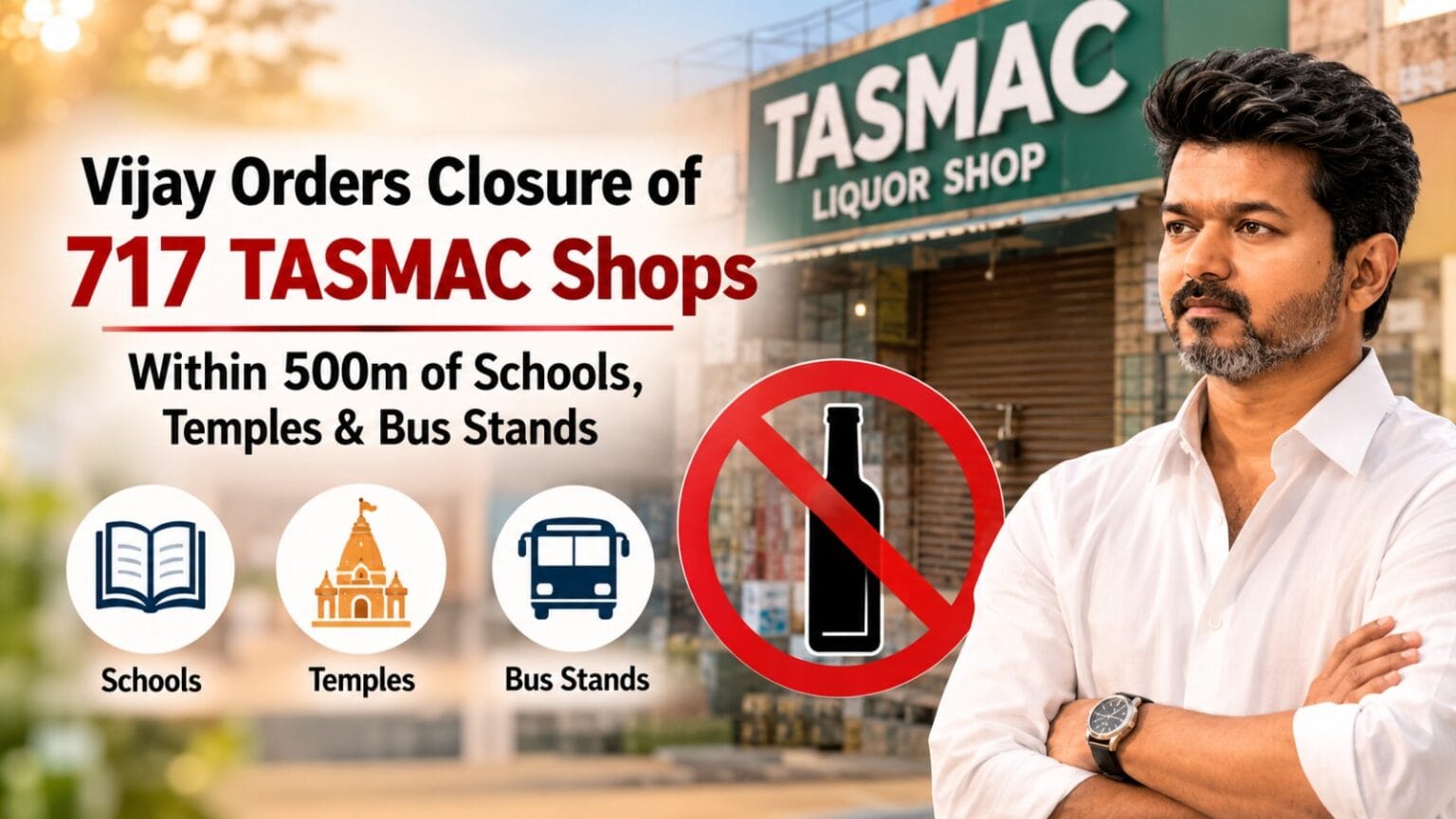
Tamil Nadu Chief Minister C. Joseph Vijay has announced one of the biggest liquor-control measures the state has seen in recent years. In his first major governance decision after taking office, Vijay ordered the closure of 717 TASMAC liquor shops located within 500 metres of schools, temples, religious places, and bus stands across Tamil Nadu.
The decision has immediately triggered political debate, public discussion, and massive online searches around topics such as “Vijay liquor ban Tamil Nadu,” “717 TASMAC shops closed,” and “Tamil Nadu alcohol policy 2026.”
The move is being projected by the new government as the first step toward building an “addiction-free Tamil Nadu,” while critics are questioning how the state will compensate for the massive revenue generated through alcohol sales.
What Exactly Did Vijay Announce?
The Tamil Nadu government confirmed that 717 state-run TASMAC outlets will be shut within two weeks because they violate location norms related to sensitive public areas. These shops are situated within a 500-metre radius of:
- Educational institutions
- Religious places
- Bus stands
- Public gathering zones
According to government data:
- 276 shops are near places of worship
- 186 are near educational institutions
- 255 are near bus stands
Tamil Nadu currently operates around 4,765 TASMAC liquor outlets statewide.
The announcement marks the first major administrative order issued by Vijay after becoming Chief Minister following the 2026 Tamil Nadu Assembly Elections.
Why This Decision Matters So Much
Alcohol sales in Tamil Nadu are not just a social issue — they are deeply tied to the state economy.
TASMAC, the Tamil Nadu State Marketing Corporation, controls liquor sales in the state through a government monopoly system. The corporation contributes tens of thousands of crores annually to the state treasury.
In 2025 alone, TASMAC reportedly generated over Rs 48,000 crore in revenue for Tamil Nadu.
That means shutting even 717 shops is not a symbolic decision. It has real financial consequences.
This is why the move is being seen as politically bold.
For decades, Tamil Nadu governments have struggled to balance:
- Public health concerns
- Anti-alcohol activism
- Revenue dependency
- Welfare funding
Vijay’s order directly enters that complicated territory.
What Is TASMAC?
Tamil Nadu State Marketing Corporation, commonly known as TASMAC, is the state-owned corporation responsible for wholesale and retail alcohol sales in Tamil Nadu.
The system was introduced to regulate alcohol distribution and reduce illegal liquor trade. Over time, TASMAC became one of the biggest revenue generators for the Tamil Nadu government.
Today, TASMAC shops are visible across cities, towns, and villages in Tamil Nadu.
However, the corporation has also faced years of criticism over:
- Alcohol addiction
- Public nuisance
- Safety concerns near schools and temples
- Corruption allegations
- Health and social consequences
Vijay’s “Addiction-Free Tamil Nadu” Vision
The closure order aligns closely with Vijay’s election promise of creating a healthier Tamil Nadu.
During the 2026 election campaign, Vijay and his party Tamilaga Vettri Kazhagam repeatedly spoke about reducing alcohol dependency and improving social welfare.
The decision is now being interpreted as Vijay attempting to build a governance identity separate from previous Dravidian governments.
Political observers say this move serves multiple purposes:
1. Public Image Building
Vijay is trying to establish himself not merely as a film star-turned-politician, but as a leader willing to take visible governance decisions quickly.
2. Appealing to Families and Women Voters
Anti-liquor sentiment has historically been strong among women and family-oriented voter groups in Tamil Nadu.
3. Youth-Centric Governance
Vijay’s campaign attracted strong youth support during the 2026 elections.
Closing liquor shops near schools and colleges directly fits into a youth welfare narrative.
4. Distancing From TASMAC Controversies
The TASMAC system has faced repeated criticism and investigations in recent years.
By targeting controversial locations first, Vijay may be attempting gradual reform rather than an immediate statewide prohibition.
The TASMAC Controversy and ED Investigation
The liquor issue in Tamil Nadu had already become politically explosive before Vijay came to power.
In 2025, the Enforcement Directorate (ED) investigated alleged irregularities involving TASMAC operations. The agency claimed it found evidence of:
- Tender manipulation
- Corporate favouritism
- Fraudulent pricing
- Unaccounted cash transactions
The ED alleged that “unaccounted” cash worth nearly Rs 1,000 crore was linked to irregularities.
The controversy escalated into a political and legal battle between the central agency and the then Tamil Nadu government.
The Supreme Court also questioned whether the ED was overstepping into state jurisdiction.
Because of this background, Vijay’s action is being viewed not only as a social policy decision but also as a political message against the previous administration’s handling of TASMAC.
Also read – PM Modi’s Latest Speech Explained: Don’t Buy Gold & Avoid Foreign Trips
Will Tamil Nadu Eventually Ban Alcohol Completely?
That remains unclear.
Tamil Nadu has a long and complicated history with prohibition.
The state has repeatedly experimented with:
- Partial prohibition
- Liquor restrictions
- Reduced shop timings
- Shop closures
- State-controlled sales
Even former Chief Ministers like J. Jayalalithaa had ordered the closure of hundreds of liquor shops during previous administrations.
However, complete prohibition has always faced one major obstacle: revenue.
Liquor taxes fund several welfare schemes and public spending programs in Tamil Nadu.
Experts believe Vijay is unlikely to impose total prohibition immediately because of the economic impact.
Instead, analysts expect:
- Gradual reduction in liquor availability
- Tighter regulations
- Relocation of shops
- Increased social awareness campaigns
- Stricter enforcement around public areas
Public Reaction to Vijay’s Decision
The reaction has been sharply divided.
Supporters Say:
- Shops near schools should never have existed
- Public safety will improve
- Students and women will benefit
- Religious and residential areas deserve protection
- Vijay is fulfilling election promises quickly
Critics Say:
- It is more symbolic than structural
- Alcohol sales may simply shift elsewhere
- Revenue losses could affect welfare spending
- Illegal liquor trade may increase if restrictions grow rapidly
On social media, the move has already become one of the biggest political discussions in Tamil Nadu after Vijay’s election victory.
Why Liquor Shops Near Schools and Temples Became a Major Issue
For years, Tamil Nadu residents and activist groups have complained about TASMAC outlets being located too close to sensitive areas.
Common concerns included:
- Drunken crowds near schools
- Harassment near bus stands
- Public nuisance around temples and churches
- Safety concerns for women
- Noise and late-night disturbances
Many petitions and local protests over the years demanded relocation or closure of such shops.
Vijay’s government appears to be responding directly to these long-standing public complaints.
Vijay’s Political Rise and the 2026 Election Shock
The 2026 Tamil Nadu Assembly Election changed the state’s political landscape dramatically.
Vijay’s party, TVK, emerged as the single-largest party in its first election, ending decades of dominance by traditional Dravidian parties.
Political analysts credited Vijay’s success to:
- Massive youth support
- Strong digital campaigning
- Anti-incumbency sentiment
- Celebrity influence
- A “fresh alternative” image
His liquor shop decision is now being seen as an attempt to convert campaign messaging into immediate governance action.
Economic Impact of Closing 717 TASMAC Shops
The closures may affect:
- Local employment
- Nearby commercial activity
- State excise revenue
- Distribution logistics
However, the state government has not yet revealed:
- Revenue impact estimates
- Relocation plans
- Compensation strategies
- Whether more closures are coming
Analysts expect more clarity in the coming weeks.
What Happens Next?
Over the next two weeks, authorities are expected to:
- Identify all affected TASMAC outlets
- Begin phased closures
- Monitor public response
- Assess revenue impact
The move may also trigger:
- Legal challenges
- Opposition criticism
- Demands for wider prohibition
- Calls for further regulation
Much will depend on how Vijay balances public welfare with economic realities.
Final Thoughts
The closure of 717 TASMAC liquor shops is more than just an administrative order. It is a defining political statement from Tamil Nadu’s new Chief Minister C. Joseph Vijay.
For supporters, it signals the beginning of a cleaner and more socially responsible governance model.
For critics, it raises difficult questions about revenue, practicality, and long-term alcohol policy.
Either way, Vijay’s first major decision has ensured that the debate around liquor regulation, public health, and governance in Tamil Nadu will dominate headlines for weeks to come.
Subscribe to our YouTube Channel The Logic Stick for more video insights