





PM Modi’s Latest Speech Explained
Prime Minister Narendra Modi delivered a major public address in Hyderabad on May 10, 2026, where he urged Indians to adopt what many are calling a “Covid-era style economic discipline” to help the country navigate rising global uncertainty, the West Asia crisis, increasing crude oil prices, and pressure on India’s foreign exchange reserves.
The speech has quickly become one of the most discussed political and economic developments in India because Modi did not just speak about policy — he directly appealed to citizens to change their lifestyle habits, travel patterns, fuel consumption, shopping behavior, and even gold buying decisions.
The Prime Minister framed these recommendations as a national responsibility during a period of global instability, particularly due to disruptions linked to tensions in West Asia and energy supply chains.
Why PM Modi Made This Speech
According to reports, Modi’s speech comes at a time when:
- Global crude oil prices are rising sharply
- The Strait of Hormuz disruptions are affecting oil supply chains
- India’s import bill is under pressure
- Fuel subsidies and oil company losses are increasing
- Foreign exchange conservation has become strategically important
- Commodity prices including gold are rising globally
The Prime Minister warned that India could face economic pressure if consumption habits are not adjusted early.
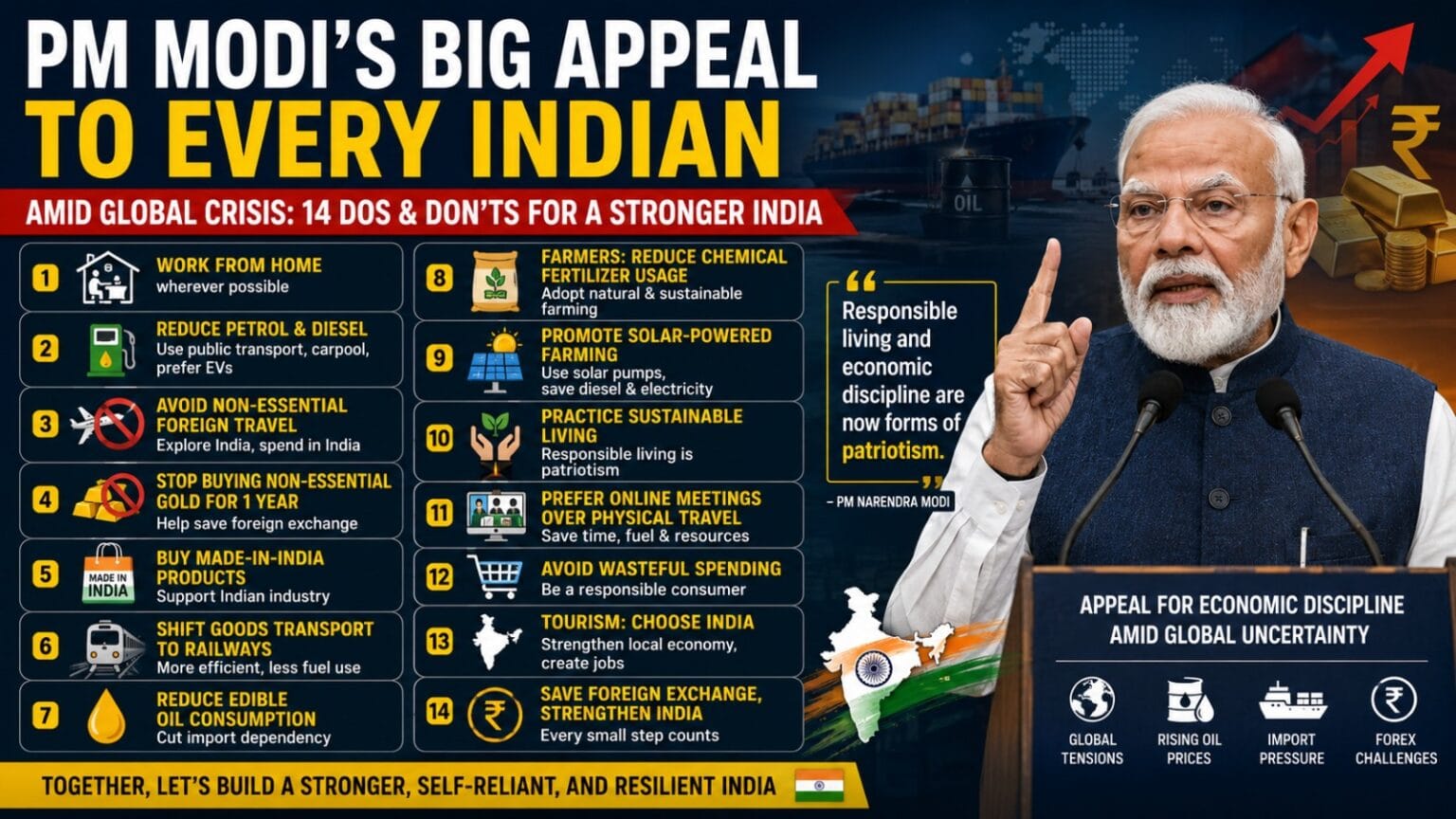
He repeatedly emphasized that “responsible living” and “economic discipline” are now forms of patriotism.
Also read – Hantavirus Explained: Everything you need to know
Everything PM Modi Said: Full Breakdown Of His Key Appeals
1. Work From Home Should Return Where Possible
One of the biggest headlines from the speech was Modi’s suggestion that companies and employees should consider returning to Work From Home (WFH) practices wherever possible.
He said remote work can significantly reduce fuel consumption and urban congestion. Online meetings and virtual conferences should be preferred over unnecessary physical travel.
This immediately triggered comparisons with the Covid-19 lockdown era, when fuel consumption had dropped dramatically across India.
Why Modi Suggested WFH
- Lower petrol and diesel usage
- Reduced office commuting
- Less traffic congestion
- Lower import dependency on crude oil
- Better fuel conservation during global uncertainty
The recommendation is not mandatory, but a public appeal for voluntary participation.
2. Reduce Petrol And Diesel Consumption
Fuel conservation was the central theme of Modi’s speech.
He urged Indians to:
- Use public transport
- Prefer metro travel
- Carpool whenever possible
- Shift to electric vehicles
- Avoid unnecessary driving
He also asked businesses to rethink logistics and reduce fuel-heavy operations.
Modi’s Message On Fuel
The Prime Minister suggested that every litre of fuel saved helps India reduce dependence on imported oil and protects the economy during global crises.
This appeal comes as fears grow over a potential fuel price hike in India if global crude prices continue rising.
3. Avoid Non-Essential Foreign Travel
Another major point from the speech was Modi’s request to Indians to postpone non-essential foreign trips for some time.
He specifically mentioned:
- Leisure tourism abroad
- Destination weddings
- Non-urgent international travel
Instead, he encouraged citizens to explore domestic tourism and spend money within India.
Why This Matters
Foreign travel increases:
- Dollar outflow
- Pressure on forex reserves
- Fuel consumption through aviation
- Import-linked spending abroad
The government appears to be signaling that conserving foreign exchange has become strategically important.
4. PM Modi Asked Indians To Stop Buying Non-Essential Gold
Perhaps the most surprising appeal from the speech was Modi’s request that Indians avoid purchasing non-essential gold for at least one year.
India is one of the world’s largest gold importers, and rising gold imports directly affect the country’s trade deficit and forex reserves.
Why Gold Imports Are A Concern
Gold is largely imported into India using foreign currency. During periods of economic stress:
- Heavy gold imports weaken forex reserves
- Import bills rise sharply
- Pressure on the rupee increases
Modi’s appeal appears aimed at reducing avoidable imports during uncertain global conditions.
5. Buy Made-In-India Products
The Prime Minister once again emphasized the “Made in India” and “Aatmanirbhar Bharat” vision.
He urged citizens to:
- Support Indian manufacturers
- Buy locally made goods
- Reduce dependence on imports
- Strengthen domestic industries
This was presented not just as an economic move, but as a patriotic responsibility during global instability.
6. Shift Goods Transport From Roads To Railways
Modi also appealed to industries and logistics companies to move more cargo transportation from trucks to railways.
Reason Behind The Suggestion
Rail transport:
- Uses less fuel per tonne
- Is more energy efficient
- Reduces diesel consumption
- Lowers logistics costs
This aligns with the government’s broader push toward freight corridors and railway modernization.
7. Reduce Edible Oil Consumption
In another unexpected appeal, Modi asked citizens to reduce edible oil consumption where possible.
India imports a large percentage of its edible oil requirements, making the sector vulnerable during global supply disruptions.
Why This Was Mentioned
Reducing edible oil imports could:
- Save foreign exchange
- Reduce dependency on imports
- Improve long-term food sustainability
The speech also connected dietary discipline with national economic resilience.
8. Farmers Should Reduce Chemical Fertilizer Usage
The Prime Minister encouraged farmers to:
- Adopt natural farming methods
- Use less chemical fertilizer
- Shift toward sustainable agricultural practices
He warned that global supply chain disruptions can impact fertilizer imports and prices.
9. Solar-Powered Farming Was Strongly Promoted
Modi highlighted the importance of solar-powered irrigation systems and solar pumps in agriculture.
Benefits Mentioned
- Lower diesel usage
- Reduced electricity burden
- Cleaner farming infrastructure
- Long-term cost savings for farmers
This ties into India’s broader renewable energy goals.
10. Sustainable Living Is “Patriotism”
A recurring phrase throughout the speech was that responsible living is now a national duty.
Modi framed:
- Fuel saving
- Reducing imports
- Conserving resources
- Buying Indian products
- Avoiding wasteful spending
as acts of patriotism.
This was one of the speech’s strongest emotional and political messages.
Telangana Projects Worth ₹9,400 Crore Announced
Apart from the economic appeals, Modi also inaugurated and launched projects worth around ₹9,400 crore in Telangana.
The projects focused on:
- Infrastructure
- Manufacturing
- Connectivity
- Textile sector expansion
- Industrial development
He described Telangana as an important driver of India’s manufacturing future.
Political Reactions To PM Modi’s Speech
The speech immediately triggered reactions from both supporters and opposition leaders.
BJP Leaders Supported The Appeal
Several BJP leaders praised the speech as:
- Forward-looking
- Responsible
- Necessary during global uncertainty
Maharashtra Chief Minister Devendra Fadnavis publicly supported Modi’s call for responsible fuel usage.
Opposition Leaders Questioned The Move
Some opposition leaders questioned whether:
- The country is facing a deeper economic concern
- Parliament should discuss the situation
- Citizens are being asked to shoulder economic burdens
Congress MP Karti P. Chidambaram reportedly demanded greater clarity from the government regarding the seriousness of the global situation.
Why This Speech Matters
This speech is significant because it reflects a shift from purely government-led economic management to citizen-led economic participation.
Instead of announcing subsidies or restrictions, Modi asked people to voluntarily change behavior to:
- Protect the economy
- Reduce import dependence
- Save foreign exchange
- Prepare for global disruptions
Many analysts see this as one of Modi’s strongest public economic messaging campaigns since the pandemic period.
Key Takeaways From PM Modi’s Latest Speech
Here’s a quick summary of Modi’s main appeals:
| PM Modi’s Appeal | Purpose |
|---|---|
| Work from home | Reduce fuel consumption |
| Use metro/carpool | Save petrol and diesel |
| Avoid unnecessary foreign travel | Save forex reserves |
| Reduce gold purchases | Lower imports |
| Buy Indian products | Support domestic economy |
| Shift freight to railways | Improve fuel efficiency |
| Reduce edible oil use | Cut import dependency |
| Promote natural farming | Lower fertilizer dependence |
| Use solar pumps | Promote renewable energy |
| Practice sustainable living | National economic resilience |
Final Thoughts
Prime Minister Narendra Modi’s latest speech was not just a political address — it was a public economic caution message aimed directly at ordinary citizens.
The speech reflects growing concern over:
- Rising global instability
- Oil price shocks
- Import dependency
- Pressure on foreign exchange reserves
- Supply chain vulnerabilities
Whether Indians fully adopt these recommendations remains to be seen, but the speech has already sparked nationwide debate on fuel usage, consumer behavior, gold buying, travel habits, and economic preparedness.
For many observers, this may become one of the defining economic speeches of 2026 if global tensions continue escalating.
Subscribe to our YouTube Channel The Logic Stick for more video insights