






GLP-1 Drug War in India intensifies with low-cost semaglutide launches challenging global giants like Ozempic and Wegovy.
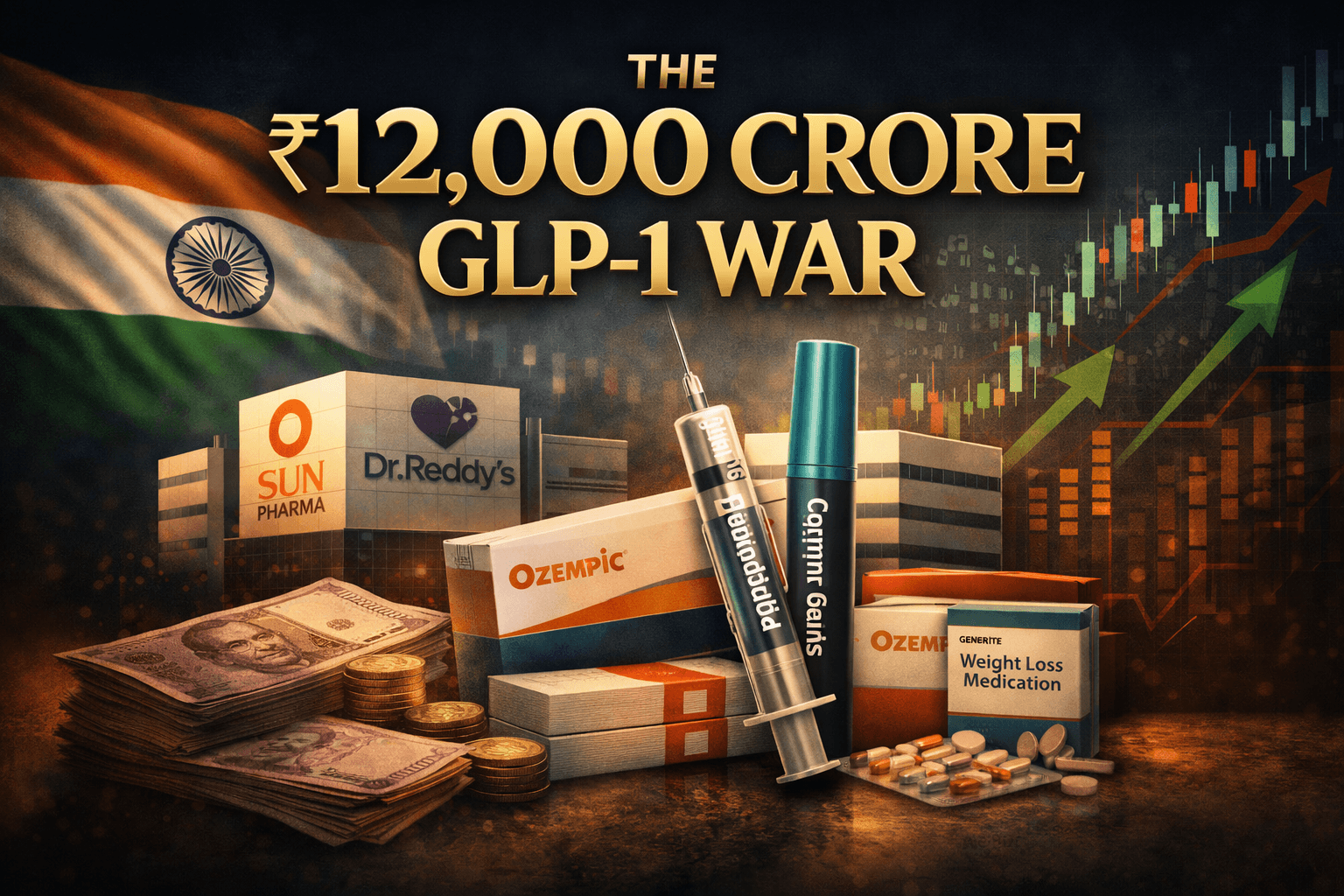
India’s pharmaceutical sector has entered a high-stakes new chapter as domestic drugmakers rush to launch cheaper versions of semaglutide, the molecule behind Novo Nordisk’s blockbuster drugs Ozempic and Wegovy. The patent expiry of semaglutide in India has opened the door for a wave of generic competition, setting off what analysts now describe as a potentially massive ₹12,000 crore market opportunity over the next five years.
This is not just another product launch cycle. It is shaping up to be one of the biggest pricing, access, and market-share battles in Indian pharma. At least half a dozen Indian companies launched cheaper semaglutide products over a single weekend in March 2026, and analysts expect more than 40 Indian drugmakers to eventually introduce over 50 lower-cost variants.
The significance of this moment lies in both healthcare demand and pricing power. Semaglutide is used in the management of type 2 diabetes and, in some versions, for chronic weight management. In India, where obesity and diabetes together affect a vast population, lower-cost competition could rapidly widen access to a class of drugs that had so far remained expensive and relatively underpenetrated. The Economic Times report says analysts see a huge untapped market of around 100 million diabetics and 250 million obese individuals, with current GLP-1 penetration estimated at just 5% among diabetics and 4% among obese individuals.
Read more on the Israel Iran War here.
The turning point was the expiry of the semaglutide patent in India in March 2026. Reuters reported that the patent expired in India the previous week, paving the way for manufacturers to flood the market with dozens of brands. Economic Times similarly described the patent expiry as the trigger for the generic wave now unfolding across the country.
That patent expiry has translated almost immediately into aggressive price disruption. Reuters reported that the new Indian launches are slashing treatment costs by about 70%, while Economic Times said prices have been cut by 50% to 90% below innovator brands, depending on the product and form factor.
The contrast is sharp. According to Economic Times, innovator brands were costing roughly ₹8,800 to ₹16,400 per month, while generics have entered at roughly ₹1,290 to ₹5,200 per month. That price compression is the core reason analysts believe the market can expand far beyond its current base.
Several Indian pharma companies have moved quickly to claim ground. Reuters identified Sun Pharmaceutical, Dr. Reddy’s Laboratories, Zydus Lifesciences, Torrent Pharmaceuticals, Glenmark Pharmaceuticals, Alkem Laboratories, Eris Lifesciences, and Natco Pharma among the early players in the semaglutide rollout. Economic Times also highlighted these names while adding that alliances and licensing deals are helping companies enter the market faster and with more diverse product offerings.
Sun Pharma, India’s largest drugmaker by revenue, launched semaglutide injectable under the brand names Noveltreat for chronic weight management and Sematrinity for type 2 diabetes. Reuters reported that Noveltreat is expected to cost around ₹900 to ₹2,000 per week, while Sematrinity is expected to cost around ₹750 to ₹1,300.
Dr. Reddy’s Laboratories launched semaglutide under the brand name Obeda for diabetes in 2 mg and 4 mg disposable pen formats, with Reuters reporting a monthly cost of about ₹4,200.
Zydus Lifesciences launched injectable semaglutide under three brand names — Semaglyn, Mashema, and Alterme — for diabetes and obesity treatment in a reusable pen device, with an average monthly cost of about ₹2,200, according to Reuters. Economic Times separately noted that Zydus differentiated itself through a reusable, adjustable-dose pen and had licensed this pen platform to Lupin and Torrent.
Torrent Pharmaceuticals launched both oral and injectable semaglutide, under the brands Sembolic and Semalix, with Reuters saying the injectable version starts at ₹3,999 per month. Economic Times noted that Torrent became the first to launch oral semaglutide in India after patent expiry, though some analysts remain cautious about the oral form’s market-share potential.
Glenmark launched injectable semaglutide under the brand GLIPIQ in vial and pen formats for diabetes, with the vial estimated to cost around ₹1,300 to ₹1,760 for a month’s usage, according to Reuters.
Alkem Laboratories appears to have taken one of the most aggressive pricing positions. Reuters said Alkem’s semaglutide, launched under Semasize, Obesema, and Hepaglide, starts at ₹1,800 per month in a pre-filled disposable injection pen. Economic Times went further, saying analysts viewed Alkem as the price leader, with entry-level doses at prices substantially below both innovator products and many rival generics.
Eris Lifesciences launched generic semaglutide in vial format under the brand Sundae, starting at ₹1,290 per month, and Reuters reported that the company is partnered with Natco Pharma for commercial manufacturing. Economic Times also said Natco is supplying generic semaglutide pens and vials to Eris and Glenmark.
The form factor battle is becoming almost as important as the pricing battle. Economic Times said companies are competing across three dosage forms, including disposable pens, reusable pens, and oral products. That matters because adoption may depend not just on cost, but on ease of use, dose flexibility, doctor preference, and patient convenience. The report suggested reusable pens from Zydus and Alkem could stand out for combining pricing and convenience.
This is one of the reasons analysts are beginning to separate likely winners from the broader field. Economic Times cited Nomura analyst Saion Mukherjee as saying Zydus could be a key beneficiary because of its differentiated offering, while Alkem could gain above-average volume share due to aggressive pricing. The same report also pointed to Dr. Reddy’s, Torrent, and Sun Pharma as likely contenders because of tie-ups and commercial reach. SBI Securities, according to Economic Times, called the GLP-1 wave a “multi-year opportunity” but emphasized that it is “stock-specific, not sector-wide.”
The market thesis is not only domestic. Reuters reported that Indian drugmakers are targeting international opportunities too, eyeing future launches in Canada, Brazil, Latin America, and Turkey. The same Reuters report said the global obesity market is projected to be worth about $100 billion by the end of the decade, giving Indian manufacturers an incentive to build scale early.
Still, the near-term story is India first. Economic Times said the domestic semaglutide market alone could exceed ₹12,000 crore over the next five years across diabetes and weight-loss segments. It added that even a 2% penetration in the obese population could generate more than ₹2,500 crore in weight-loss brand sales, underscoring how little adoption is needed to create a very large business.
The other major takeaway from the two source articles is that this is not a simple one-company-versus-one-company contest. It is an ecosystem race involving manufacturers, licensors, marketing partners, device suppliers, and formulation strategies. Economic Times reported that Dr. Reddy’s licensed its product to USV and Torrent, Zydus provided semi-exclusive rights to Lupin and Torrent for its reusable pen, and Ajanta and Biocon partnered for marketing in 26 countries. Those arrangements suggest that the ultimate winners may be the companies that combine manufacturing strength with the right commercial partnerships.
At the same time, the reports do not support some of the broader claims often circulating around these drugs. The two source articles focus primarily on patent expiry, pricing, launches, product formats, and market potential. They do not establish that India has already imposed new prescription restrictions, nor do they provide evidence in these stories of a formal nationwide crackdown on GLP-1 misuse. Any such claim would need separate sourcing. That is why those points have been removed from this corrected version.
What the articles do support is a clear conclusion: India’s GLP-1 market has moved from anticipation to active competition. Patent expiry has turned semaglutide into one of the most closely watched opportunities in Indian pharma, and the early weeks already show the contours of the battle — lower prices, multiple brands, device innovation, and a scramble for first-mover advantage.
For patients, this could mean wider access to an important treatment class. For companies, it could mean years of brand building and fierce margin competition. For investors, it is a story that may reward precision more than hype: analysts are already signaling that while the overall market could become huge, gains may accrue unevenly depending on pricing strategy, product differentiation, and commercial reach.
In short, India’s GLP-1 boom is no longer theoretical. It has begun. And with dozens more brands expected, the real fight over who wins India’s semaglutide market — and which pharma stocks emerge strongest — is only just starting.