







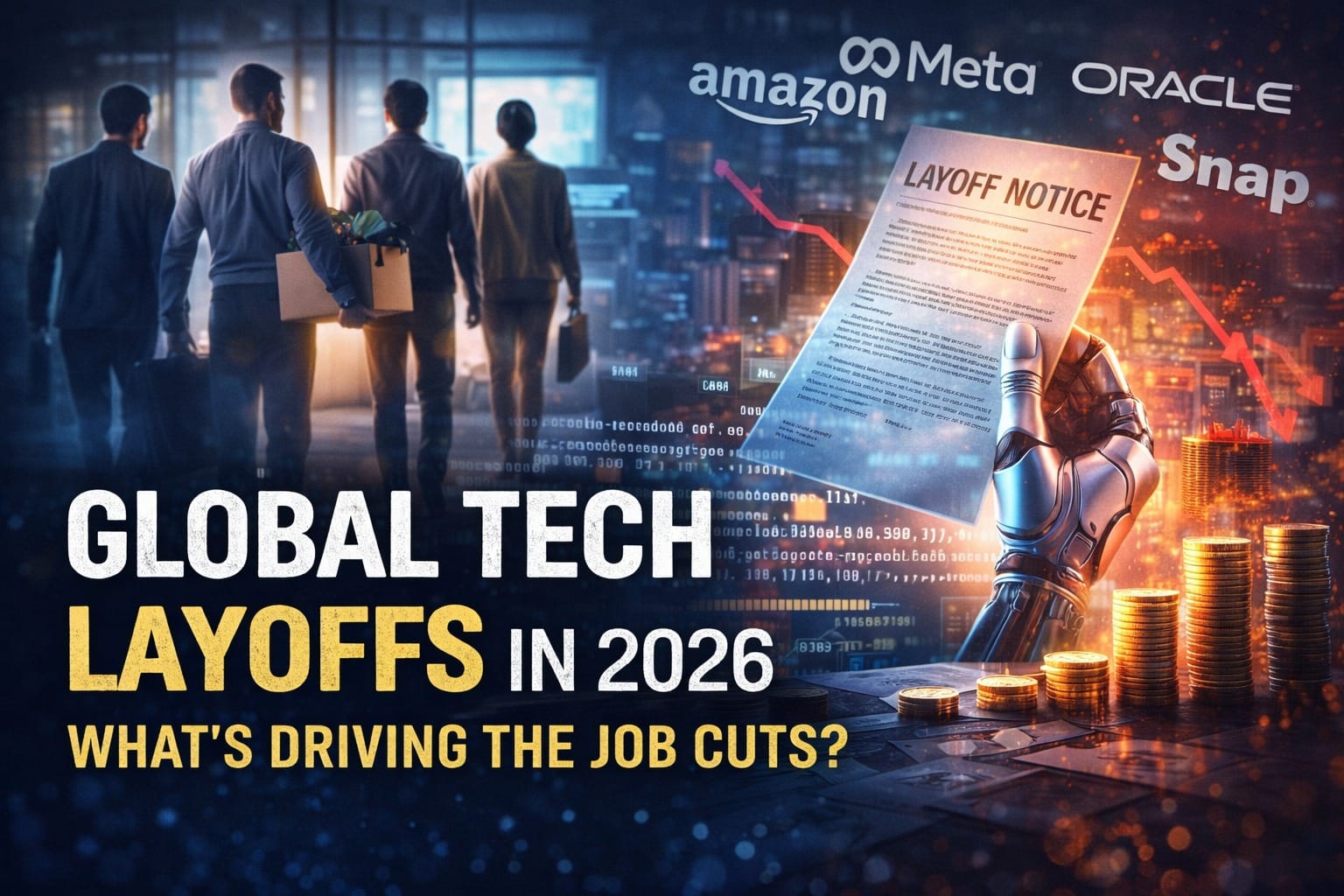
What’s Driving Global Tech Layoffs
Introduction
If you’ve been following the news lately, one number keeps showing up again and again:
70,000+ tech jobs lost in 2026.
And the narrative is simple.
“AI is replacing jobs.”
But here’s the uncomfortable truth:
AI is part of the story. Not the whole story.
Because if AI alone was the reason, layoffs would look very different.
Instead, what we’re seeing is something deeper — a structural shift in how tech companies operate, hire, and grow.
Let’s break it down — clearly, honestly, and without the hype.
The Headline Reality: Layoffs Are Real — and Massive
By early 2026:
- Over 70,000 tech workers have already been laid off globally
- Some trackers suggest 90,000+ layoffs across hundreds of companies
- Nearly 78,000 jobs were cut in just the first quarter, with a large portion linked to automation
This is not a slowdown.
This is a reset.
Also read – How AI Car Assistants can become your Personal Co Pilots
1. AI Is Replacing Tasks — Not Entire Jobs (But That’s Enough)
Let’s start with the obvious one: AI.
Companies are not firing entire teams because AI can fully replace them.
They are doing something smarter:
They are shrinking teams.
Why?
Because:
- AI can now write code
- AI can handle customer support
- AI can automate repetitive tasks
For example:
- Snap cut ~1,000 jobs citing AI efficiency gains
- Many companies now generate 65% of code using AI tools
So instead of 10 people doing a job, companies now need 6.
That difference?
That’s layoffs.
2. The Real Reason: Overhiring During the Pandemic
This is the part most people ignore.
Between 2020–2022:
- Tech companies overhired aggressively
- Demand was artificially high (remote work, digital boom)
Now:
- Growth has normalized
- Revenues are stabilizing
- Costs are too high
So companies are correcting.
Experts even argue that many firms are using AI as a cover for these corrections
3. The Shift: From Growth to Profitability
For years, tech companies focused on:
“Grow fast. Hire fast. Figure profits later.”
Now the mindset is:
“Cut costs. Increase margins. Become efficient.”
This is why:
- Snap is restructuring for profitability
- Meta is cutting jobs while investing billions in AI
Layoffs are no longer a sign of failure.
They are a strategy for survival and investor confidence.
4. AI Investment Is Redirecting Money (And Jobs)
Here’s the paradox:
Companies are firing people…
to invest more in AI.
This shift is massive.
- Amazon, Meta, Oracle — all cutting jobs
- Simultaneously investing billions into AI
This creates a simple equation:
Budget is fixed → AI spending increases → Human hiring decreases
And it’s happening across the industry.
5. Automation Is Eliminating Entry-Level Roles First
AI is not replacing senior experts immediately.
It’s targeting:
- Data entry
- Customer support
- Junior developers
- Content roles
These roles are:
- Repetitive
- Process-driven
- Easy to automate
That’s why:
The biggest impact is happening at the bottom of the pyramid
And that’s dangerous.
Because entry-level jobs are how careers begin.
6. The “Efficiency Era”: Smaller Teams, Bigger Output
This is one of the most important shifts.
Companies have realized:
Smaller teams + AI = Same output (or more)
So they are redesigning teams.
- Fewer people
- Higher productivity
- More reliance on tools
Even hiring managers agree:
- 44% believe AI will drive layoffs in 2026
This is not temporary.
This is the new operating model.
7. Economic Pressure Is Still a Big Factor
AI gets the headlines.
But the economy is still a major driver.
- Rising interest rates
- Slower global growth
- Reduced venture funding
Companies are under pressure to:
- Cut costs
- Preserve cash
- Show profitability
Layoffs become the fastest solution.
8. The “AI Arms Race” Is Forcing Companies to Cut Faster
Here’s a deeper insight.
Companies are not just adopting AI…
They are competing in AI.
And that creates pressure.
Research suggests:
- Companies may over-automate just to stay competitive
This leads to:
- Faster layoffs
- More aggressive restructuring
- Industry-wide ripple effects
Even if it’s not always optimal.
9. AI Is Also Being Used as a “Narrative Tool”
This is controversial — but important.
Some experts believe:
“AI is being used as a justification — not always the real reason.”
Why?
Because saying:
- “We overhired” → Looks like bad management
- “AI made us efficient” → Sounds strategic
That’s why critics call it:
“AI-washing” of layoffs
10. The Hidden Truth: Jobs Are Changing, Not Just Disappearing
Here’s the nuance most people miss.
AI is not only destroying jobs.
It is also:
- Creating new roles
- Changing skill requirements
- Reshaping teams
Even studies suggest:
- Only ~18% of jobs face high short-term AI risk
Which means:
The real change is transformation — not total elimination.
So What’s Actually Driving Global Tech Layoffs?
Let’s simplify everything into one clear framework:
The 5 Real Drivers:
- AI Efficiency (doing more with fewer people)
- Post-pandemic overhiring correction
- Shift from growth → profitability
- Massive investment shift toward AI
- Global economic pressure
AI is just the trigger.
The system itself is changing.
Conclusion
Global tech layoffs in 2026 are not just about job cuts.
They are about a fundamental reset of the tech industry.
We are moving from:
- Hiring fast → Hiring smart
- Scaling teams → Scaling systems
- Human-driven work → AI-assisted work
And in this transition, jobs are not just disappearing.
They are being redefined.
The real question is not:
“Will AI take your job?”
The real question is:
Can you evolve faster than the system is changing?
Subscribe to our YouTube Channel The Logic Stick for more video insights